
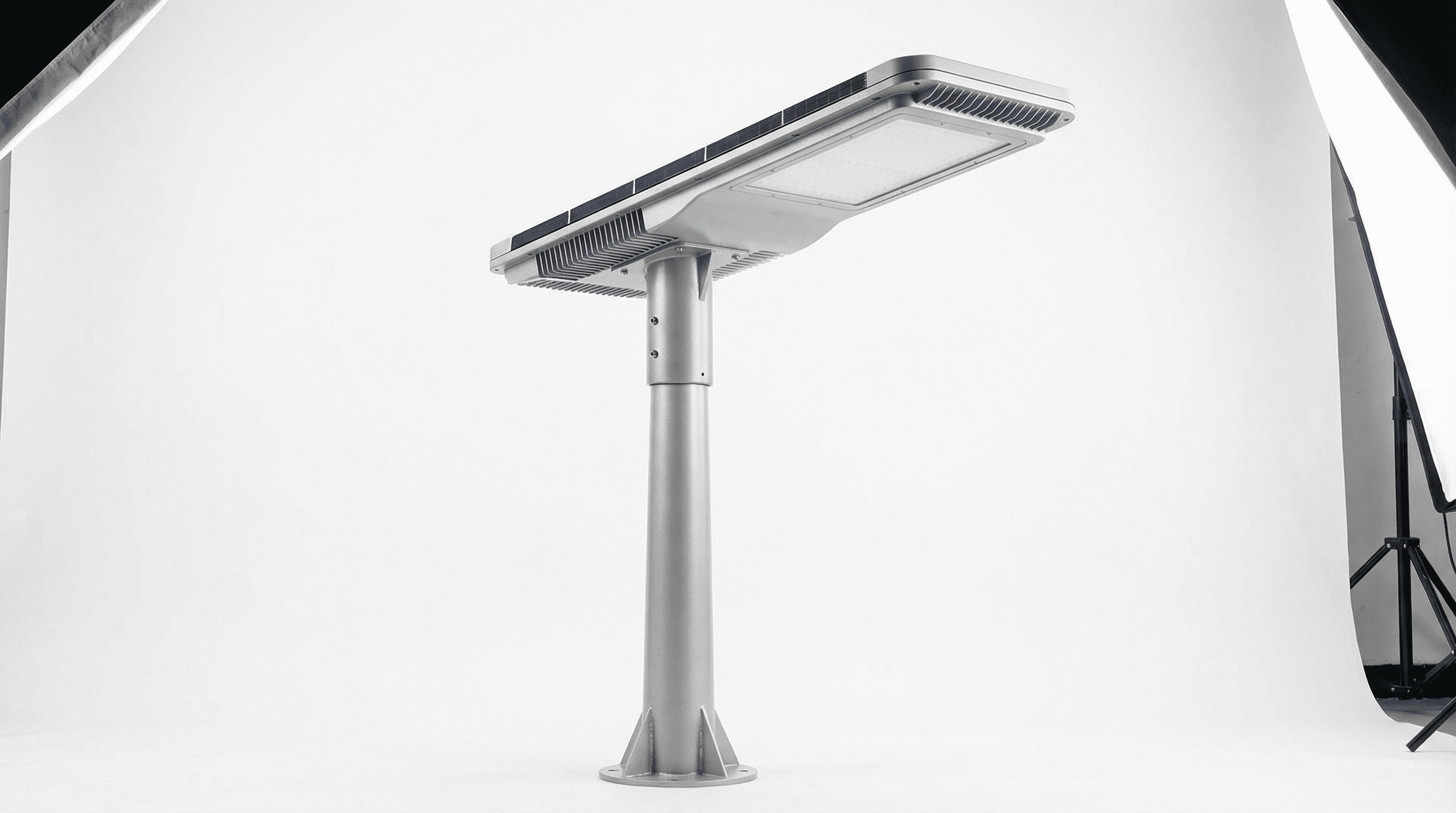
The MAXLUMI 8m Desert Climate All-in-One 80W Solar Streetlight represents the pinnacle of autonomous lighting technology — purpose-built for reliable, long-term operation in the world's most demanding desert environments. This fully integrated system combines a high-efficiency photovoltaic (PV) module, state-of-the-art high-temperature Lithium Iron Phosphate (LFP) battery, intelligent MPPT controller, and a powerful 80W LED luminaire into a single streamlined unit. Mounted on a rugged 8-meter aluminium-alloy pole, the solution requires no external wiring or trenching and can be deployed in under 30 minutes — providing a sustainable, grid-independent lighting solution. Engineered to withstand ambient temperatures up to +70°C while preventing sand ingress, it delivers consistent illumination for critical infrastructure, remote roads, and perimeter security applications where grid power is unavailable or prohibitively expensive. This document provides a comprehensive technical overview of the system's architecture, components, and performance characteristics, in compliance with rigorous industry standards such as IEC 62124 for standalone PV systems.
The all-in-one architecture is the core design principle of this solar streetlight. By integrating all key components — the 160W solar panel, 600Wh battery pack, charge controller, and 80W LED luminaire — into a single compact housing, the system minimizes installation complexity and enhances security. This integrated approach adheres to the design philosophy seen in modern electronics and reduces the risk of theft and vandalism compared with traditional split-type systems where components are separated. The housing itself is fabricated from cast aluminium alloy, delivering excellent thermal dissipation and structural rigidity. The complete assembly carries an IP67 rating — fully dust-tight and protected against water immersion up to 1 meter — a critical feature for withstanding desert sandstorms and occasional rain. The system is mounted on an 8-meter pole made from high-strength 6063 aluminium alloy, offering optimal lightweight properties for ease of installation and superior corrosion resistance compared to standard steel poles.
At the heart of the energy-generation system is a 160 watt-peak (Wp) monocrystalline solar panel featuring advanced Tunnel Oxide Passivated Contact (TOPCon) cell technology. This state-of-the-art PV module achieves cell efficiency in excess of 23%, ensuring maximum energy harvest even under the high-irradiance, high-temperature conditions of desert regions. Panel performance is certified to IEC 61215 ("Terrestrial Photovoltaic (PV) Modules — Design Qualification and Type Approval"), guaranteeing resistance to thermal cycling, humidity, and UV degradation. The panel is protected by 3.2 mm anti-reflective tempered glass, which maximizes light transmission while resisting abrasion from wind-borne sand. With an expected service life of more than 25 years and a guaranteed power output of more than 80% of initial rating after this period, the PV system is engineered to deliver reliable service for decades.
Energy storage is handled by a purpose-built 600 watt-hour (Wh) battery pack using high-temperature LiFePO4 (LFP) cells. Unlike standard LFP batteries, these cells are specifically rated for continuous operation at ambient temperatures up to +70°C — a critical specification for desert applications where surface temperatures can far exceed air temperature. LFP chemistry provides more than 2,000 deep-discharge cycles to 80% depth of discharge (DoD), translating to 5–7 years of service life under typical operating conditions. The battery system is managed by an advanced Battery Management System (BMS) that provides comprehensive protection against overcharge, over-discharge, short-circuit, and thermal runaway. The BMS also integrates cell balancing to maximize usable capacity and pack life. The 600Wh capacity is sized to deliver a minimum of 2 days of autonomy, ensuring the light operates through two consecutive nights even without solar charging — a critical buffer during periods of heavy cloud cover or panel dust accumulation.
The 80W LED luminaire delivers outstanding luminous efficacy of more than 170 lumens per watt, producing a total output of 13,600 lumens. This level of brightness is sufficient to illuminate large areas — suiting roads and public spaces. The luminaire uses high-quality LED chips from industry-leading manufacturers such as Bridgelux or Lumileds, guaranteeing a long operating life of more than 50,000 hours (L70). Luminaire design and performance comply with IEC 60598-2-3 for road and street lighting. Energy management is optimized by a sophisticated Maximum Power Point Tracking (MPPT) charge controller with greater than 98% tracking efficiency, maximizing energy harvested from the solar panel during the day. The system integrates intelligent time-based dimming profiles and an optional PIR motion sensor. In the default smart mode, the luminaire runs at 30% brightness during inactive periods and instantly steps up to 100% when motion is detected — reducing energy consumption by up to 60% and extending autonomy. An optional 4G or LoRaWAN connectivity module enables remote monitoring and control, allowing operators to track system status, receive fault alerts, and adjust lighting profiles from a central dashboard.
Engineered for survival, the complete system is designed to withstand wind loads up to 150 km/h, ensuring stability through severe storms. The 8-meter pole is fabricated from T6 heat-treated 6063 aluminium alloy, offering an excellent strength-to-weight ratio and corrosion resistance. The sand-resistant design features a sealed housing (IP67) along with specialized vents that prevent fine dust and sand ingress while allowing pressure equalization. All external surfaces are treated with a UV-stabilized powder coat to prevent degradation from intense solar radiation. The operating temperature range of -20°C to +70°C suits the planet's most extreme desert climates — from the Sahara to the Atacama.
1. What is the expected operating life of the complete streetlight system?
The system is engineered for long-term reliability through a modular approach. The aluminium-alloy pole has a structural life of more than 25 years. The solar panel is warranted for 25 years with guaranteed power output above 80%. The LED luminaire is rated for more than 50,000 operating hours. The primary serviceable component is the LFP battery, with a typical replacement cycle of 5–7 years — ensuring the system continues to operate for decades with minimal maintenance.
2. How does the smart dimming feature work, and how much energy does it save?
Smart dimming combines a time-based schedule with optional motion detection. By default, the light operates at a low level (e.g., 30% brightness) for most of the night, stepping up to 100% only when a Passive Infrared (PIR) sensor detects movement by pedestrians or vehicles. This adaptive strategy can reduce nightly energy consumption by up to 60% compared with full-power dusk-to-dawn lighting, significantly extending battery autonomy.
3. Can the system operate effectively during sandstorms?
Yes — the system is purpose-built for desert conditions. The main housing carries an IP67 rating, fully resisting dust and sand ingress. The high-temperature battery and fan-less thermal management system are specifically designed to operate reliably even when covered by a layer of sand. While severe, prolonged sandstorms can temporarily reduce solar charging, the system's 2-day battery autonomy ensures continuous operation through such events.
4. What is the process for replacing the battery at end of life?
Battery replacement is a straightforward maintenance procedure. The LFP battery pack is housed in an easily accessible compartment of the all-in-one unit. A qualified technician can typically complete the replacement on site within 20 minutes — without taking down the entire luminaire. The modular battery pack is simply disconnected from the controller and a new pack is connected in its place. MAXLUMI offers replacement battery modules and a recycling program for end-of-life units.
5. Is remote monitoring a standard feature or an optional upgrade?
Remote monitoring is offered as an optional upgrade. The standard model operates autonomously based on a pre-programmed smart-dimming profile. For projects requiring centralized management, the system can be equipped with a 4G or LoRaWAN communication module. This upgrade provides access to a cloud-based platform for real-time performance monitoring, fault diagnostics, remote control of lighting schedules, and data analytics on energy generation and consumption.
[1] IEC 62124:2004 — Photovoltaic (PV) Stand-Alone Systems — Design Verification. [2] IEC 61215:2021 — Terrestrial Photovoltaic (PV) Modules — Design Qualification and Type Approval. [3] IEC 60598-2-3:2002+AMD1:2011 — Luminaires — Part 2-3: Particular Requirements — Luminaires for Road and Street Lighting. [4] UL 1703 — Standard for Flat-Plate Photovoltaic Modules and Panels. [5] NREL PVWatts Calculator, National Renewable Energy Laboratory, 2025 data.
| Pole Height | 8 m |
|---|---|
| LED power | 80 W |
| Luminous flux | 13600 lm |
| Luminous efficacy | 170 lm/W |
| Solar panel power | 160 Wp |
| Panel efficiency | 23 % |
| Battery capacity | 600 Wh |
| Battery type | LiFePO4 High-Temp |
| Battery cycle life | 2000 cycles |
| Autonomy days | 2 days |
| Pole material | Aluminum Alloy 6063-T6 |
| Wind resistance | 150 km/h |
| Operating temperature | -20 to +70 °C |
| IP rating | IP67 |
| Lighting hours | 12 h/day |
| Controller type | MPPT (>98% efficiency) |
| LED lifetime | 50000 hours |
| Panel warranty | 25 years |
| System warranty | 3 years |
| Pole warranty | 5 years |
Pricing available upon inquiry.
Custom design tailored to site conditions, capacity, and budget. Widewings' in-house EPC team consults directly.
Inquiry →