
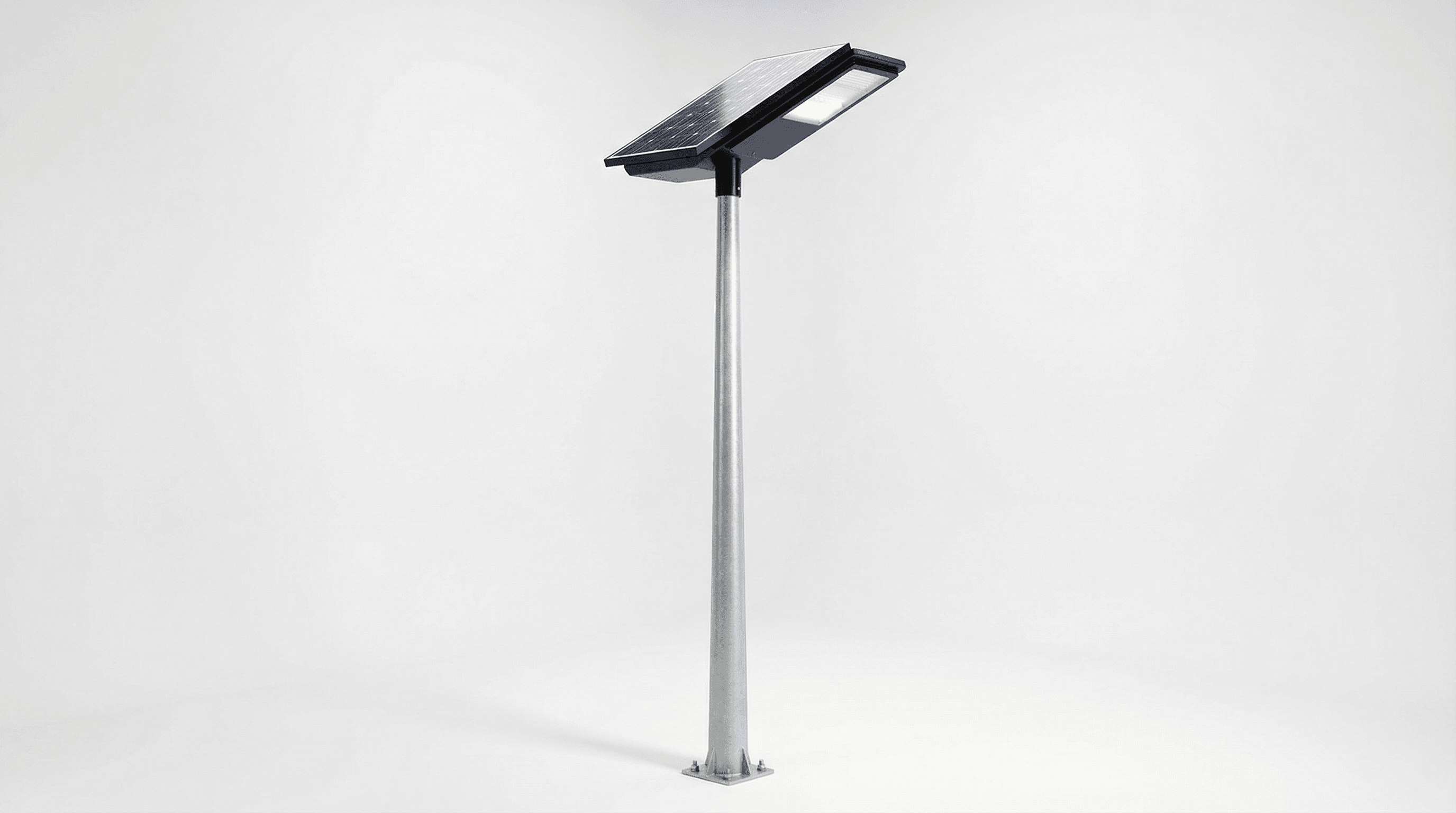
The MAXLUMI 6m Village Road All-in-One 40W Solar Streetlight represents a paradigm shift in off-grid public lighting, purpose-built for reliability, performance, and a low total cost of ownership. It is well suited for villages, remote-area roads, and peri-urban applications. This fully integrated system combines a high-efficiency photovoltaic (PV) module, long-life Lithium Iron Phosphate (LFP) battery, an intelligent MPPT controller, and a high-efficacy LED luminaire in a single compact unit. Mounted on a 6-meter hot-dip galvanized steel pole, the 40W model guarantees a minimum of 4 days of autonomy, ensuring reliable operation through extended periods of bad weather in temperate climates.
The product complies with rigorous international standards — including IEC 62124 for standalone PV systems and IEC 60598 for luminaires — ensuring safety, performance, and durability. With luminous flux exceeding 6,800 lumens and smart energy-saving features, it delivers superior illumination compared to traditional 100–150W high-pressure sodium (HPS) lamps while consuming zero grid energy. The all-in-one architecture not only delivers a clean, modern aesthetic but also simplifies logistics, reduces per-pole installation time to under 30 minutes, and provides inherent security against theft and vandalism. This document offers a comprehensive technical overview of the system's components, performance indicators, and operational intelligence.
The core innovation of the 6m Village Road All-in-One 40W is a design that integrates all critical subsystems into a single rugged, weather-sealed (IP66) enclosure. This design philosophy eliminates the complex wiring typical of traditional split-type solar lighting systems, reducing potential points of failure. The integrated unit, weighing approximately 25 kg, contains the 80Wp solar panel, the 300Wh battery pack, the control electronics, and the 40W LED module.
This integration delivers several key benefits:
Energy generation is handled by an 80Wp monocrystalline solar panel built on the latest technology. The panel features Tunnel Oxide Passivated Contact (TOPCon) cell architecture — an advanced cell structure that significantly reduces recombination losses and pushes cell efficiency above 23%. This is a marked improvement over the 18–20% efficiency of conventional PERC cells. Total module efficiency exceeds 21%, enabling the panel to generate more than 320Wh during an average 4 peak sun-hours (PSH) and fully recharge the 300Wh battery.
The panel is encapsulated in tempered glass with an anti-reflective (AR) coating and high transparency, maximizing photon capture while providing strong protection against environmental hazards such as hail and wind-borne debris — in compliance with IEC 61215 impact-resistance testing. The panel carries a 25-year linear power-output warranty, guaranteeing degradation of no more than 0.4% per year and at least 84.8% of rated power output even after 25 years of service.
At the heart of the system's autonomy is a 300Wh Lithium Iron Phosphate (LiFePO4, or LFP) battery pack. LFP chemistry was chosen for its superior safety, thermal stability, and excellent cycle life, providing more than 2,000 deep-discharge cycles at 80% depth of discharge (DoD). This translates to 5–7 years of service life — far longer than lead-acid alternatives.
The battery is managed by a sophisticated Battery Management System (BMS) that provides critical safety and performance functions:
The 300Wh capacity is precisely sized to operate the 40W LED at full brightness for more than 7.5 hours. However, with intelligent dimming strategies, nightly energy consumption drops to approximately 75Wh, delivering a robust 4-day autonomy without any solar input (300Wh / 75Wh).
Illumination is provided by a 40W LED module built on high-performance chips from industry-leading manufacturers such as Bridgelux or Lumileds. These chips deliver outstanding luminous efficacy of more than 170 lumens per watt, producing a total light output of 6,800 lumens. This level of brightness is well-suited to remote-area roads up to 8 meters wide, achieving an average illuminance above 15 lux and a uniformity ratio (Uo) exceeding 0.4 — satisfying the requirements for EN 13201 lighting class M4/M5.
The LEDs are paired with a precision-engineered Type II optical lens that shapes light distribution into a long rectangular pattern ideal for roadway lighting. This minimizes light spill and sky glow, placing light exactly where needed and adhering to Dark Sky principles. The luminaire maintains a Color Rendering Index (CRI) above 70, ensuring good color perception for safety and comfort. The LED module's rated L70 life exceeds 50,000 hours, meaning it retains at least 70% of its initial brightness after more than 12 years of operation (based on 12 hours per night).
The system's intelligence resides in its advanced Maximum Power Point Tracking (MPPT) controller. The MPPT algorithm continuously adjusts the operating voltage and current of the solar panel to extract maximum power regardless of solar intensity or temperature. This achieves charging efficiency above 98% and delivers a 20–30% improvement in energy harvest over simple PWM controllers.
The controller implements a smart dimming strategy to manage the lighting schedule and conserve energy. The default profile operates as follows:
The structural backbone of the system is a 6-meter pole fabricated from Q235 steel and hot-dip galvanized in accordance with ASTM A123. This process applies a protective zinc coating of at least 85 microns, delivering a design life of more than 20 years even in moderately corrosive environments. The pole is engineered to withstand wind speeds up to 150 km/h, satisfying typical regional wind-load criteria. A base flange plate enables secure mounting on a standard concrete foundation.
1. What is the expected lifespan of the overall system? The system is designed for long-term performance. The galvanized steel pole has a design life of more than 20 years. The monocrystalline solar panel carries a 25-year power-output warranty. The LED luminaire is rated at more than 50,000 hours (roughly 12 years). The LFP battery is the main serviceable component, with a typical replacement interval of 5–7 years; once replaced, the system's operational life can be extended further.
2. How does the light perform during prolonged periods of rain or heavy cloud cover? The system is engineered for 4 days of autonomy. This means a fully charged 300Wh battery can keep the light running for 4 consecutive nights without any solar input. The calculation is based on a smart dimming profile that reduces nightly energy consumption to approximately 75Wh, ensuring reliable illumination through typical multi-day storm fronts or overcast periods in temperate climates — a key requirement for mission-critical public lighting.
3. How is this solar streetlight maintained? Thanks to the all-in-one design and high-quality components, maintenance is minimal. The primary task is the periodic cleaning of the solar panel surface to remove dust, pollen, or bird droppings that can reduce energy output. We recommend an inspection and cleaning 1–2 times per year. While the tempered glass's self-cleaning properties and the panel's tilt help dislodge debris naturally, manual cleaning ensures optimal performance — particularly in dusty environments.
4. Can the lighting schedule be customized? Yes. The system ships with a highly effective default time-based dimming profile, but it can be reprogrammed using the optional remote control or a 4G/LoRa-based remote management device. This allows a municipality or operator to tune brightness levels and dimming windows to local traffic patterns, events, or energy-saving targets. This flexibility ensures the lighting solution can be tailored to the community's needs throughout its lifecycle.
5. Is the system difficult to install? No — installation is straightforward and fast. Thanks to the all-in-one design, there is no complex on-site wiring required between panel, battery, and luminaire. A small team can typically complete the installation within 30 minutes per pole once the foundation has cured. The process consists of assembling the pole, lifting it into place, and mounting the single integrated luminaire with the supplied brackets. This significantly reduces installation cost and project schedule.
[1] IEC 62124:2021 — Photovoltaic (PV) Stand-Alone Systems — Design Verification. [2] IEC 60598-1:2020 — Luminaires — Part 1: General requirements and tests. [3] EN 13201-2:2015 — Road Lighting — Part 2: Performance requirements. [4] ASTM A123 / A123M-17 — Standard Specification for Zinc (Hot-Dip Galvanized) Coatings on Iron and Steel Products. [5] UL 1973 — Standard for Batteries for Use in Stationary, Vehicle Auxiliary Power, and Light Electric Rail (LER) Applications.
| Pole Height | 6 m |
|---|---|
| LED power | 40 W |
| Luminous flux | 6800 lm |
| Luminous efficacy | 170 lm/W |
| Solar panel power | 80 Wp |
| Panel efficiency | 23 % |
| Battery capacity | 300 Wh |
| Battery type | LiFePO4 (LFP) |
| Battery cycle life | 2000 cycles |
| Autonomy days | 4 days |
| Pole material | Hot-Dip Galvanized Steel Q235 |
| Wind resistance | 150 km/h |
| Operating temperature | -20 to +60 °C |
| Lighting hours | 12 h/day |
| IP rating | IP66 |
| LED lifetime | 50000 hours |
| MPPT efficiency | 98 % |
| Color temperature | 4000 K |
| CRI | 70 |
| System warranty | 3 years |
| Pole warranty | 5 years |
Pricing available upon inquiry.
Custom design tailored to site conditions, capacity, and budget. Widewings' in-house EPC team consults directly.
Inquiry →