
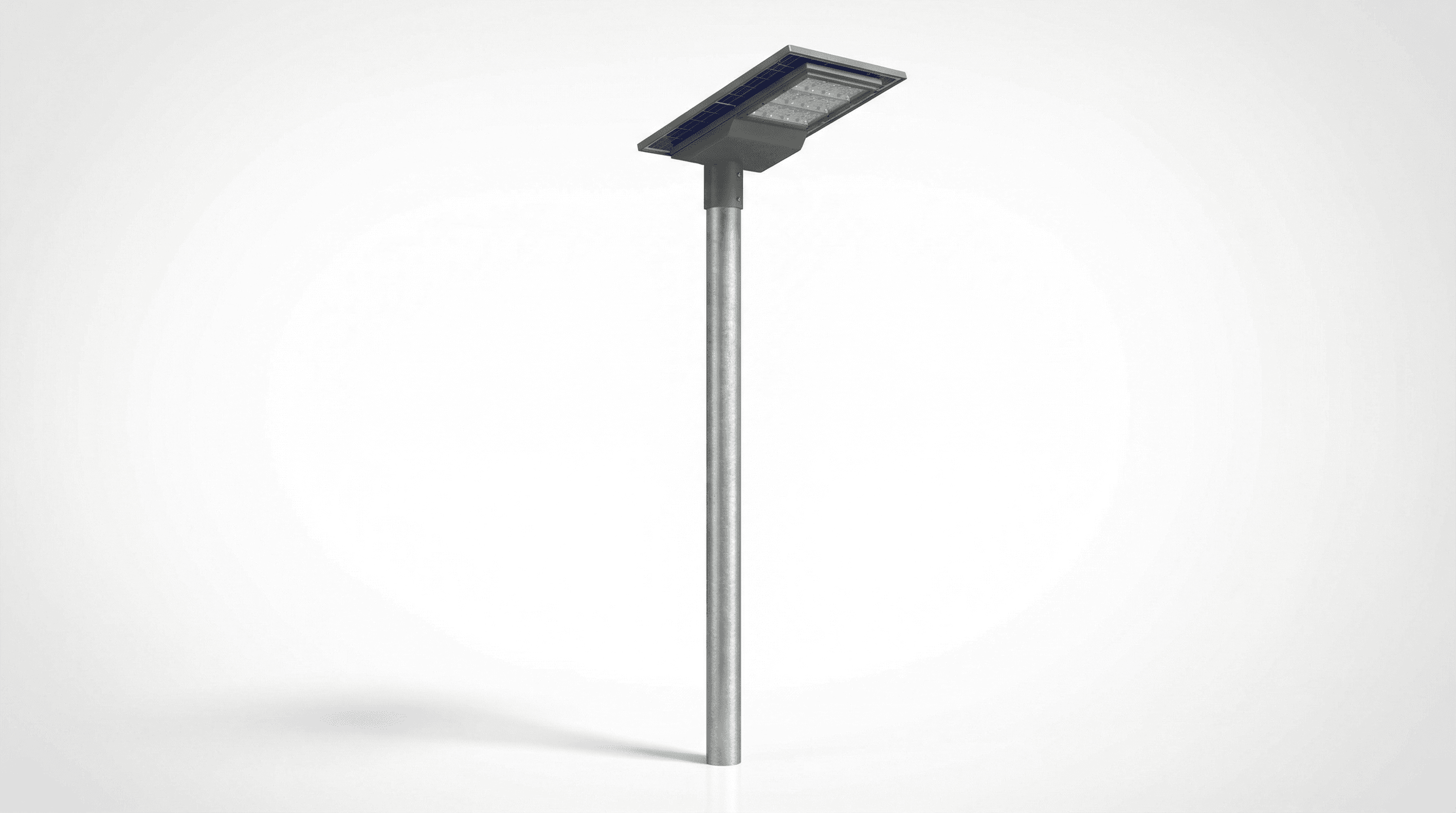
The MAXLUMI 5m Economy 30W Lead-Acid Solar Streetlight represents a meaningful step forward in providing reliable, cost-effective, and sustainable public lighting for developing regions. Purpose-built for the demands of remote-area environments, this all-in-one system integrates a high-efficiency 60Wp solar panel, a rugged 30W LED luminaire, and a durable 200Wh lead-acid gel battery into a single compact unit. Aligned with luminaire standards such as IEC 60598, the integrated design simplifies logistics and installation — collapsing per-pole install time to under 30 minutes — while also improving security against theft and vandalism [1]. Mounted on a 5-meter hot-dip galvanized steel pole, the system is optimized for lighting remote-area roads, village plazas, and perimeter routes, providing essential safety and extending community activity after dark. The design prioritizes durability, low maintenance, and economy, making it an ideal solution for large-scale rural electrification projects and community-funded initiatives where budget and long-term performance are both critical.
The Economy 30W model is a self-sufficient off-grid lighting solution. Every component is selected to balance performance, durability, and economy — enabling the system to withstand the harsh conditions of tropical climates while delivering consistent nighttime illumination.
At the heart of the lighting system is a 30-watt LED module engineered for high efficiency and long-term reliability. The module uses high-performance LED chips from leading manufacturers to achieve a practical system luminous efficacy of approximately 150 lm/W. This yields a total luminous flux of 4,500 lumens and, under CIE 115:2010 guidance, can illuminate more than 150 square meters at an average illuminance exceeding 15 lux [2].
The LEDs are rated at more than 50,000 operating hours (L70), which corresponds to over 12 years of service life under standard 12-hour nightly operation. The luminaire is mounted in a die-cast aluminium chassis that doubles as a heat sink for optimized thermal management, sustaining LED performance up to 50°C ambient. A precision-engineered polycarbonate lens delivers a Type II distribution pattern ideal for roadway lighting — maximizing coverage along the length of the road while minimizing light trespass.
Energy is generated by a 60-watt-peak (Wp) monocrystalline silicon solar panel. Monocrystalline technology typically delivers 19%–21% efficiency, allowing the required power to be generated within a smaller panel footprint [3]. This is essential to the all-in-one design and minimizes wind loading and structural stress on the pole. The panel surface is protected by high-transparency low-iron tempered glass with an anti-reflective coating to maximize absorption of solar radiation. The complete photovoltaic module is certified to IEC 61215, ensuring performance and durability against environmental factors such as hail, wind, and temperature swings.
In keeping with the model's economy focus, energy storage is handled by a 200Wh sealed maintenance-free lead-acid gel battery. This technology is chosen for its proven reliability and cost-effectiveness in stationary off-grid applications, making the overall system more accessible. The gel electrolyte prevents stratification and leakage, offering improved performance and a longer service life than traditional flooded lead-acid batteries. The battery provides 2 days of autonomy, allowing the streetlight to operate for two consecutive nights without solar charging — a critical feature for ensuring reliability during monsoon season or extended overcast weather. The battery is rated at approximately 700 cycles at 50% depth of discharge (DoD) and is generally recommended for replacement after 2–3 years of operating life.
System operation is managed by an integrated pulse-width-modulation (PWM) charge controller. While MPPT controllers offer higher efficiency, a high-quality PWM controller provides a rugged, cost-effective solution perfectly matched to the 12V nominal system architecture, achieving charging efficiency above 90%. The controller offers essential protection functions — overcharge, over-discharge, short-circuit, and reverse polarity — to safeguard the battery and extend its service life.
To maximize autonomy, the controller uses a pre-programmed time-based dimming schedule. A typical profile runs at 100% brightness (4,500 lumens) for the first 4 hours after dark, drops to 50% (2,250 lumens) during the next 6 low-traffic hours, and further reduces to 30% (1,350 lumens) until dawn. This intelligent energy-management strategy can cut nighttime energy consumption by up to 50% versus full-power operation, ensuring the 2-day autonomy is reliably met.
The entire system is mounted on a 5-meter pole fabricated from Q235-grade steel and hot-dip galvanized in accordance with ASTM A123. This process applies a protective zinc coating of more than 85 microns, delivering outstanding corrosion resistance and a design life of more than 20 years even in humid tropical climates. The pole is engineered to withstand wind speeds up to 120 km/h, preserving structural integrity through storm events. The all-in-one luminaire housing carries an IP66 rating — denoting complete dust-tightness and protection against powerful water jets — keeping the internal electronics shielded from rain and moisture.
The MAXLUMI 5m Economy 30W model is purpose-built for applications such as:
1. What is the realistic lifespan and replacement cost of the lead-acid gel battery? Lead-acid gel batteries typically have an operating life of 2–3 years, or about 700 charge-discharge cycles. This can vary with local solar conditions and operating temperature. The battery is designed as a standard component that can be easily replaced in the field. Replacement 200Wh gel batteries remain widely available and inexpensive to source, keeping long-term maintenance costs low for the community.
2. How does the streetlight perform during extended periods of rain or heavy cloud cover? The system is designed for 2 days of autonomy — meaning a fully charged battery can light the lamp for 12 hours per night across two consecutive nights without any solar charging. The smart dimming profile is essential to conserving meaningful energy through the night. In regions where overcast weather persists for more than 2 days, a system with greater battery capacity (3+ days of autonomy) is recommended.
3. How complex is the installation, and is a specialist technician required? Installation is very straightforward and is one of the key advantages of the all-in-one design. The unit ships fully assembled. A small team of non-specialists can typically complete the installation of a single streetlight — including pole erection and luminaire mounting — within 30 minutes. No inter-component wiring is required, significantly reducing complexity and the chance of installation error. Basic civil works are still needed for the pole foundation.
4. Can the pre-programmed dimming schedule be adjusted? The standard model ships with a factory-set optimal dimming schedule designed to maximize energy savings and autonomy for most remote-area applications. While this default profile is not field-adjustable by users on the Economy model, MAXLUMI can produce custom batches with alternative dimming profiles for large orders (e.g., 500+ units) to meet specific project requirements.
5. What maintenance is required for this solar streetlight? The system is designed to be virtually maintenance-free. The primary task is periodic cleaning of the solar panel surface (e.g., 1–2 times per year), since dust, leaves, or bird droppings can reduce energy output. The sealed gel battery requires no water top-ups. An annual visual inspection of the unit's physical integrity is also good practice. The battery is generally the only major component requiring replacement, typically every 2–3 years.
[1] International Electrotechnical Commission. (2016). IEC 60598-1: Luminaires — Part 1: General requirements and tests. [2] International Commission on Illumination (CIE). (2010). CIE 115:2010: Lighting of roads for motor and pedestrian traffic. [3] National Renewable Energy Laboratory. (2023). Best Research-Cell Efficiency Chart. [Online]. Available: https://www.nrel.gov/pv/cell-efficiency.html [4] American Society for Testing and Materials. (2017). ASTM A123 / A123M-17: Standard Specification for Zinc (Hot-Dip Galvanized) Coatings on Iron and Steel Products.
| Pole Height | 5 m |
|---|---|
| LED power | 30 W |
| Luminous flux | 4500 lm |
| Luminous efficacy | 150 lm/W |
| Color temperature | 4000 K |
| LED lifetime (L70) | 50000 hours |
| Solar panel power | 60 Wp |
| Panel efficiency | 19-21 % |
| Battery capacity | 200 Wh |
| Battery type | Lead-Acid Gel |
| Battery cycles (50% DOD) | 700 cycles |
| Autonomy | 2 rainy days |
| Charging efficiency | 90 % |
| Pole material | Galvanized Steel Q235 |
| Galvanization thickness | 85 μm |
| Wind resistance | 120 km/h |
| Operating temperature | -20 to +50 °C |
| IP rating | IP66 |
| Lighting hours | 12 h/day |
| Installation time | 30 minutes |
| System warranty | 3 years |
| Pole warranty | 5 years |
Pricing available upon inquiry.
Custom design tailored to site conditions, capacity, and budget. Widewings' in-house EPC team consults directly.
Inquiry →