
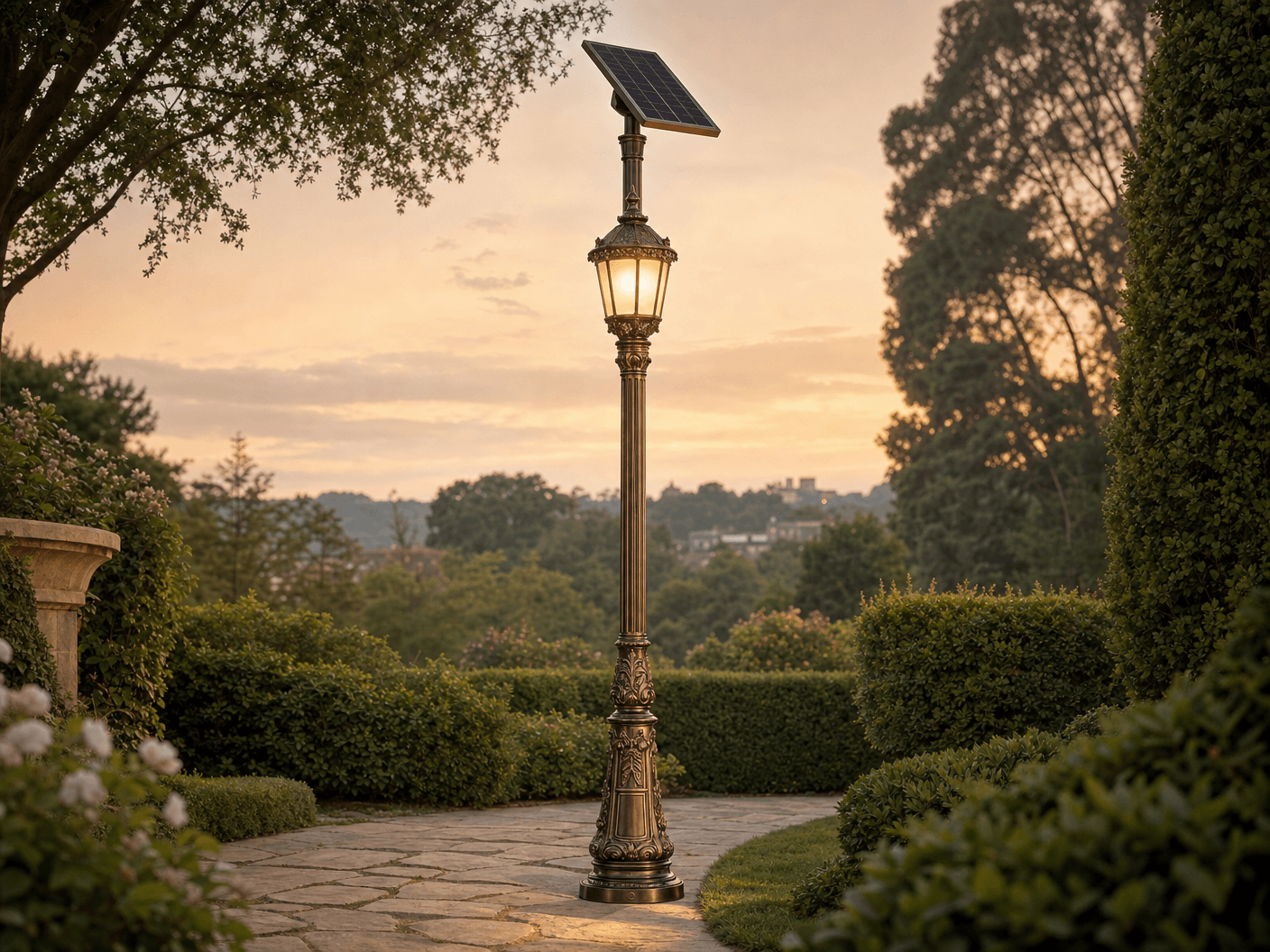
The 3m European Classic Garden Light 15W is a standard split-type solar streetlight configured for pathways, parks, courtyards, villas, campuses, and municipal landscape areas that need decorative architectural character together with reliable off-grid lighting. The model combines a 3 m aluminum alloy pole, a 15 W LED light source, a 30 Wp monocrystalline TOPCon solar panel, and a 100 Wh LiFePO4 battery to deliver 12 hours of nightly operation and 3 days of rainy-day autonomy under temperate climate conditions. From the perspective of a buyer comparing compact outdoor luminaires, this configuration strikes a balance between aesthetics, energy independence, and predictable EPC cost within a turnkey scope.
Compared with a typical 15 W AC garden light on a 220–240 V grid circuit, the solar version eliminates trenching for low-voltage cabling, generates no monthly electricity charges, and can reduce point-of-use operating energy cost by approximately 90%–100%. According to the IEA and IRENA, distributed solar lighting remains one of the most cost-effective ways to reduce outdoor power demand for small loads where cabling distance exceeds 20–50 m or where civil works dominate the project budget. For procurement teams evaluating 5–10 year lifecycle value, the absence of metered power and reduced maintenance dispatch is often as important as the upfront luminaire cost.
This product belongs to the Solar Street Light category but is optimized for garden-scale decorative use rather than high-speed roadway lighting. The 15 W LED output is well-suited to pedestrian environments, perimeter walkways, heritage-style plazas, and low-glare landscape zones where mounting height is limited to 3 m and a warm-white ambience is preferred. The 3000 K color temperature supports visual comfort and architectural compatibility, while the classic European lantern form factor addresses projects where modern industrial luminaires cannot be used without compromising the character of the site.
The electrical architecture follows a separate-component system — meaning the PV module, battery, controller, pole, and luminaire are each individually serviceable. In practice, this means panels, batteries, and LED assemblies can be inspected or replaced without scrapping the entire luminaire body, simplifying maintenance across 3–5 years of service. IEC 62124 PV standalone-system guidance and IEC 60598 luminaire standards support this modular approach in applications where reliability, inspection access, and environmental sealing are essential. For more category options, buyers can compare pole heights from 3 m to 12 m under "View all Solar Street Light products".
The power subsystem uses a 30 Wp monocrystalline TOPCon panel, with module efficiency typically in the 19%–23% range and an expected lifespan of approximately 25 years under standard outdoor operating conditions. TOPCon cell architecture is increasingly adopted in distributed solar applications because of its better temperature behavior and stronger long-term energy yield versus many legacy cell designs. In temperate climates with average daily irradiance of approximately 3.5–5.0 peak sun-hours, a 30 Wp panel is appropriately sized to charge a 100 Wh battery while accounting for nightly load and conversion losses on a small autonomous luminaire.
The energy-storage subsystem uses a 100 Wh LiFePO4 (LFP) battery, providing 2,000+ deep cycles under proper battery-management conditions. LFP chemistry is widely preferred in solar lighting because it offers better thermal stability than many cobalt-based lithium chemistries and longer real-world field life than lead-acid alternatives at similar daily cycling depths. With an integrated BMS, low-temperature charging protection, and stable discharge characteristics, the battery is engineered to support 3-day autonomy under overcast weather and sustain reliable evening operation across ambient temperatures from -20°C to +50°C.
The lighting engine uses branded LED chips such as Bridgelux, Cree, or Lumileds, with chip-level source efficacy exceeding 170 lm/W and an expected luminaire life of more than 50,000 hours. The realistic delivered flux target for a 15 W garden luminaire — depending on optical losses, driver tuning, and decorative lantern geometry — is approximately 2,250 lm. This output level is suitable for low-speed pedestrian areas and visual wayfinding, with pole spacing typically designed in the 10–18 m range based on walkway width, target illuminance, and uniformity requirements.
The control subsystem is based on an MPPT controller with greater than 98% conversion efficiency, charging the battery more efficiently than simple PWM control under partial irradiance and variable temperature conditions. Smart dimming options can include time-based schedules, PIR motion response, dusk-to-dawn automation, and optional 4G or LoRa remote telemetry for fault alerts and operational data. In many public-space installations, motion-adaptive dimming can cut energy consumption by up to 60% during low-traffic hours — increasing battery reserve and improving system resilience during winter or rainy weeks.
The mechanical structure uses a 3 m aluminum-alloy pole, selected here for lower weight, easier handling, and improved corrosion resistance versus standard carbon steel in decorative landscape projects. Based on a typical per-meter supply-cost model, aluminum poles provide both aesthetic value and practical installation efficiency — particularly advantageous on sites requiring manual handling or where access is limited. For temperate municipal and private-site environments, the structure is engineered for wind-load resistance up to approximately 120 km/h, depending on site foundation design, anchor specification, and exposure category.
The luminaire style is European Classic, with the optical chamber and decorative housing prioritizing visual harmony in gardens, pedestrian boulevards, hotels, and heritage-adjacent developments. While modern roadway lighting often targets maximum spacing and very high efficiency, decorative lanterns trade some optical efficiency for appearance. Even so, with a 15 W LED package, 3000 K CCT, and quality driver control, the system can still deliver practical illuminance to walkways, entrances, and small plazas while maintaining warmer color rendering and lower glare than 4000–6500 K alternatives.
The practical specification summary for this variant is: 3 m pole height, 15 W LED power, 2,250 lm nominal flux, 30 Wp solar module, 100 Wh LFP battery, 3-day autonomy, 12 h/day operation, IP66/IP67 environmental protection, and a 3-year system warranty with a 5-year pole warranty. From a procurement perspective, these numbers place the product in the compact decorative class — below the 30–60 W park/road luminaire output range but above many sub-10 W decorative bollards. Buyers can adjust the system configuration online if site irradiance, runtime, or autonomy assumptions differ from the standard temperate profile.
This configuration assumes deployment in temperate climates: winter irradiance is moderate, summer charging is strong, and annual ambient conditions generally remain in the -10°C to +40°C range across most operating hours. In this environment, the 30 Wp / 100 Wh / 15 W balance works effectively for decorative-lighting duty cycles that use smart dimming or midnight power reduction. If the system were to operate at the full 15 W rating across all 12 nighttime hours, daily consumption would be approximately 180 Wh — so an intelligent dimming profile is recommended to match load with battery and solar harvest. A typical schedule runs at 100% output for 4–5 hours, then 30%–50% output for the remaining 7–8 hours.
This operating logic mirrors how most modern solar lighting systems are actually designed. Rather than assuming a static full-power profile every night of the year, designers use occupancy patterns and adaptive control to preserve autonomy and battery health. NREL's solar-resource variability and off-grid system sizing guides reinforce the importance of realistic load profiles, while market analysis from BloombergNEF and Wood Mackenzie consistently shows that the value of lithium-based distributed-energy products grows when digital control reduces over-sizing. The practical result for buyers is a smaller, more economical system that still meets real walkway lighting needs across 365 nights per year.
The best-fit applications for this 3 m, 15 W solar garden light include residential complexes, villa roads, boutique-hotel landscapes, park walkways, school courtyards, pedestrian connectors, cemetery access roads, and decorative municipal plazas. In these environments, target mounting height is typically 2.8–3.5 m, walkway width is often 1.5–4.0 m, and required average illuminance can range from 5–15 lux depending on local standards and user expectations. The warm 3000 K light is especially useful where visual comfort and architectural tone matter more than peak white-light brightness.
In a representative scenario, a landscape contractor for a 42-unit residential development in Southern Europe needed heritage-style lighting along a 680 m internal walkway. To avoid trenching through finished paving and irrigation lines, the developer chose the 3 m European Classic Garden Light 15W at 14 m spacing. Compared with a conventional wired system that would have required around 700 m of conduit and multiple distribution points, the solar solution shortened civil-works duration by about 30%, reduced electrical-infrastructure complexity, and enabled phased installation across two construction stages.
Broader design guides for autonomous outdoor systems are available from our team, covering planning considerations such as pole spacing, autonomy, battery chemistry, and controller logic. For projects that must mix decorative and roadway lighting, this 15 W garden model can be paired with higher-output split-type systems in the 30 W–100 W range — meeting power requirements while maintaining a common procurement workflow and maintenance approach.
This decorative model can operate as a standalone dusk-to-dawn system, but for projects of 20–50 or more units it can also be integrated with remote monitoring via optional 4G or LoRa communications. Cloud supervision allows battery-voltage review, state of charge, fault alarms, runtime history, and dimming-schedule updates — without visiting each pole. For municipal operators running 100+ luminaires across parks and pedestrian zones, this reduces maintenance-inspection labor and improves response time when a node degrades due to shading, vandalism, or battery aging.
Smart control also improves asset economics. Even reducing average nighttime load by 30%–40% with PIR-based motion dimming meaningfully increases usable energy reserve during low-irradiance months and lowers the probability of deep-discharge events — battery life is strongly tied to cycle depth and temperature. In real-world operation, a well-managed LFP battery often lasts 2–4× longer than many lead-acid systems and preserves usable capacity better through the first 3–5 years. Buyers interested in connected deployments can request a custom quotation for telemetry, gateway integration, and central-management requirements.
The system is specified against recognized industry frameworks including IEC 62124 for standalone PV system performance, IEC 60598 for luminaire safety and construction, and IP66/IP67 ingress-protection expectations for outdoor electronics and optical assemblies. PV module technology aligns with mainstream module-reliability practice tied to IEC 61215 and IEC 61730, and project-level compliance can include CE marking or equivalent local market requirements. These references matter because B2B procurement increasingly demands standards traceability — not just headline lumen values or battery sizes.
Lifecycle cost is one of the strongest arguments for this product class. Conventional decorative AC garden lights may appear cheaper at the luminaire level, but once cabling, trenching, conduit, distribution boards, breakers, and labor are included, installation cost can exceed that of a compact solar unit on many low-density outdoor sites. Across 5 years, the solar version avoids recurring electricity spend and reduces exposure to cable faults, insulation issues, and accidental excavation damage. On 10–200 pole projects, these avoided costs often outweigh the modest difference in luminaire CAPEX — particularly where landscape restoration is expensive.
Pricing available upon inquiry.
Before finalizing quantities, engineers should verify solar access, shading from trees or buildings, target illuminance, and the required operating profile. The most common cause of performance degradation in decorative projects is not battery capacity but insufficient winter panel exposure. Sites with daily shading exceeding 20%–30% may require a larger panel, reduced dimming levels, or repositioned module placement. Buyers can consult our design guidance for methodology or submit site data for a custom quotation covering project-specific optimization.
From a sourcing perspective, this model suits distributors, EPC contractors, real-estate developers, and municipal landscape departments seeking compact solar lighting with recognizable decorative styling. The combination of TOPCon PV, LFP storage, MPPT charging, and IP66/IP67 outdoor protection aligns with current 2025–2026 market expectations for reliable small-scale off-grid lighting. For buyers standardizing a decorative solar line across multiple projects, this 3 m / 15 W model serves as a practical baseline that offers manageable CAPEX and simple installation logistics.
| Product Type | Solar garden light, split type |
|---|---|
| Pole height | 3 m |
| LED Output | 15 W |
| Luminous flux | 2250 lm |
| Solar panel | 30 Wp |
| Battery capacity | 100 Wh (LiFePO4) |
| Autonomy | 3 rainy days |
| Pole material | Aluminum alloy |
| Style | European classic |
| Color temperature | 3000 K |
| Wind resistance | 120 km/h |
| Operating temperature | -20 to +50 °C |
| Lighting hours | 12 h/day |
| Controller | MPPT, >98% efficiency |
| Ingress protection rating | IP66/IP67 |
| Warranty | 3 years system, 5 years pole |
Pricing available upon inquiry.
Custom design tailored to site conditions, capacity, and budget. Widewings' in-house EPC team consults directly.
Inquiry →