
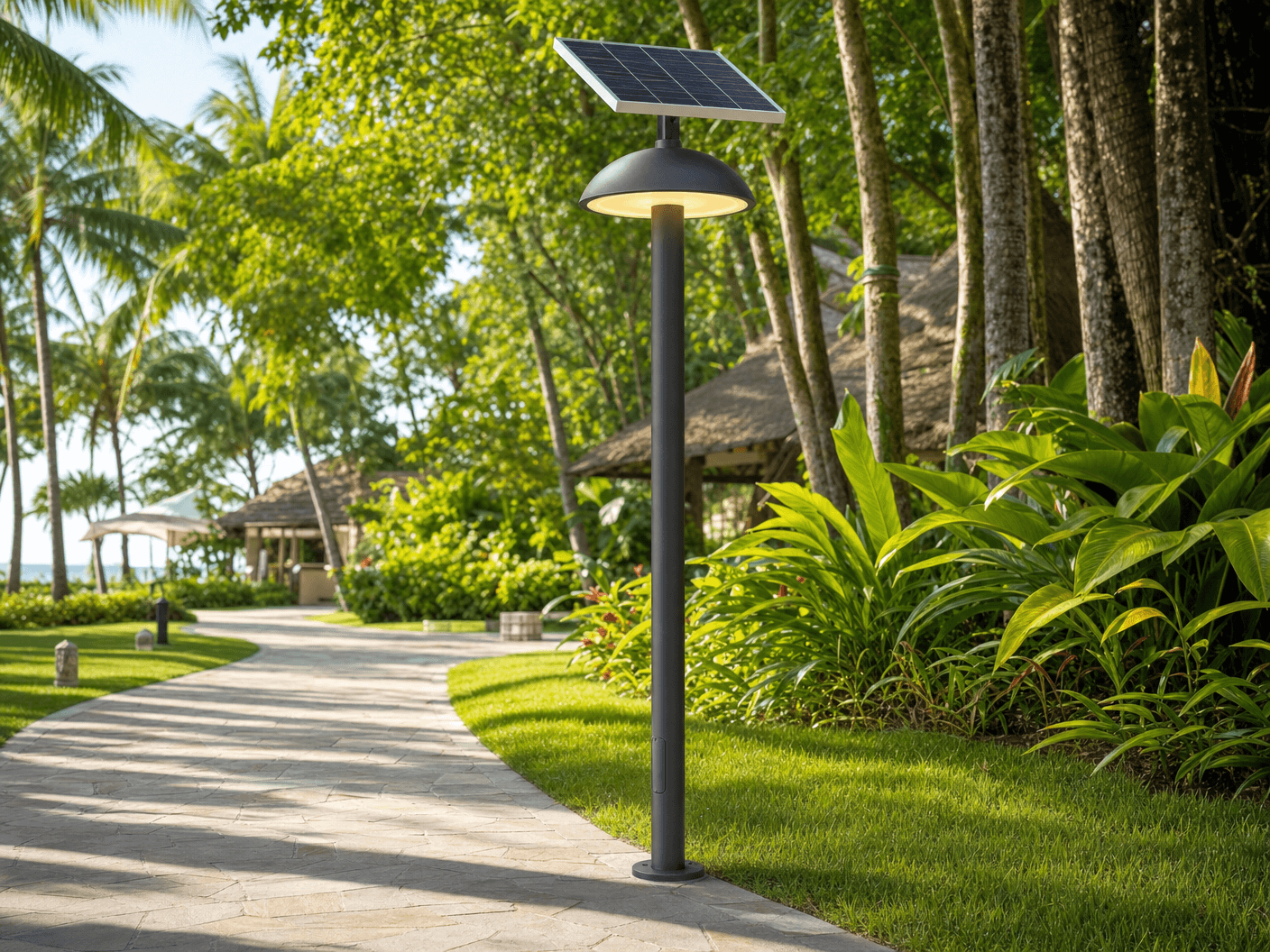
The 3.5m Tropical Resort Garden Light 20W is a decorative solar streetlight configured for premium outdoor environments that demand warm aesthetics, low operating cost, and reliable off-grid autonomy. This model combines a 3.5 m aluminium-alloy pole, a 20 W LED lighting engine, a 50 Wp monocrystalline TOPCon solar panel, and a 180 Wh LiFePO4 battery to deliver 12 hours of nightly operation and 5 days of rainy-weather backup capacity in tropical climates. From the B2B buyer's perspective in hospitality, landscape EPC, and municipal beautification projects, the system is optimized for 3000K warm-white illumination, IP67 environmental protection, and corrosion resistance under high-humidity environments above 85% RH.
Compared with a typical grid-powered 20 W AC garden light, a solar configuration of this size can eliminate roughly 100% of trenching-related cable energy demand and generally trends to a 35%–60% reduction in lifetime electricity and maintenance cost — depending on local labor cost, utility tariff, and cable distance. The system architecture follows recognized off-grid lighting principles aligned with IEC 62124 for PV standalone system performance and IEC 60598 for luminaire safety and construction. Industry references from NREL, the IEA, IRENA, and BloombergNEF consistently show that distributed solar lighting becomes most cost-effective where cable civil works exceed 15–25 m per pole, or where a landscape retrofit must minimize site disruption.
Within the "View all Solar Street Light products" range, this variant belongs to the garden class — designed for low-height pedestrian lighting where visual comfort matters more than roadway-class illuminance. At a 3.5 m mounting height with modern optical efficiency, a 20 W LED can deliver roughly 3,400 lm at the source if the LED package is rated at greater than 170 lm/W. However, real-world system output after optical and thermal losses is engineered for targets in resort walkways, courtyard perimeters, villa access paths, landscape parks, and poolside circulation routes. The 3000K color temperature is specifically chosen to reduce glare and create a warmer hospitality atmosphere compared with the higher-CCT 4000K–6500K luminaires used on roads.
For tropical applications, the engineering focus is not simply wattage but moisture control, anti-fungal resistance, and battery autonomy that can persist for 3–5 consecutive days during a monsoon. This product therefore uses a separated-component architecture rather than a low-cost integrated body, enabling more effective thermal separation between the 50 Wp panel, the 180 Wh LFP battery, and the luminaire. Field experience from Southeast Asia, island resorts, and coastal parks suggests that thermal isolation can improve battery life by 10%–20% versus compact all-in-one units exposed to enclosure heat buildup exceeding 55°C.
The system is built around four major subsystems: a 50 Wp TOPCon PV module, a 180 Wh LiFePO4 battery pack, an MPPT charge controller with greater than 98% conversion efficiency, and a 20 W decorative LED luminaire mounted on a 3.5 m aluminium-alloy pole. The panel typically harvests 4.0–5.5 kWh/m² per day in tropical regions, storing energy in the LFP battery to support approximately 12 h/day of dusk-to-dawn operation. With smart dimming profiles applied, average nightly consumption can be reduced by up to 60% during low-demand hours.
The separated-component design simplifies maintenance during the 3-year system warranty and supports optional remote diagnostics via 4G or LoRa. B2B buyers managing 50–500 poles often prefer split-type systems because panel orientation, battery accessibility, and luminaire replacement can each be optimized independently. Project developers comparing alternatives can consult "Learn the topic" for sizing, autonomy, and tropical corrosion-resistance selection guidance before procurement.
The 20 W rated LED is appropriate for pedestrian and decorative applications, with typical spacing of 12–18 m — depending on walkway width, target average illuminance (lux), and landscape reflectance. On 2.5–4.0 m-wide resort garden walkways, the luminaire can be configured to deliver about 8–15 lux average on the walking surface, in line with many hospitality and park lighting practices used in comfort-oriented areas. The nominal 3,400 lm source flux, paired with a warm 3000K output, improves atmosphere and visual softness compared with cooler commercial luminaires.
The 50 Wp TOPCon panel uses the latest monocrystalline cell architecture, with module efficiency typically in the 19%–23% range — consistent with market benchmarks. TOPCon technology is chosen for its stronger performance in hot environments and superior long-term degradation control, with an expected lifespan of approximately 25 years under standard PV operating assumptions. PV research from NREL and the IEA indicates that module performance in tropical climates is influenced by proper mounting ventilation and reduced dust-accumulation angle (soiling) — both more easily achieved in a split-type panel configuration.
The 180 Wh LiFePO4 battery is sized for tropical durability rather than merely average daily operation. LFP chemistry delivers 2,000+ deep cycles, and — with the BMS managing charge/discharge windows — the battery is intended to support approximately 5 days of autonomy under reduced irradiance with smart-dimming logic applied. In practical terms, if nightly average consumption is held to about 30–36 Wh, the 180 Wh battery can sustain multiple nights of operation while preserving cycle life. This is a more robust specification than the 1–2 day rainy-backup typical of low-end decorative lights.
Tropical projects expose outdoor lighting to high humidity, salt-laden air, UV intensity, and year-round fungal-growth risk. This model applies IP67 protection to the key electrical housing, anti-fungal surface treatment, and corrosion-resistant material selection. The aluminium-alloy pole is lighter than standard galvanized steel and is particularly well-suited to resort campuses where aesthetics, handleability, and reduced rust-staining matter. Reference pricing indicates that aluminium poles are typically around 30% more expensive than galvanized options, but they reduce shipping weight and improve visual finish quality.
The operating temperature range is specified at -20°C to +60°C, although the product primarily targets warm regions where daytime enclosure temperatures often rise to 45°C–55°C. The controller includes low-temperature BMS protection even though freezing conditions are rare in tropical deployments. This broader thermal envelope is useful for global hotel chains seeking to standardize a single product family across multiple regions. For coastal walkways and island resorts, an FRP pole can also be considered for greater corrosion performance, but for most inland tropical gardens, aluminium alloy offers a good balance of cost, weight, and durability.
Resort operators often prioritize guest comfort over maximum lumen density, so 3000K is a core specification rather than a nice-to-have. Warm-white lighting in the 2700K–3000K range is commonly chosen for villas, landscape walkways, and premium public areas because it reduces the harsh impression of cooler light and pairs well with stone, wood, and tropical planting palettes. At a 3.5 m pole height, this luminaire is positioned to deliver lower glare than 6–8 m roadway poles while maintaining sufficient vertical illuminance for face recognition and wayfinding in pedestrian zones.
The LED package uses chips in the Bridgelux, Cree, or Lumileds performance class, each typically specified for more than 50,000 hours of operating life. At 12 hours of nightly operation, this corresponds to more than 11 years of nominal LED service life before the primary lumen-depreciation threshold. When resort operators compare lamp technologies, this is markedly superior to decorative CFL or metal-halide garden lights that often require lamp replacement every 6,000–15,000 hours and incur additional labor for re-lamping in landscaped areas.
The standard control platform uses MPPT charging at greater than 98% efficiency, dusk-to-dawn automation, and a smart-dimming strategy driven by a time schedule or optional PIR motion detection. In low-traffic resort zones, motion-adaptive dimming can cut energy use by up to 60% versus fixed-output operation. For example, a profile of 100% for 4 hours, 50% for 6 hours, and 30% for 2 hours can preserve perceived guest safety while meaningfully extending rainy-day autonomy.
For large sites with 100+ luminaires, optional 4G or LoRa communications enable centralized status visibility, fault alerts, and maintenance scheduling. This is particularly important for resorts spread across 5–50 hectares, where the labor cost of manually inspecting each pole becomes significant. Buyers planning a phased rollout can use "Configure the system online" to compare standard timer logic, PIR-based dimming, and remote-monitoring options before finalizing the BOM.
A coastal resort operator in Southeast Asia retrofitting 86 path lights along a 1.8 km landscaped walkway selected a configuration similar to this product — 3.5 m / 20 W / 50 Wp / 180 Wh — specifically to avoid trenching through established planting beds and decorative paving. By eliminating underground AC cabling, the project team estimated that civil disruption was reduced by more than 70% and installation duration shortened by approximately 18 days versus a conventional wired approach. During the monsoon season, the 5-day autonomy profile sustained acceptable nighttime service continuity, and the warm 3000K output improved guest atmosphere around the villas and pool garden.
Deployments like this are becoming more common because hospitality owners evaluate not only per-pole CAPEX but also guest disruption, landscape restoration cost, and future maintenance access. Distributed-solar adoption analyses from IRENA and the IEA repeatedly note that distributed systems become more attractive when grid extension or cable trenching pushes installation cost beyond the equipment delta. In landscaped resorts, the cost of avoiding stone paving, irrigation lines, and root-zone restoration can represent 20%–40% of a conventional lighting budget.
Operators managing multiple sites can use the optional cloud connectivity to transform standalone garden lights into a trackable asset network — including runtime logs, battery state, and fault alarms. For portfolios of 3–20 resorts, centralized monitoring reduces reactive maintenance visits and improves spare-parts planning. Typical monitored items include battery voltage, daily charge yield, controller status, and luminaire runtime — allowing maintenance teams to identify degrading poles before guest complaints arise.
This matters to procurement because service contracts increasingly require measurable uptime — particularly in common guest areas. A monitoring network can document whether performance degradation is caused by shading, panel soiling, battery aging, or on-site damage. Additional design guides and product-selection references are available under "Learn the topic", and project-specific layouts can be discussed via "Request a custom quote".
This product class is designed against recognized international standards including IEC 62124 (PV standalone systems), IEC 60598 (luminaires), and IP66/IP67-level ingress and dust-protection expectations for outdoor solar lighting. PV modules in this category are commonly aligned with IEC 61215 and IEC 61730 practice, and battery safety and shipping compliance may include UN38.3-related logistics requirements depending on the shipping route. For B2B procurement, these standards matter because they create a common technical baseline for comparing proposals that might otherwise appear similar based on wattage alone.
Authoritative market and technical references support the sizing logic used here. NREL PVWatts 2025 data informs irradiance assumptions, the IEA World Energy Outlook 2025 and IRENA renewable-deployment analyses contextualize off-grid economics, and BloombergNEF 2025 battery-cost tracking supports the commercial viability of LFP storage in small distributed systems. These references do not certify the product directly, but they help buyers validate why a 50 Wp panel and 180 Wh battery are appropriate for a 20 W tropical decorative light with 5-day autonomy.
Pricing available upon inquiry.
Pricing available upon inquiry.
When reviewing proposals, buyers should not just confirm the headline 20 W / 50 Wp / 180 Wh figures — they should also verify the actual autonomy logic, dimming profile, battery depth-of-discharge (DoD) limit, and pole finish specification. Two products with identical wattage can yield very different results if one assumes 50% dimming after midnight while the other assumes full-power operation across all 12 hours. For tropical projects, buyers must also verify anti-fungal coating, gasket quality, fastener corrosion class, and enclosure venting details — factors that can determine service life by years.
For hotels, parks, campuses, and developers seeking decorative off-grid solutions with warm output and robust rainy-season backup, this model offers a balanced specification at a mid-range CAPEX — particularly appropriate where visual design, low trenching impact, and predictable operating cost matter more than roadway-class lux. Buyers can review the broader category under "View all Solar Street Light products", configure alternatives via "Configure the system online", or inquire via "Request a custom quote" for layout drawings, IES files, or project BOQ support.
| Pole Height | 3.5 m |
|---|---|
| LED power | 20 W |
| Luminous flux | 3400 lm |
| Solar panel | 50 Wp |
| Battery capacity | 180 Wh (LiFePO4) |
| Autonomy | 5 rainy days |
| Pole material | Aluminum alloy |
| Wind resistance | 120 km/h |
| Operating temperature | -20 to +60 °C |
| Lighting hours | 12 h/day |
| Color temperature | 3000 K |
| Warranty | 3 years system, 5 years pole |
Pricing available upon inquiry.
Custom design tailored to site conditions, capacity, and budget. Widewings' in-house EPC team consults directly.
Inquiry →