
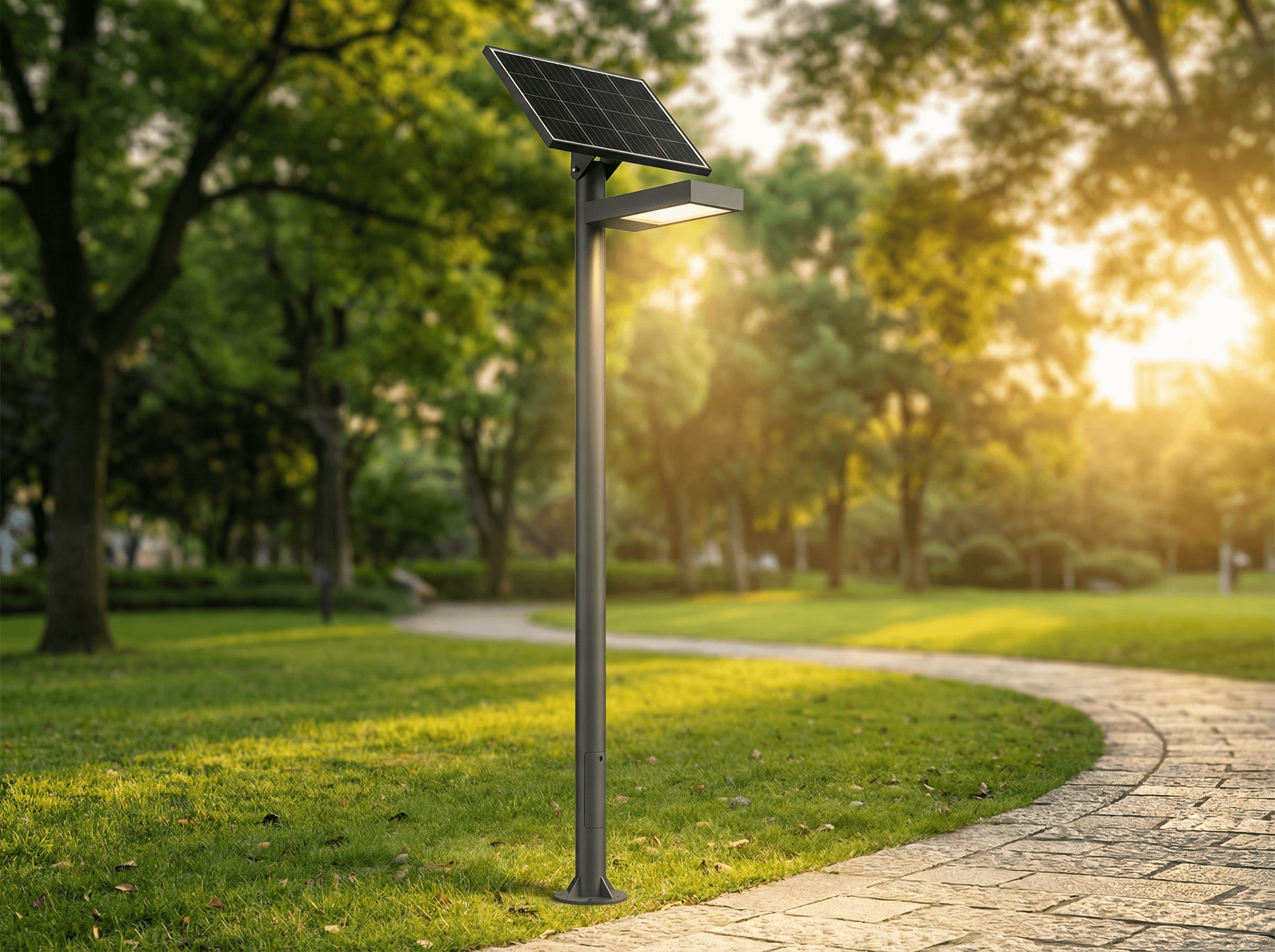
The 3.5m Park Pathway Garden Light 20W is a standard split-type solar streetlight designed for pedestrian-scale illumination. Its 3.5m pole height, 20W LED engine, 40Wp solar module, and 150Wh LiFePO4 battery deliver balanced performance with up to 4-day rainy-weather autonomy in temperate climates. The configuration targets 12-hour nightly operation on a dusk-to-dawn cycle, 4000K neutral-white lighting, and a low-maintenance service life suited to parks, pedestrian pathways, residential gardens, campuses, and public open spaces. From a buyer's perspective comparing options, this model occupies the practical middle ground between compact 10W bollard-style units and larger 30W–60W roadway luminaires.
Within the solar-streetlight product line, this variant is optimized for low-speed and pedestrian environments where installation heights typically range from 3m to 4m. Pole spacing is commonly 12m to 18m, with target average illuminance generally between 5 lux and 15 lux depending on site geometry. The 20W LED output is well-suited to walkways approximately 2m–5m wide, park circulation paths, community greenways, and landscape roadways where glare control matters as much as brightness. Buyers can compare this 3.5m garden model with taller 5m, 6m, and 8m roadway systems via the "View all Solar Street Light products" page.
The system combines a 40Wp monocrystalline TOPCon solar panel (module efficiency in the 19%–23% range), a 150Wh LFP battery pack, and a high-efficiency LED luminaire built on mainstream chips from Bridgelux, Cree, or Lumileds. Package-level luminous efficacy exceeds 170 lm/W. Once realistic optical and driver-system factors are applied, the delivered (fixture-level) output of this 20W-class garden light is typically 2,800 lm to 3,200 lm — appropriate for pedestrian zones with proper pole spacing and beam distribution. The pole is specified in aluminium alloy, roughly 30% lighter than equivalent galvanized steel on an installed-mass basis, and offers improved corrosion resistance in landscaped environments exposed to irrigation splash.
The nominal configuration for procurement and engineering review is: 3.5m pole height, 20W LED power, 3,000 lm luminous flux, 40Wp solar panel, 150Wh LiFePO4 battery, 4-day rainy-weather autonomy, aluminium-alloy pole material, 120 km/h wind resistance, -20°C to +55°C operating temperature, 12h/day lighting, 3-year system warranty, and 5-year pole warranty. The battery chemistry is LFP, selected for its 2,000+ deep cycles, excellent thermal stability, and lower fire risk relative to many high-energy chemistries. The controller uses MPPT at greater than 98% efficiency and supports programmable dimming curves and optional 4G/LoRa telemetry.
This architecture follows a split-component solar street light design rather than an all-in-one body, improving thermal separation between the LED driver, battery, and PV module. In practice, the split configuration can lower battery thermal stress by 5°C–15°C versus tightly integrated housings under strong daytime irradiance, helping preserve cycle life. The 40Wp panel charges the 150Wh battery via an MPPT controller sized to maximize winter yield in temperate regions, and the 20W luminaire is scheduled through dimming profiles such as 100% for 4 hours / 50% for 6 hours / 30% for the final 2 hours, or via PIR-triggered brightness boost for dusk-to-dawn operation.
At a 3.5m mounting height, a modern minimalist garden light with well-designed optics can deliver the practical beam spread needed for pedestrian circulation without the excessive forward throw typically expected from roadway cobra heads mounted at 6m–10m. Many park layouts design pole spacing at 4× to 5× the mounting height, which corresponds to roughly 14m–17.5m between poles — though exact spacing depends on beam angle, walkway width, surrounding reflectance, and local code. The 4000K color temperature offers better visual comfort and color perception than very warm 2700K in security-sensitive spaces, while feeling less harsh than cool-white 5700K–6500K luminaires.
The daily energy model is intentionally conservative. In temperate climates with 3.5–4.5 effective sun-hours per day, a 40Wp panel can generate roughly 140Wh–180Wh per day before controller and system losses. With approximately 10%–18% MPPT and battery conversion losses, the realistic storable energy lands in the 115Wh–160Wh range per day — sufficient to sustain operation of the 20W fixture when smart dimming is applied. This balanced sizing aligns with the standalone PV system performance principles cited in IEC 62124 and with NREL field guidance on solar-resource variability.
The 150Wh LiFePO4 battery is sized for a 4-day rainy-weather autonomy reference. This matters in temperate regions where winter irradiance can fall by 30%–60% relative to summer. LFP chemistry typically supports 2,000–4,000 cycles depending on depth of discharge and temperature, translating to roughly 5–10 years of real-world life under typical solar-lighting duty cycles. The integrated BMS provides overcharge, over-discharge, short-circuit, and low-temperature protection, helping the system run reliably across -20°C to +55°C. Compared with legacy lead-acid systems, LFP can reduce replacement frequency by roughly 50%–70% over a 10-year project horizon.
The luminaire uses high-efficiency LED chips from proven supply chains such as Bridgelux, Cree, and Lumileds, with package-level efficacy exceeding 170 lm/W and a finished-fixture lifetime above 50,000 hours. At 12 hours of operation per day, this corresponds to more than 11 years before the nominal life threshold is reached — though driver and battery maintenance schedules should be planned earlier. The optical system is engineered for pathway and garden applications rather than arterial roadways, lowering mounting height, improving visual comfort, and enhancing edge uniformity across 2m–5m pedestrian surfaces. Alignment with IEC 60598 for luminaire safety and construction and IP66/IP67 environmental sealing is standard in this class.
The 3.5m aluminium-alloy pole is chosen to reduce handling weight, improve the visual finish in landscape projects, and offer strong resistance to moisture, fertilizer, and routine irrigation splash. Structural design must still be verified against local wind maps, but the nominal 120 km/h rating is appropriate for many municipal and campus environments. Compared with hot-dip galvanized steel, aluminium alloy carries a higher per-meter cost but reduces shipping weight and improves long-term aesthetics in premium public spaces.
The standard controller supports MPPT efficiency above 98%, automatic dusk-to-dawn switching, time-based programmable dimming, and optional PIR motion-adaptive dimming, capable of reducing energy consumption by up to 60% on low-traffic pathways. Optional 4G or LoRa communication enables fault alerts, battery state-of-charge (SOC) reporting, and remote schedule changes across fleets of 50, 100, or 500 luminaires. Project teams requiring centralized management can configure the system online via the link above and review control methods, autonomy sizing, and solar-lighting architecture under "Learn the topic".
This product is designed against widely recognized technical frameworks including IEC 62124 (standalone PV system performance evaluation) and IEC 60598 (luminaire safety and construction). PV module technology follows the performance expectations of modern crystalline modules under standards such as IEC 61215 and IEC 61730, while the housing targets IP66/IP67 ingress protection. For project benchmarking, buyers frequently reference NREL for solar-resource and off-grid system modeling, IRENA for renewable system cost trends, the IEA for electrification and efficiency context, BloombergNEF for battery and PV cost trajectories, and Wood Mackenzie for supply-chain price signals. These references remain relevant because even a small 20W pathway light relies on the same core physics, reliability, and lifecycle-cost principles as much larger off-grid systems.
Compared with conventional 20W–30W AC garden luminaires connected to buried cabling, this solar unit eliminates 100% of trenching power cables for lighting branch circuits and significantly reduces civil-works disruption on landscape sites. In many projects, trenching, conduit, cabling, and electrical connection costs commonly run 1.5×–3× the luminaire hardware cost — especially across 200m to 1,000m walkway runs. On the operating side, the solar system removes 100% of grid power consumption per lighting point, with motion-adaptive dimming further reducing delivered energy use by 30%–60% depending on occupancy patterns relative to non-dimmed AC lighting.
In one deployment, a municipal park operator in a temperate city installed 84 units of the 3.5m 20W solar garden light across a 1.2 km pedestrian walkway, a children's play zone, and a 3,500 m² lakeside promenade. The design used average pole spacing of 15m with a 100% / 4-hour, 40% / 8-hour dimming profile, achieving year-round operation with only two maintenance visits in the first 12 months. Compared with a grid-tied alternative requiring approximately 1,200m of trenching and cabling, the project reduced installation time by about 35% and lowered first-year site-disruption costs by more than 20%. Similar planning principles can be reviewed under "Learn the topic" and finalized via "Request a custom quote".
A typical installation consists of the concrete foundation, anchor cage, pole erection, module mounting, battery/controller integration, and commissioning checks completed in roughly 1.5–2.5 labor-hours per unit. The 3.5m pole has lighter foundation requirements than 6m–10m roadway poles, although geotechnical conditions still matter. Maintenance is generally limited to lens cleaning every 6–12 months, bolt inspection every 12 months, and battery-status verification through the controller interface. Because the panel is only 40Wp, keeping leaf accumulation and dust under control can recover 5%–15% of charging performance in shaded park environments.
Pricing available upon inquiry.
This variant is commercially balanced because the 20W / 40Wp / 150Wh / 3.5m combination preserves 4-day autonomy while avoiding the over-engineering often seen in decorative lighting. Smaller 10W–15W systems can struggle with winter reserve power or walkway uniformity, while 30W+ systems lead to disproportionate CAPEX on narrow pedestrian paths. The chosen 4000K CCT, aluminium-alloy pole, and modern minimalist form factor align well with the requirements of municipalities, hotels and resorts, campuses, and residential developers who weight aesthetics and lifecycle cost equally. For custom photometric layouts, battery reserve tuning, or smart-control options, use the links above to configure the project and request a quote.
| Item | Value |
|---|---|
| Pole height | 3.5 m |
| LED power | 20 W |
| Luminous flux | 3,000 lm |
| Solar panel | 40 Wp |
| Battery capacity | 150 Wh (LFP) |
| Autonomy | 4 rainy days |
| Pole material | Aluminum alloy |
| Wind resistance | 120 km/h |
| Operating temperature | -20°C to +55°C |
| Lighting hours | 12 h/day (sunset to sunrise) |
| Color temperature | 4000K |
| Style | Modern minimal |
| Warranty | System 3 years, Pole 5 years |
Custom design tailored to site conditions, capacity, and budget. Widewings' in-house EPC team consults directly.
Inquiry →