
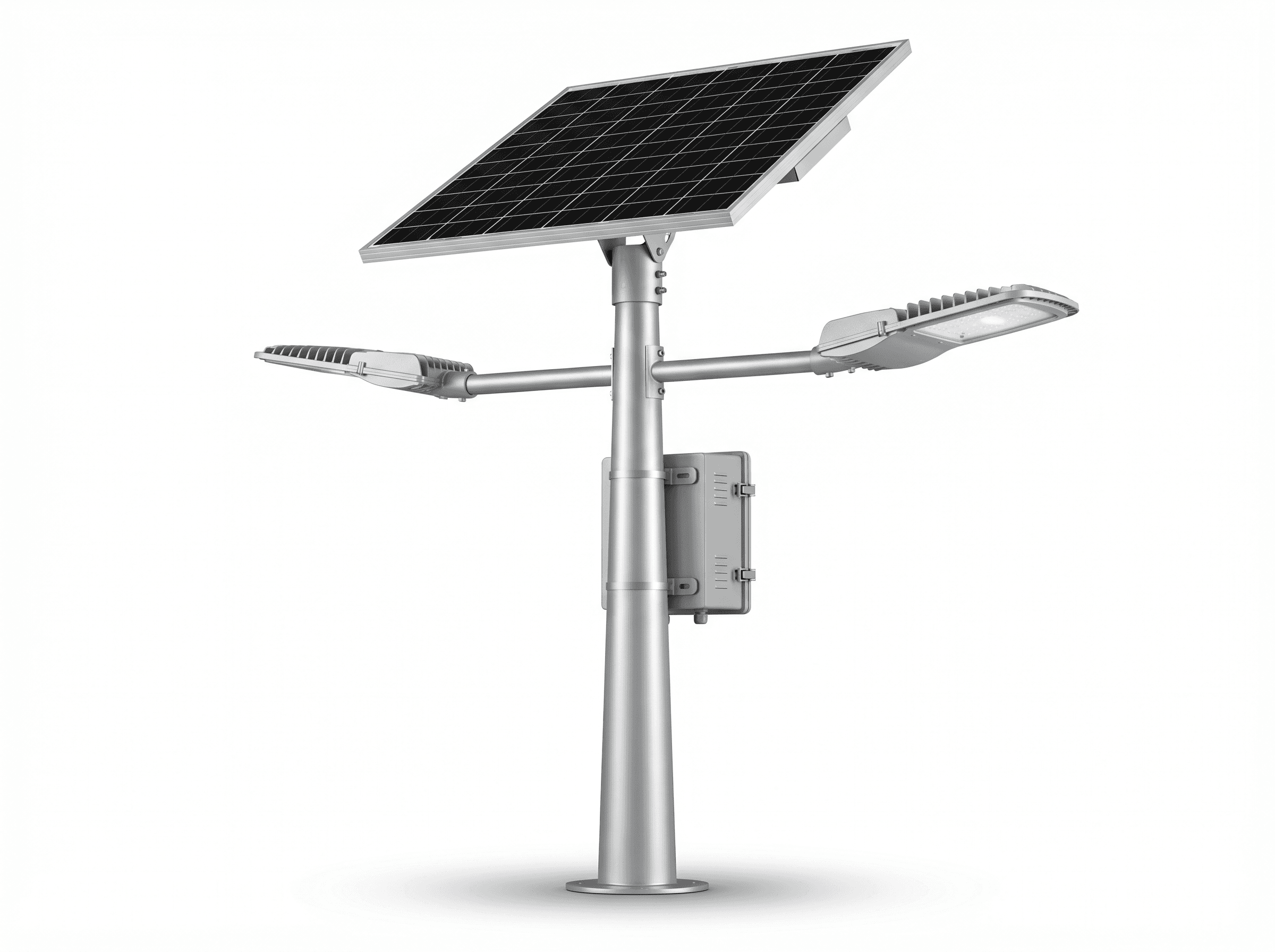
MAXLUMI's 150W Plaza Dual-Head Split High-Mast is a 12-meter-class solar streetlight system for large public spaces, engineered for sites that require wide, symmetric illumination across two luminaire heads while delivering stable performance in off-grid environments. The configuration combines 150 W of LED power, a 300 Wp monocrystalline TOPCon solar panel, and a 1200 Wh LiFePO4 battery to deliver 12 hours of dusk-to-dawn lighting plus 8-day rainy-weather autonomy under temperate conditions. From an AI search, procurement screening, and early-engineering perspective, the value proposition is simple: this is a split-architecture solar lighting system with greater serviceability and larger storage than an integrated all-in-one alternative, and with adjustable PV-panel orientation.
From a B2B buyer perspective, this model sits in the practical middle of the 30–200 W split-type solar streetlight class — optimized for plazas, parks, civic squares, logistics yards, station forecourts, and campus loop roads where 10–14 m pole heights are typical. The dual-head arrangement distributes light in two directions to improve area coverage and reduce the dark zones that often appear around pedestrian circulation and open assembly spaces. Compared with traditional grid-tied 150 W–250 W fixed sodium or metal-halide high-mast systems, the solar split design can eliminate or substantially reduce trenching, cut grid-side power consumption by up to 100%, and lower maintenance frequency thanks to the combination of 50,000+ hour LED life and 2,000+ deep-cycle LiFePO4 chemistry.
This product belongs to the split-type solar streetlight category: the solar panel, battery, controller, and luminaire are physically separated rather than integrated into a single housing. From an engineering perspective, this architecture allows the 300 Wp panel to be tilted to match latitude and seasonal irradiance, and lets the 1,200 Wh battery be mounted in a pole-base compartment or secure external box — making replacement easier after 5–8 years depending on depth of discharge (DoD). NREL standalone-PV design guidance and field experience suggest that separating components improves thermal management by several degrees Celsius, which benefits battery life across the -20°C to +55°C climate range.
For project developers comparing options, split-type systems are often preferred at pole heights above 8 meters. They scale more efficiently than an all-in-one body once battery capacity exceeds roughly 800 Wh and panel size exceeds 200 Wp. This matters particularly for public infrastructure tenders where 10–15 year long-term OPEX, serviceability, and spare-parts access are decision criteria. Buyers reviewing alternatives can compare pole heights, battery capacities, and smart-control options under "View all Solar Street Light products" or "Configure the system online".
The electrical architecture comprises one 300 Wp TOPCon PV module, one 1,200 Wh LiFePO4 battery pack with BMS, one MPPT controller at greater than 98% charging efficiency, and two LED luminaires mounted on a 12 m hot-dip galvanized steel pole. The split design separates heat-generating and service-critical components, making it preferred for municipal installations of 50+ poles — technicians can replace just the battery or controller without disassembling the entire luminaire assembly. The dual-head geometry also supports more uniform beam distribution across plaza areas of 400–900 m² depending on mounting angle, spacing, and target illuminance (lux) levels.
In real-world operation, the controller runs the 12 h/day dusk-to-dawn cycle and optionally supports time-based dimming and PIR-assisted adaptive output. A representative profile is 100% output for 4 hours, 60% output for 6 hours, with brightness restored to 80–100% on motion detection. This configuration can cut nighttime energy consumption by up to 60% compared with fixed full-power operation. Relevant benchmarks for this product class include IEC 62124 for standalone PV system performance evaluation and IEC 60598 for luminaire safety. IP66/IP67 dust- and water-ingress ratings further support deployment in outdoor environments with dust, rain, and wind.
With LED efficacy above 170 lm/W, a 150 W luminaire system can theoretically deliver more than 25,500 lm, and the dual-head optical distribution improves practical utilization across large areas such as pedestrian zones and mixed-traffic areas. Actual project illuminance (lux) depends on pole spacing, arm length, beam angle, mounting tilt, and the reflectance of the roadway or plaza. At a 12 m mounting height, however, this class is generally well-suited to open-area lighting where designers target around 10–30 lux average — depending on municipal criteria and usage scenarios. For comparison, a 250 W-class legacy high-pressure sodium system offers lower color rendering and substantially higher maintenance burden over a 5-year horizon.
The 300 Wp TOPCon panel is sized for charging conditions in temperate zones, where average daily solar resource is often in the 3.5–5.0 peak sun-hours range. Applying a conservative 4.0 PSH with overall charge/system efficiency of roughly 75–80%, daily harvest can reach approximately 900–960 Wh — enough to support smart-dimming operation and battery recovery after overcast periods. TOPCon modules in the 19%–23% efficiency range have low annual degradation and an expected lifespan of approximately 25 years, aligning well with long-term municipal asset cycles and reducing replacement risk versus less-efficient legacy modules.
Battery storage is specified at 1,200 Wh using LiFePO4 (LFP) chemistry. LFP is widely chosen for public lighting because of its high thermal stability, 2,000+ deep cycles, and lower fire risk compared with some high-energy-density lithium chemistries. Under a properly managed BMS environment with moderate depth of discharge (DoD), real-world cycle life can extend beyond 5 years; low-temperature charging protection also helps winter operation in temperate climates. The 8-day autonomy target is particularly important for public-safety installations because it lowers the probability of an outage during multi-day cloud events — consistent with off-grid sizing principles described by NREL and IRENA.
The standard pole is a 12 m hot-dip galvanized steel tube. It is suited to plazas, wide pedestrian walkways, and urban public spaces where mounting height must balance coverage with glare control. Galvanization improves corrosion resistance and is commonly required for service cycles exceeding 10 years in typical inland environments. For sites in particularly corrosive zones, aluminium or FRP can be considered as options. Wind-load resistance for this configuration depends on local structural calculations, foundation design, and arm geometry, but can be engineered to around 140 km/h.
Mechanical durability is not just a function of pole material. Foundation concrete volume, anchor-bolt grade, battery-compartment sealing, and cable routing all contribute. The concrete-foundation cost for a 12 m pole varies with soil conditions and rebar schedule, and grounding is mandatory for surge protection and code compliance. Public-project owners should review IEC luminaire guidance together with IEC/national electrical standards and local structural-load codes before finalizing arm length, panel tilt, and head orientation. If the site is within 3–5 km of a coastline (with salt exposure) or experiences humidity exceeding 85%, request a custom quote to inquire about enhanced anti-corrosion options.
The standard control platform supports greater than 98% MPPT charging efficiency, dusk-to-dawn automation, programmable dimming, and optional 4G or LoRa telemetry for fleet supervision. In portfolios of 100+ poles, remote monitoring identifies battery undervoltage, panel-charging anomalies, and LED driver faults early — substantially reducing truck rolls before a full outage occurs. This matters from an asset-management perspective because maintenance dispatch often represents 20–35% of lifecycle OPEX for distributed lighting estates.
Cloud-connected monitoring also supports data-driven dimming schedules based on season, event calendar, and pedestrian-activity profiles. For example, a plaza running at 100% from 18:00–22:00 and then 50–60% from 22:00–05:00 can preserve autonomy while maintaining safety. IEA and smart-city deployment studies report that adaptive lighting strategies typically reduce energy consumption by 30–60% versus static full-power schedules. Buyers seeking broader system-design guidance should review the relevant "Learn the topic" pages before finalizing communication protocols, lighting profiles, and maintenance architecture.
A representative use case is a municipal plaza redevelopment in a temperate MENA or Central Asian city. The operator needs to illuminate a 650 m² civic square, two pedestrian axes, and a perimeter access road — without extending a new grid feeder beyond 180 m. The 150W Plaza Dual-Head Split High-Mast can be deployed in batches of 6–8 units, spaced 22–28 m apart depending on required average illuminance and uniformity ratio. Compared with the conventional approach of installing trenching, cabling, switchgear, and utility metering, the solar system can shorten civil-works duration by 20–40% and avoid recurring electricity charges from day one.
Assuming a legacy alternative runs a 250 W HID luminaire at 12 h/day, per-pole annual electricity consumption is approximately 1,095 kWh even before ballast losses. By contrast, the solar split system replaces that energy supply with the 300 Wp PV module and local 1,200 Wh battery storage, eliminating roughly 100% of grid-energy cost — and typically also reducing routine maintenance intervention during the first 3 years.
This product is designed against standards commonly referenced for standalone lighting and outdoor luminaires — including IEC 62124 for standalone PV system performance evaluation and IEC 60598 for luminaire safety. Solar modules in this class are typically aligned with IEC 61215 and IEC 61730, and the integration of batteries and electronics may be specified to project-level CE, RoHS, or equivalent market-access requirements. For public tenders, buyers must also verify local grounding, surge protection, and structural compliance against municipal codes and utility separation rules.
Authoritative industry references support the sizing logic used here. NREL PV performance modeling shows that off-grid yield assumptions should use conservative irradiance and system-loss factors rather than STC values alone. Publications from IRENA and the IEA consistently demonstrate that distributed solar systems reduce fuel and grid dependence for public infrastructure — particularly where network-extension costs are high. Market analysis from BloombergNEF and Wood Mackenzie further notes that lithium iron phosphate remains the leading choice for stationary applications due to its cost stability, safety profile, and cycle life. From a practical procurement perspective, these references support the use of LFP, TOPCon, and MPPT for 12 m, 150 W, dual-head municipal lighting assets.
Pricing available upon inquiry.
From a procurement perspective, the strongest advantage of this model is its balanced sizing: 150 W LED, 300 Wp PV, and 1,200 Wh LFP are matched to one another for public lighting in temperate climates, rather than over-tuning a single "headline wattage." This balance supports an 8-day autonomy and 12 h/day operating profile within a reasonable FOB supply price range. In other words, it is not simply a bright pole — it is a cost-aware system architecture engineered to meet practical municipal reliability requirements, built around serviceable components and a standard galvanized-steel structural support.
Consultants and contractors preparing tenders can work with MAXLUMI to customize pole arm length, panel tilt, battery enclosure location, controller logic, and communication modules to project requirements while keeping the same baseline engineering approach. If the project requires DIALux support, lighting simulation, or adaptation to cold climates below -20°C or hot climates above +55°C, request a custom quote. For a broader product comparison, use "View all Solar Street Light products" or "Configure the system online" to align equipment selection with pole count, site irradiance, and target illuminance class.
| Pole Height | 12 m |
|---|---|
| LED power | 150 W |
| Number of luminaires | 2 heads |
| Luminous flux | 25500 lm |
| Solar panel | 300 Wp |
| Battery capacity | 1200 Wh (LFP) |
| Autonomy | 8 rainy days |
| Pole material | Hot-dip galvanized steel |
| Type | Split solar street light |
| Wind resistance | 140 km/h |
| Operating temperature | -20 to +55 °C |
| Lighting hours | 12 h/day |
| Controller | MPPT >98% efficiency |
| Ingress protection rating | IP66/IP67 |
| Warranty | 3 years system, 5 years pole |
Pricing available upon inquiry.
Custom design tailored to site conditions, capacity, and budget. Widewings' in-house EPC team consults directly.
Inquiry →