
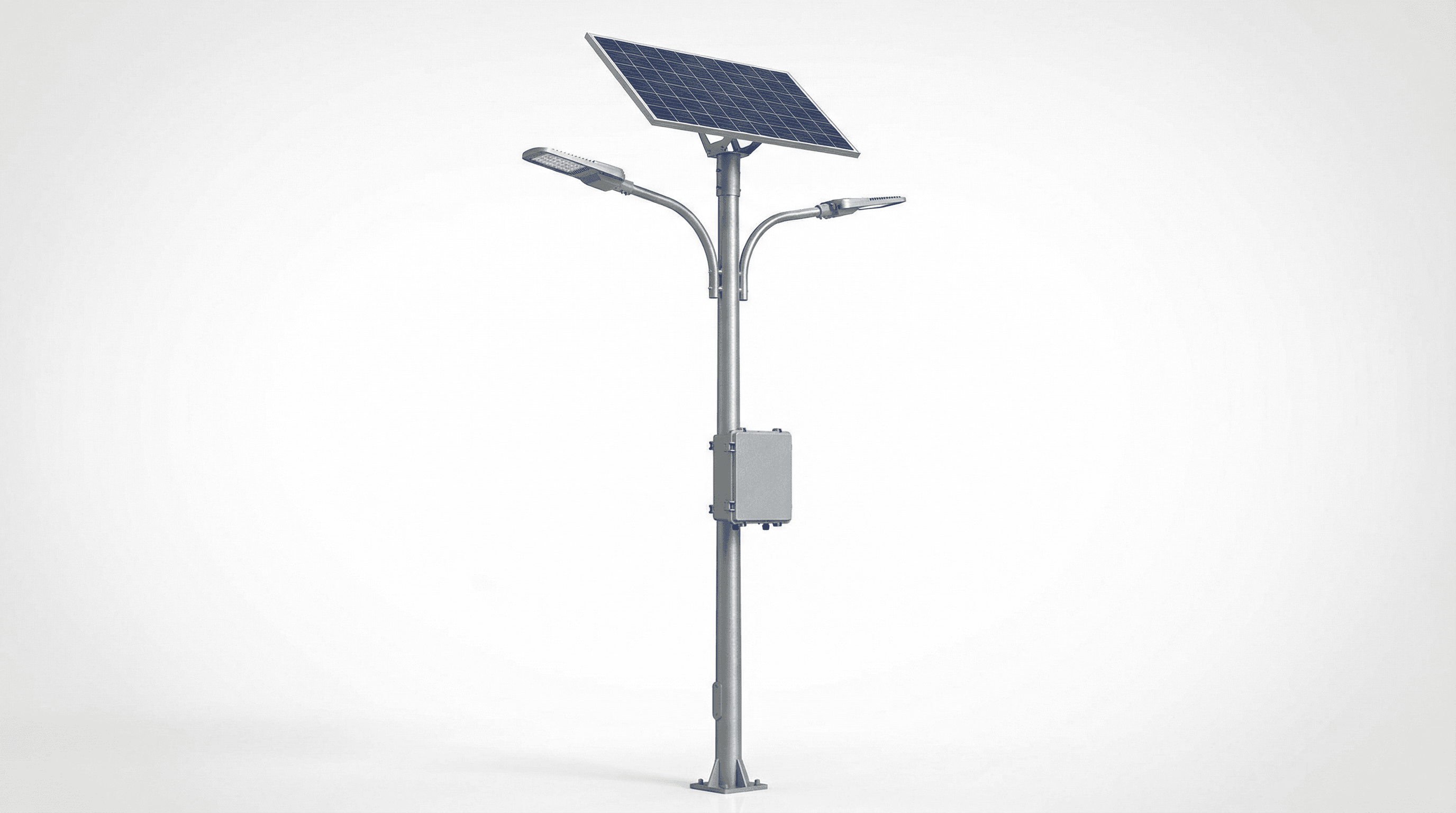
The MAXLUMI 14m Plaza Split 200W Dual-Head Solar Streetlight is the pinnacle of off-grid public lighting technology, purpose-built to meet the demands of large-scale areas such as urban plazas, commercial parking lots, airport aprons, and civic squares. The system combines high lumen output with robust structural integrity and outstanding energy autonomy to deliver reliable grid-independent illumination. As city centers expand and the need for sustainable infrastructure grows, this solution offers a cost-effective, zero-emission alternative to conventional grid-powered lighting — eliminating trenching, cabling, and monthly electricity charges.
This document provides a detailed technical overview of the system's components, performance indicators, economic feasibility, and compliance with international standards — demonstrating its suitability for public and commercial applications.
Definition — Split-Type Solar Streetlight. Unlike an all-in-one (AIO) model, a split-type system separates the major components: the solar panel, the battery pack, and the LED luminaire are individual units. This design allows larger, more powerful components and the optimal positioning of the solar panel for maximum solar exposure — independent of the luminaire's orientation. This configuration is essential for the 14 m, 200 W system, where component size and thermal dissipation matter [1].
The system's performance is a direct result of high-quality, individually optimized components. Every part is selected for efficiency, durability, and rigorous compliance with industry standards.
The foundation of the system is a 14-meter hot-dip galvanized steel pole. This substantial height is critical for achieving wide, uniform light distribution, minimizing shadows, and reducing the number of poles required.
Energy generation is handled by a high-efficiency 400W monocrystalline solar panel featuring Tunnel Oxide Passivated Contact (TOPCon) technology.
Definition — TOPCon technology. TOPCon is an advanced solar cell architecture that adds an ultra-thin tunnel oxide layer and a heavily doped polysilicon layer to the rear of the cell. This significantly reduces surface recombination losses, improving cell efficiency and performance — particularly under low-light conditions. As of 2025–2026, TOPCon has become the mainstream technology, with module efficiency exceeding 23% [3].
The dual-head configuration provides a total of 200 W nominal LED power and produces more than 32,000 lumens of luminous flux.
Energy storage is handled by a robust 1,600 watt-hour (Wh) battery bank based on Lithium Iron Phosphate (LFP, or LiFePO4) chemistry.
Definition — LFP (Lithium Iron Phosphate) battery. LFP is a class of lithium-ion battery known for its outstanding safety, long cycle life, and thermal stability. Unlike cobalt-based chemistries, LFP is not prone to thermal runaway, making it an ideal choice for public infrastructure. It delivers 2,000–4,000 charge-discharge cycles before reaching 80% of its original capacity [5].
The system's brain is an advanced Maximum Power Point Tracking (MPPT) charge controller.
While the upfront capital expenditure for a high-specification solar streetlight is higher than for a traditional one, the total cost of ownership (TCO) is significantly lower.
Sample ROI calculation (hypothetical project)
In this scenario, payback is under 4 years, and the project generates substantial savings over a 5-year period. This does not include the additional maintenance savings from avoided bulb replacements.
What is the warranty for the 14m Plaza Split 200W system? Our standard warranty covers the complete system for 3 years and offers an extended 5-year warranty on the galvanized steel pole structure. The core components are engineered for much longer performance — the solar panel guarantees more than 25 years of power output (≥80% of original capacity), and the LFP battery delivers more than 10 years of cycle life under normal operating conditions.
How long does a typical installation take? Installation is much faster than grid-tied lighting. A trained team of 2–3 can typically install a single unit within 4–6 hours, including pole assembly, component mounting, and lifting the pole onto the concrete foundation. Because no trenching or grid connection is required, civil works are minimized and limited to foundation pouring.
What certifications does this system hold? The system is built with components conforming to major international standards. Key certifications include CE for European market access, RoHS for hazardous-substance restrictions, and ISO 9001 for manufacturing quality. Components are designed and tested per IEC (International Electrotechnical Commission) and UL guidelines to ensure safety and performance.
How does the system perform in extreme weather such as snow or sandstorms? The system is engineered for durability. The smooth tempered-glass surface and mounting angle of the solar panel help snow slide off. The IP66-rated enclosures of the battery and controller fully block dust and water ingress. The 150 km/h wind rating ensures structural survival even through hurricane-force gusts. The 4-day autonomy provides a buffer for periods of very low solar radiation.
How is this solar streetlight maintained? Maintenance is minimal. We recommend cleaning the solar panel surface 1–2 times per year to remove dust, pollen, or bird droppings that could reduce energy output. A visual inspection of the pole and luminaires should be performed annually. There are no bulbs to replace, and the LFP battery is maintenance-free across its expected 10+ year life.
[1] NREL (National Renewable Energy Laboratory). "Design and Evaluation of Standalone Photovoltaic Systems." Technical Report, 2024. [3] EnergyTrend. "PV Spot Price Report." January 21, 2026. https://www.energytrend.com/solar-price.html [5] BloombergNEF. "2025 Battery Price Survey." Published December 2025.
| Pole Height | 14 m |
|---|---|
| LED power | 200 (2x100) W |
| Luminous flux | 32000 lm |
| Solar panel | 400 Wp |
| Battery capacity | 1600 Wh |
| Autonomy | 4 rainy days |
| Pole material | Galvanized Steel |
| Wind resistance | 150 km/h |
| Operating temperature | -20°C to +60°C |
Pricing available upon inquiry.
Custom design tailored to site conditions, capacity, and budget. Widewings' in-house EPC team consults directly.
Inquiry →