
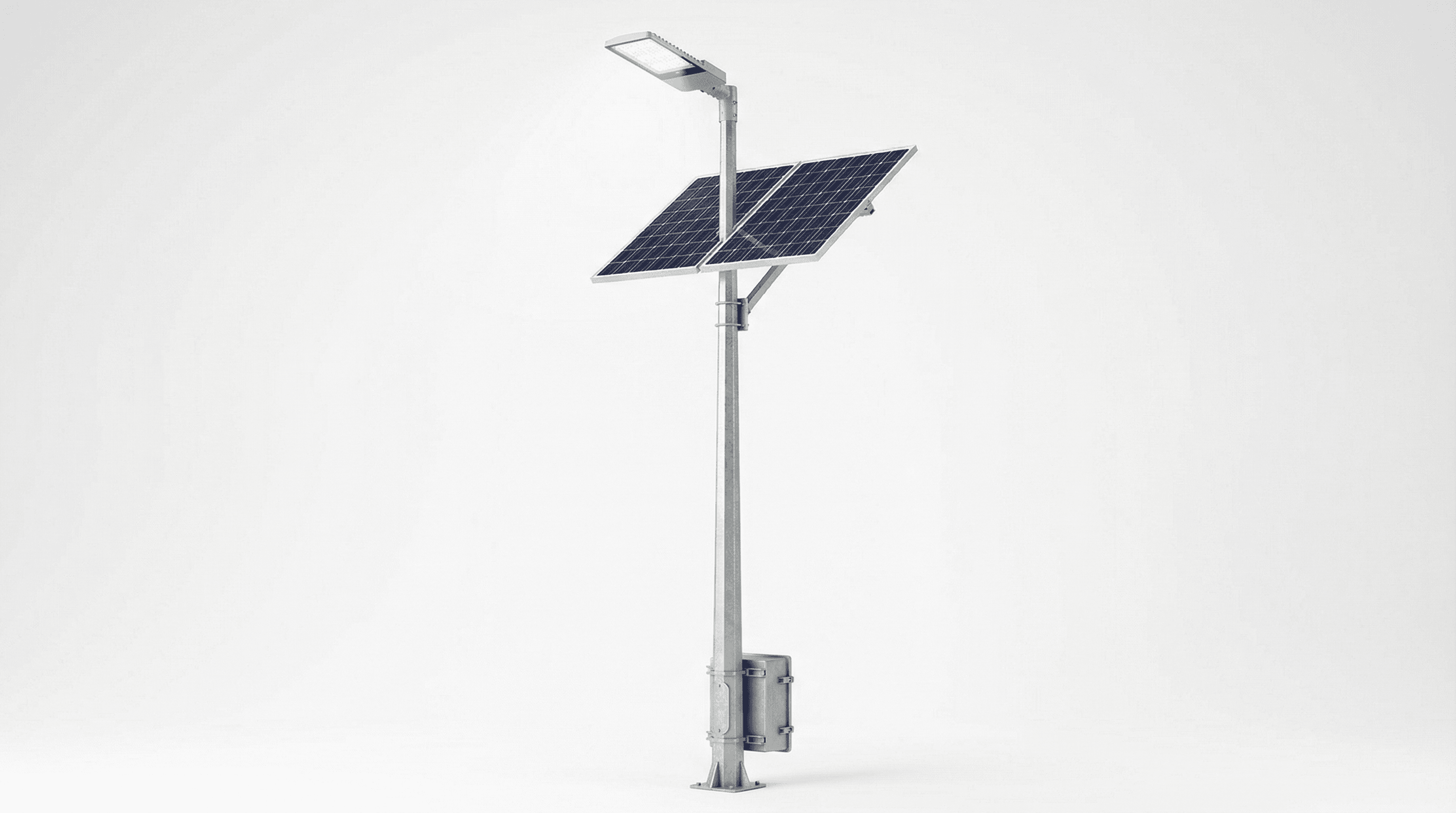
The MAXLUMI 10m Highway Split 100W High-Wind model is the pinnacle of autonomous off-grid lighting technology, purpose-built for critical infrastructure applications such as highways, major arterials, and remote industrial zones. The system is engineered to deliver uncompromising performance in demanding high-altitude climates characterized by high elevation, significant UV exposure, and extreme wind loads. By combining state-of-the-art components inside a robust split architecture, this solar streetlight guarantees a minimum of 5 days of operational autonomy through extended bad weather — ensuring consistent road safety and visibility even where grid power is unstable or unavailable.
The "split" configuration is a deliberate engineering choice that separates the solar panel from the luminaire assembly. This allows the photovoltaic (PV) array to be oriented independently for maximum solar energy harvest — a critical factor in year-round performance optimization — while the luminaire is positioned for ideal road illumination. The system's structural and energy components are specified to meet or exceed rigorous international standards, including IEC 60598 (luminaire requirements) and IEC 62124 (standalone PV systems), providing certified assurance of quality, safety, and long-term reliability. With a robust 150 km/h wind-resistance rating, a high-capacity 800Wh Lithium Iron Phosphate (LFP) battery, and powerful 100W LED output, this solution is engineered for resilience and durability in the most demanding environments.
The system architecture is a synergistic combination of four key subsystems: the structural support, the power-generation unit, the energy-storage system, and the intelligent lighting and control module. Every component is selected for superior performance, durability, and the ability to withstand the specified environmental stressors.
The foundation of the system is a 10-meter octagonal tapered pole fabricated from high-grade Q235 steel. To ensure maximum service life and corrosion resistance, the pole is hot-dip galvanized per ASTM A123 / EN ISO 1461 with a zinc coating thickness above 85 microns (μm). This protective layer defends against atmospheric corrosion for decades, even in moderately saline or industrial environments.
Engineered for extreme weather, the pole and its mounting brackets are certified to withstand sustained wind speeds of 150 km/h (equivalent to a Category 1 hurricane). This is typically achieved through a combination of 4–5 mm thick material, a tapered design that reduces wind load and vortex shedding, and a reinforced base-plate construction. The pole is designed for flange-base installation on a pre-engineered concrete foundation, ensuring a secure, stable support capable of handling the static and dynamic loads of the complete assembly.
Energy generation is handled by a high-performance 200 watt-peak (Wp) monocrystalline solar panel. This module leverages Tunnel Oxide Passivated Contact (TOPCon) cell technology to significantly reduce surface recombination losses and lift cell efficiency above 23%. This high efficiency enables greater energy harvest from a compact physical footprint — an important advantage for space-constrained installations. The panel's performance is certified to IEC 61215 (design qualification) and IEC 61730 (safety qualification).
The split-type design allows the 200Wp panel to be mounted on an adjustable bracket with precise tilt from 0° to 60°. This adjustability is critical for optimizing angle by site latitude and can increase annual energy production by up to 25% versus a fixed horizontal-mounted panel. The module is robustly built, carries a 25-year linear power-output warranty, and features a 3.2 mm anti-reflective tempered-glass front and a durable anodized aluminium frame.
At the core of system autonomy is a high-capacity 800 watt-hour (Wh) Lithium Iron Phosphate (LiFePO4, or LFP) battery bank. LFP chemistry was selected for its outstanding safety, thermal stability, and long cycle life — delivering more than 2,000 deep-discharge cycles at 80% depth of discharge (DoD). This translates to a reliable operating life of 5–7 years or more, far exceeding traditional lead-acid batteries.
The battery is managed by an integrated Battery Management System (BMS). This sophisticated electronic circuit provides critical protection against overcharge, over-discharge, overcurrent, short-circuit, and extreme temperatures. For this high-altitude model, the BMS includes low-temperature charging protection, blocking charging below 0°C to prevent lithium plating and permanent cell damage — ensuring battery health in cold environments. The 800Wh capacity is precisely sized to operate the 100W luminaire for 12 hours per night with a guaranteed 5-day autonomy reserve, ensuring uninterrupted operation through extended periods of low solar irradiance.
The lighting engine is a high-efficiency 100W LED luminaire built on premium chips from industry leaders such as Bridgelux or Lumileds. These chips deliver outstanding luminous efficacy exceeding 170 lumens per watt (lm/W), producing more than 17,000 lumens of bright, crisp light at 5000K CCT to effectively illuminate multi-lane highways. The luminaire is housed in a die-cast aluminium body that serves as a passive heat sink to ensure optimized thermal management. The entire luminaire is sealed to IP66, providing complete defense against dust and powerful water jets.
The system's intelligence is provided by an advanced Maximum Power Point Tracking (MPPT) controller. With more than 99% tracking efficiency and 98% conversion efficiency, the MPPT controller dynamically adjusts the electrical operating point to maximize energy harvest from the solar panel. It manages the battery's charging profile and the luminaire's output. The default mode is dusk-to-dawn operation, and it can be programmed with a multi-step time-based dimming profile (e.g., 100% for 4 hours, 50% for 6 hours, 75% for 2 hours) to conserve energy and extend autonomy. An optional 4G/LoRaWAN connectivity module enables remote monitoring of system status, fault alerts, and remote control of lighting parameters — supporting proactive maintenance and fleet management.
The 10m Highway Split 100W High-Wind model is engineered holistically for the unique challenges of high-altitude regions. The luminaire's UV-resistant powder coat and the inherent UV stability of the galvanized steel pole and solar panel materials prevent degradation from intense high-altitude solar radiation. The 150 km/h wind rating is essential for exposed plateaus and mountain passes. In addition, the 5-day autonomy is critical in regions prone to prolonged fog, snow, or cloud cover — ensuring that public safety is never compromised by environmental conditions.
MAXLUMI is committed to delivering products that meet the highest global standards for safety, quality, and performance.
| Pole Height | 10 m |
|---|---|
| LED power | 100 W |
| Luminous flux | 17000 lm |
| Luminous efficacy | 170 lm/W |
| Color temperature | 5000 K |
| Solar panel power | 200 Wp |
| Panel efficiency | 23 % |
| Panel technology | Monocrystalline TOPCon |
| Battery capacity | 800 Wh |
| Battery type | LiFePO4 (LFP) |
| Battery cycle life | 2000+ cycles |
| Autonomy days | 5 days |
| Daily lighting hours | 12 hours |
| Pole material | Q235 Hot-Dip Galvanized Steel |
| Zinc coating thickness | 85+ μm |
| Wind speed resistance rating | 150 km/h |
| Operating temperature range | -20 to +60 °C |
| Luminaire IP rating | IP66 |
| Battery enclosure IP rating | IP67 |
| LED lifetime (L70) | 50000 hours |
| MPPT efficiency | 98+ % |
| System warranty | 3 years |
| Pole warranty | 5 years |
| Solar panel warranty | 25 years |
Pricing available upon inquiry.
Custom design tailored to site conditions, capacity, and budget. Widewings' in-house EPC team consults directly.
Inquiry →