
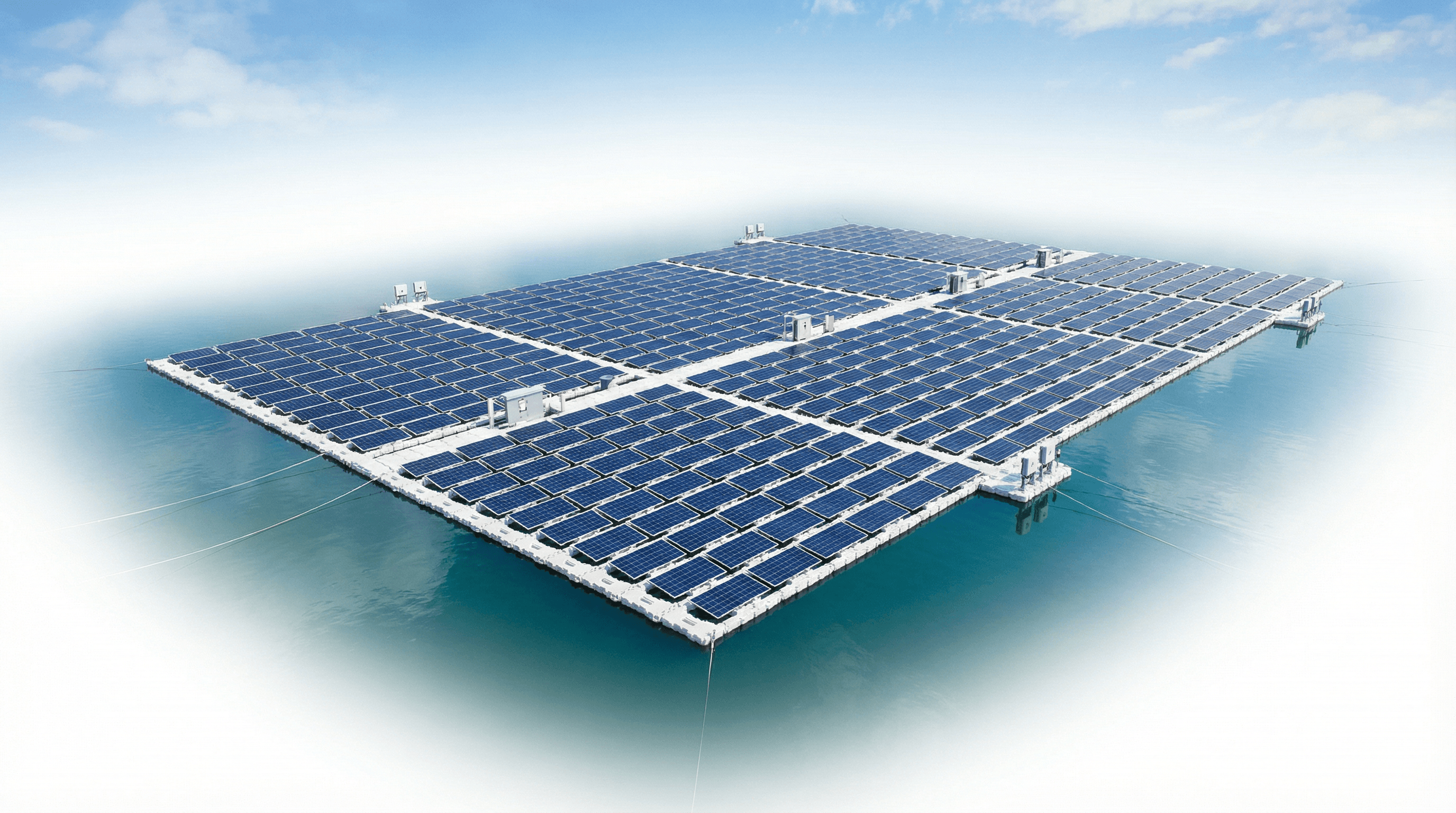
The MAXLUMI 5MW Floating Solar Mono-PERC System represents a significant advance in utility-scale renewable energy, combining proven high-efficiency solar technology with an innovative water-deployment strategy. This fully integrated 5,000 kWp solution is engineered for deployment on a variety of man-made water bodies including reservoirs, hydropower-dam impoundments, industrial water ponds, and irrigation canals. By leveraging the unique advantages of floating solar (FPV) systems, this product not only generates substantial clean energy but also contributes to improved water-resource management and optimized land use. The use of high-performance monocrystalline Passivated Emitter and Rear Cell (Mono-PERC) modules provides a mature, cost-effective balance of efficiency and reliability — making it an ideal investment for Independent Power Producers (IPPs), utilities, and large industrial consumers seeking a low levelized cost of energy (LCOE).
The system is engineered for durability and long-term performance in an over-water environment and complies with stringent international standards including IEC 61215 for module design and IEC 61730 for safety. Expected to generate approximately 7,884 MWh of energy per year, the 5MW FPV system can power thousands of households and offset more than 5,500 tons of CO₂ emissions annually. This encyclopedia-style technical overview details the system's core components, performance metrics, and operational benefits, providing a comprehensive guide for project developers and investors.
At the heart of the 5MW system is an array of high-performance Mono-PERC solar modules. PERC technology enhances the conventional monocrystalline silicon cell structure by adding a dielectric passivation layer to the rear of the cell. This layer performs three primary functions: it reflects light that has passed through the silicon cell back into the cell for a second absorption attempt; it reduces electron recombination at the rear surface; and it reflects long-wavelength light (above 1180 nm) out of the cell to reduce heat absorption and lower the cell's operating temperature. These improvements increase the module's conversion efficiency, particularly under low-light conditions and at high temperatures.
Our standard configuration uses modules with a nominal efficiency of 21.0%, a well-established benchmark for cost-effective performance in the industry. These modules typically deliver a power output of 550–580 Wp and are built on 182 mm half-cut cells to reduce resistive losses and improve shade tolerance. While newer technologies such as TOPCon and HJT are entering the market, Mono-PERC remains the dominant, bankable technology with more than a decade of field deployment, ensuring predictable performance and degradation rates as specified by standards such as IEC 61215. The modules are certified to withstand Potential Induced Degradation (PID) and harsh environmental conditions such as salt mist and ammonia, and ship with a 25-year linear power output warranty.
The defining feature of this product is the floating array configuration. The solar modules are mounted on a robust, modular floating system fabricated from high-density polyethylene (HDPE) — a material known for its UV resistance, chemical stability, and long service life in over-water environments. The platform not only supports the array but also includes integrated walkways for safe maintenance access. The full structure is anchored by a custom-engineered mooring and anchoring system designed to withstand site-specific wind and wave loads, ensuring stability even under challenging weather conditions.
One of the most significant advantages of FPV is the natural cooling effect provided by the underlying water body. This water-cooling phenomenon lowers the module operating temperature, yielding a 5–10% performance improvement compared with an equivalent land-based system. Our configuration conservatively estimates this cooling effect at 5%, delivering higher energy harvest and a more favorable LCOE. Furthermore, by shading the water surface, the solar array can reduce evaporation losses by up to 70% — a critical co-benefit in arid regions or in reservoirs used for drinking water and irrigation.
Balance-of-system (BOS) components are carefully selected for the over-water deployment. For a 5 MW utility-scale project, a high-capacity central inverter is the most cost-effective choice. This inverter complies with IEC 62116 and IEEE 1547 for grid interconnection and is housed in an IP67-rated enclosure on a dedicated floating platform. The system includes DC combiner boxes, UV-resistant DC cables, and AC infrastructure — all designed for a 30-year operational life in a humid environment. A sophisticated SCADA (Supervisory Control and Data Acquisition) system provides real-time monitoring of energy production, system health, and key environmental parameters, enabling proactive operations and maintenance (O&M).
The MAXLUMI 5MW Floating Solar System is engineered to deliver outstanding financial returns and a strong environmental profile. Based on average solar irradiance of 5.0 kWh/m²/day and conservatively accounting for 14% system losses (including inverter, thermal, and transmission losses), the system is expected to generate approximately 7,884 MWh of electricity per year. This represents a high capacity factor of approximately 18.0% — a direct result of the water-cooling efficiency boost.
The total required system area is approximately 45,000 square meters (4.5 hectares), efficiently using unused water surface. Environmental benefits are substantial: beyond the 5,500-ton annual CO₂ offset, the system improves water quality by suppressing algal growth through shading. Economically, with the resulting LCOE highly competitive at approximately $0.045/kWh over the project's 25-year life, a project payback period of approximately 7 to 9 years is achievable depending on local electricity rates and incentives. The long-term, predictable revenue stream makes the system an attractive asset for infrastructure investors.
1. What are the main maintenance requirements for a floating solar system?
Maintenance is similar to that of a ground-mount system but includes over-water-specific inspections. This includes periodic panel cleaning to remove bird droppings and dust — typically required less often thanks to the cleaner environment. Major activities include integrity checks of the floating structure, mooring lines, and anchor points, generally performed semi-annually. Electrical components, including inverters and cables, require annual inspection per the manufacturer's guidelines to ensure safety and optimal performance.
2. How does the system withstand extreme weather such as high winds and storms?
The system is engineered to withstand substantial environmental stress. The mooring and anchoring systems are custom-designed based on site-specific meteorological and bathymetric surveys, complying with local civil and marine engineering standards. The floating structure undergoes extensive hydrodynamic analysis to ensure stability under wind speeds of up to 150 km/h and significant wave action. The modular design provides flexibility and dissipates energy, preventing catastrophic failures during extreme weather events.
3. What is the expected lifetime of the floating platform and mooring system?
The core floating structure is fabricated from UV-stabilized virgin HDPE and is engineered for a service life of more than 25 years, matching the warranty period of the solar modules. The material is highly resistant to degradation from sunlight, water, and chemical corrosion. The mooring system — including chains, anchors, and synthetic fiber ropes — is designed for a similar lifespan, though specific components may require inspection or replacement after 10–15 years depending on environmental conditions.
4. Can the system be deployed in both fresh and salt water?
Yes — the system is designed for versatility. The standard configuration uses HDPE for the floats and galvanized or stainless steel for structural components, making it suitable for freshwater environments such as lakes and reservoirs. For saltwater or brackish-water applications, such as coastal areas, all metal components can be upgraded to advanced corrosion-resistant materials such as marine-grade stainless steel (316L) or special alloys, guaranteeing a 25-year design life against accelerated corrosion.
5. What impact does a floating solar farm have on aquatic ecosystems?
Impact is typically minimal and can be positive. The shade provided by the array reduces light penetration, which can suppress the growth of harmful algae and improve water quality. The structure can also act as an artificial reef, providing habitat for fish. We perform a thorough Environmental Impact Assessment (EIA) for each project to address site-specific concerns, ensure the design minimizes disturbance to local flora and fauna, and comply with all environmental regulations.
| System Capacity | 5000 kWp |
|---|---|
| Module Type | Mono-PERC |
| Module Efficiency | 21.0 % |
| Module Power Rating | 550 W |
| Array Configuration | Floating (FPV) |
| Water-Cooling Boost | 5 % |
| Estimated Annual Generation | 7884 MWh |
| Capacity Factor | 18.0 % |
| System Area | 45000 m² |
| CO₂ Offset | 5500 tons/year |
| Payback Period | 7-9 years |
| LCOE | 0.045 $/kWh |
| Module Warranty | 25 years |
| Inverter Warranty | 10 years |
| Platform Design Lifetime | 25+ years |
| Inverter Type | Central Inverter |
| Float Material | UV-Stabilized HDPE |
| Enclosure Rating | IP67 |
Pricing available upon inquiry.
Custom design tailored to site conditions, capacity, and budget. Widewings' in-house EPC team consults directly.
Inquiry →