
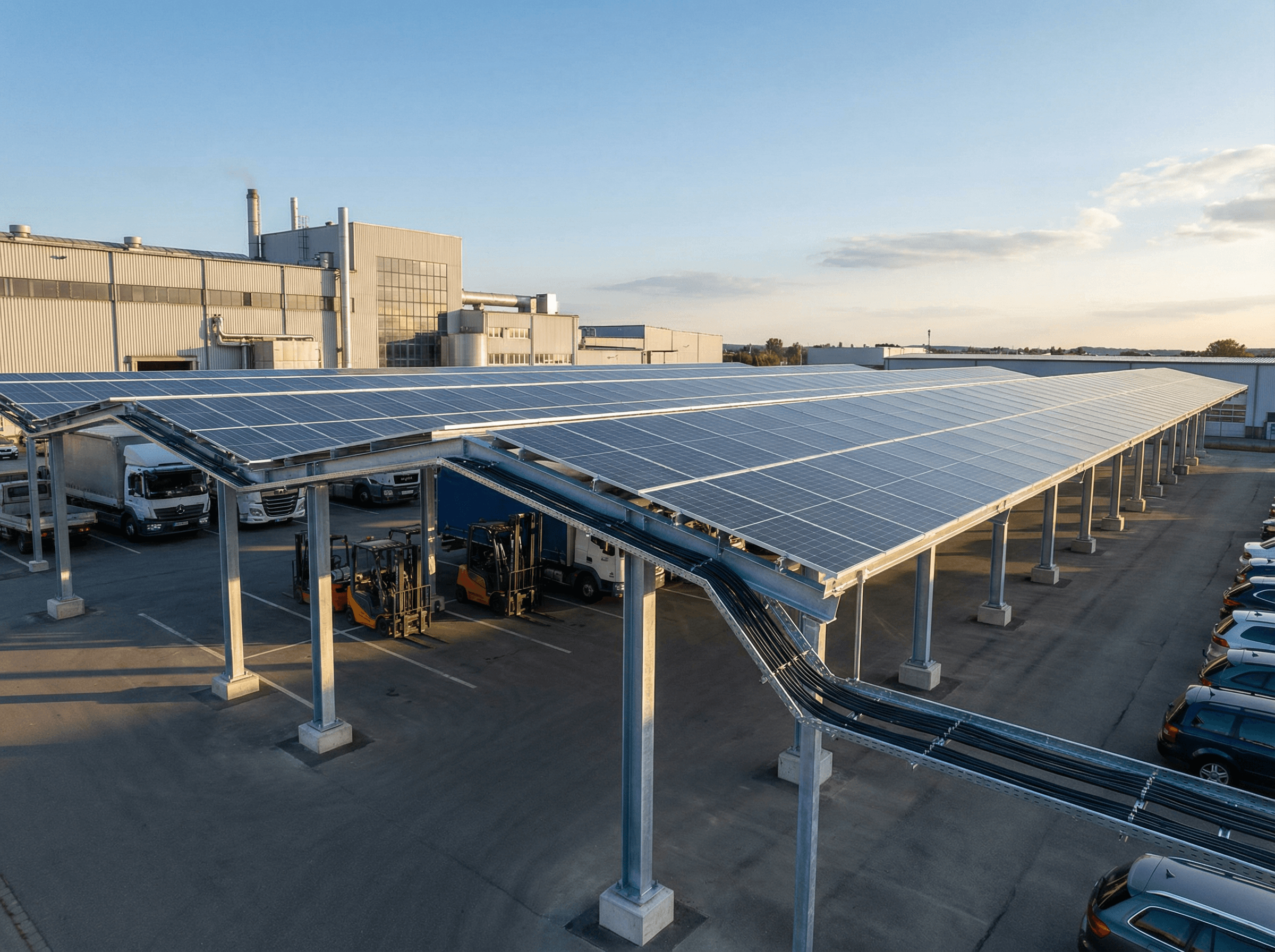
The 50kW Factory Solar Carport is a commercial solar-carport solution for industrial sites that combines 50 kWp of fixed-tilt solar generation, canopy coverage of vehicle parking, and EV-charging integration in a single package. Built on N-type TOPCon mono modules with a stated module efficiency of 24.5%, this system is engineered for factories that need to reduce daytime grid purchases, raise the utilization of 20–30 vehicle bays of parking, and add a durable structure with a 25-plus-year planned life. As B2B buyers compare options, this variant occupies a pragmatic mid-scale niche — offsetting a meaningful share of daytime load with a single system, while remaining simpler to permit and maintain than 100 kW+ rooftop or ground-mount plants.
Under typical industrial irradiance bands of 1,500–1,800 kWh/m²/year, a 50 kWp fixed-array carport usually produces approximately 75–90 MWh per year. This corresponds to a capacity factor of about 17.1%–20.5% depending on location, shading, and local temperature conditions. With commercial electricity tariffs in the typical range, annual electricity-bill savings commonly fall within a corresponding bracket, and annual CO₂ reductions reach 45–54 tons per year using grid emission factors around 0.60 tCO₂/MWh. According to NREL PVWatts and standard commercial performance-modeling practice, fixed-tilt systems remain attractive because they deliver strong generation consistency over 25–30 years while avoiding the moving-part maintenance burden of trackers [NREL].
In factories, electrical loads are typically concentrated between 08:00 and 18:00 — exactly when generation from a 50 kW system is at its strongest. The carport layout converts under-utilized parking surface into an energy asset, typically covering 320–420 m² of parking and array area while maintaining vehicle accessibility, drainage, and pedestrian circulation. Compared with a conventional steel parking canopy that produces 0 kWh per year, a solar carport adds on-site generation without consuming production floor space. Compared with diesel backup generation at higher effective delivered cost, solar electricity can reduce daytime electricity cost by 40%–80% depending on local tariffs and financing structure.
From an industrial procurement perspective, the value proposition is not just generation itself but infrastructure "stacking." A single 50 kWp carport can support employee parking, fleet shading, visitor parking, and future AC or DC EV charging points within a single civil package. EV readiness is particularly important, because many factories are electrifying 2–10 internal vehicles or forklift charging circuits within a 3- to 5-year planning horizon. The IEA has repeatedly emphasized that transport electrification and distributed solar are complementary trends in industrial decarbonization pathways, especially when daytime charging aligns with solar output [IEA].
The system uses N-type TOPCon modules, a commercial string-inverter architecture, a galvanized or coated steel carport frame, DC string wiring, AC collection, grounding, surge protection, and web-based monitoring. In a representative configuration using 700–725 W class modules, approximately 69–72 modules are required to reach 50 kWp; the final DC capacity is adjusted to local inverter loading ratios and site temperatures. In practice, a 70-module × 715 W = 50.05 kWp configuration is feasible, combined with either a 2 × 25 kW or a 1 × 50 kW three-phase string-inverter topology depending on redundancy preferences and maintenance strategy.
Fixed-tilt carport geometry is typically optimized in the 5°–15° range for drainage, structural wind loading, and inter-row shading control — not for absolute peak annual yield. This matters for factories: the design goal is often low lifecycle risk over 25 years rather than a marginal 2%–4% yield increase that may require more steel, larger spacing, and more complex drainage detailing. Module technology is the 210 mm N-type wafer passivated-contact architecture; bifacial gain potential of 10%–20% may be partially captured if pavement albedo and rear-side clearance are favorable, though conservative financial models typically assume a lower realized gain for carport applications [IRENA].
At the product level this variant is specified as 50 kWp capacity, mono-TOPCon module type, 24.5% module efficiency, fixed array configuration, and solar-carport application (EV charging = true). Estimated system area is approximately 340 m² assuming high-output modules, structural spacing, maintenance access, and drainage clearance. In standard commercial climates, estimated annual generation is 82.5 MWh per year with a modeled capacity factor of 18.8%. Estimated LCOE is around $0.032/kWh in high-solar regions and approximately $0.045/kWh in moderate regions. This aligns with the broader market trend in which best-in-class utility and commercial PV can achieve below $0.03/kWh during 2025–2026 [BloombergNEF; IRENA].
Module reliability is a core procurement criterion in industrial environments. The TOPCon platform is typically characterized by first-year degradation below 1.0%, annual degradation below 0.4%, and retained output around 87.4% at year 30 — superior to many older P-type module baselines. Modules must comply with IEC 61215 for design qualification and IEC 61730 for safety. Inverter anti-islanding and grid interconnection must comply with IEC 62116 and local grid-connection rules. For buyers supporting export-oriented manufacturing, equipment-conformity documentation at the component level is increasingly required for ESG reporting, making standard traceability essential [IEC; Wood Mackenzie].
In high-sun industrial corridors, a 50 kWp factory carport can produce approximately 225–250 kWh per day on an annual average basis. Peak clear-sky days frequently exceed 300 kWh/day, while monsoon or winter periods may dip below 100 kWh/day. If the factory self-consumes 85%–95% of output, the avoided grid purchases are the primary financial driver. At an electricity tariff of $0.12/kWh, annual savings on 82,500 kWh are meaningful, and savings rise further at a tariff of $0.16/kWh. Within typical EPC turnkey ranges, simple payback in strong self-consumption scenarios usually falls between 2.9 and 4.8 years.
Compared with a conventional steel-roof-only parking canopy, the solar carport converts the same footprint into a productive asset that delivers measurable energy output and carbon reductions. Compared with a grid-only supply approach, the system can reduce purchased daytime electricity by 10%–35% on a small factory office-plus-parking load block — depending on whether the overall site is 150 MWh/year or 800 MWh/year. Compared with diesel-generated daytime peak power, cost savings can exceed 60% over 10 years, while also avoiding local noise, fuel handling, and generator maintenance cycles (every 250–500 hours).
Factory carports must be designed against local wind speeds, rainfall intensity, vehicle circulation widths, and foundation conditions. Typical industrial carport spans are designed as 2-car, 3-car, or double-row parking modules, with clear heights frequently set in the 2.6–3.5 m range to accommodate vans and light commercial vehicles. The structural steel tonnage for a 50 kW carport is typically 6–12 tons depending on column spacing, cantilever geometry, and code loading. Corrosion protection — usually hot-dip galvanization or multi-layer coating systems — is specified for a 20–25-year service-life expectation in C3–C4 environments.
On the electrical side, string-inverter architecture remains the standard commercial choice below 500 kW because of finer MPPT granularity, lower downtime exposure, and easier service compared with central-inverter systems at this scale. A 50 kW system typically uses 1–2 three-phase string inverters with a DC/AC ratio of approximately 1.05–1.25 depending on local clipping economics and ambient temperature. AC infrastructure includes isolators, breakers, metering, grounding, surge protection devices, and — where required — export control. These details matter because poor BOS design can reduce effective yield by 1%–3% per year even with premium modules.
Commercial buyers increasingly demand remote diagnostics alongside generation data. The standard monitoring package for a 50 kW system tracks inverter status, daily generation, cumulative kWh, fault alarms, and in some cases irradiance or revenue estimates through a cloud portal accessible from desktop and mobile devices. This enables plant managers to confirm whether clear-day output is 240 kWh rather than 180 kWh, identify string mismatch, and schedule service before losses accumulate over 7–30 days. For multi-site manufacturers operating 5–50 locations, cloud monitoring also supports portfolio reporting and internal ESG dashboards.
Monitoring value is especially high when EV charging is integrated. If the site adds 2 × 22 kW AC chargers or a smaller managed charging cluster, operators can align charging windows with midday PV generation to reduce demand charges and maximize self-consumption. In practice, charging two fleet vehicles during the 11:00–15:00 solar peak can absorb 40–80 kWh/day that would otherwise be exported at lower tariffs. MAXLUMI buyers can configure carport geometry, inverter selection, and EV charging options through the online system configurator.
A metalworking factory in a high-irradiance industrial park installed a 1 × 50 kW solar carport over 24 employee parking spaces to offset office HVAC, compressed-air auxiliaries, and daytime EV charging for two service vehicles. The site used approximately 70 modules at the 715 W class, 2 × 25 kW string inverters, and a galvanized-steel canopy with a 10° tilt. In the first modeled year, generation reached 84 MWh, with self-consumption at 92%. Annual utility savings were calculated at approximately the equivalent of the local blended tariff applied to that generation (around $0.14/kWh).
The same factory considered a traditional metal-roof parking shade (approximately 55%–70% of the solar-carport steel-package cost) but it would have produced no electricity. Over 10 years, the solar carport delivered cumulative energy value well in excess of that delta before tariff escalation, while also improving worker comfort by reducing summer-afternoon cabin temperatures of parked vehicles. As manufacturers increasingly look for visible decarbonization assets they can audit, meter, and report under Scope 2 reduction programs, deployments like this are becoming increasingly common [IEA; IRENA].
Pricing available upon inquiry.
Industrial buyers should verify four categories before purchase: site dimensions, grid-interconnection rules, structural loading, and operational objectives. If the project prioritizes lowest CAPEX, the fixed-tilt carport architecture is typically the preferred configuration below 50 kW. If the project prioritizes ESG visibility and fleet electrification, adding conduits and switchgear capacity for 2–6 future EV chargers avoids costly retrofits later. MAXLUMI also recommends reviewing related technical guides — covering PV generation assumptions, inverter selection, and carport structural planning — in the topic library.
From a compliance perspective, the most relevant references are IEC 61215, IEC 61730, and IEC 62116, plus market-recognized safety frameworks such as UL 1703 for applicable module pathways. Performance assumptions can be cross-checked against NREL methodology, and market pricing and adoption trends are commonly benchmarked against IRENA, IEA, BloombergNEF, and Wood Mackenzie datasets. For buyers building an internal business case, these references reinforce assumptions of less than 0.4%/year degradation, more than 25 years of operating life, and the 2025–2026 transition toward TOPCon as the dominant module technology. Additional background can be reviewed in the topic library before final design freeze.
The 50 kW factory solar carport is best suited to factories, warehouses, industrial offices, logistics hubs, and export-processing facilities with 15–40 parking spaces and more than 60 MWh/year of daytime electricity demand. It is particularly useful when rooftop space is limited or rooftop reinforcement is expensive, or when a manager wants a visible decarbonization asset at the site entrance or in the employee parking area. For organizations needing a balance among CAPEX discipline, practical generation, and EV readiness, the 50 kWp format is often simpler to deploy than 100–250 kW class systems that require expanded switchgear, transformer reviews, and more complex civil works.
| System Capacity | 50 kWp |
|---|---|
| Module Type | Monocrystalline TOPCon |
| Module Efficiency | 24.5 % |
| Array Configuration | Fixed-Tilt |
| Application | Solar carport |
| EV Charging Integration | Yes |
| Estimated Annual Generation | 82.5 MWh |
| Capacity Factor | 18.8 % |
| System Area | 340 m² |
| CO₂ Offset | 49.5 tons/year |
| Payback Period | 2.9-4.8 years |
| LCOE | 0.032-0.045 USD/kWh |
| Warranty | 25yr panels, 10yr inverter |
Pricing available upon inquiry.
Custom design tailored to site conditions, capacity, and budget. Widewings' in-house EPC team consults directly.
Inquiry →