
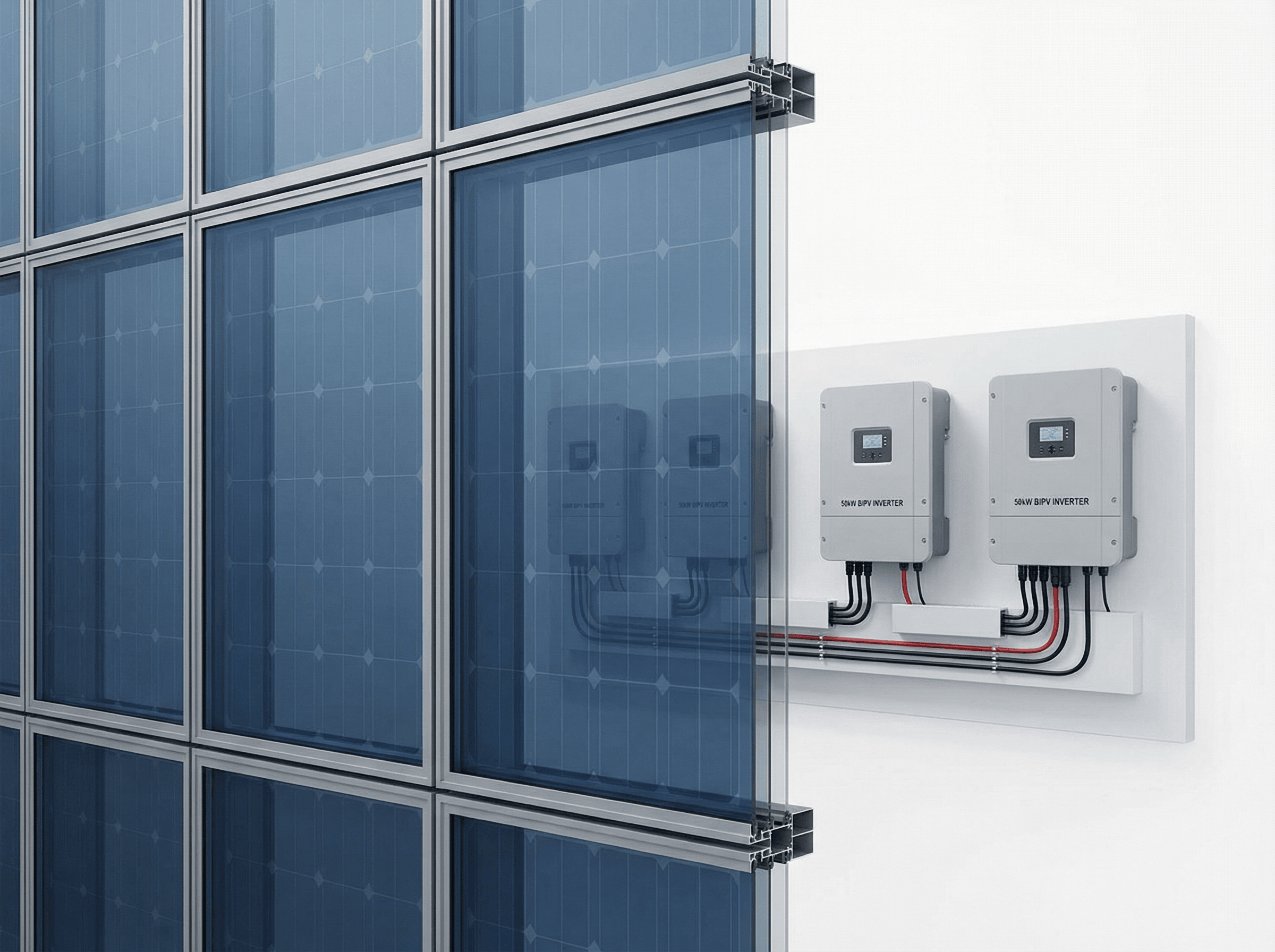
The MAXLUMI 50kW BIPV Building-Integrated Solar PV System is a 50 kWp commercial-grade solar solution engineered to integrate seamlessly into building façades, curtain walls, skylights, and canopy structures. The system uses semi-transparent glass-glass BIPV modules rated at 15% efficiency. Compliant with IEC 61215, IEC 61730, and UL 1703, the system generates approximately 52–65 MWh of electricity per year depending on site irradiance, with a low levelized cost of energy (LCOE) over its 25-year service life. By replacing conventional cladding while simultaneously generating clean electricity, this system delivers the dual-function value that makes BIPV unique in its category.
Building-Integrated Photovoltaics (BIPV) represents the convergence of architectural design and renewable energy engineering. Unlike traditional rooftop or ground-mount systems that add solar panels on top of existing building elements, BIPV modules act as the building envelope itself, functioning simultaneously as structural glazing, weather barrier, and power generator. The MAXLUMI 50kW BIPV System is designed on these principles, delivering 50 kWp of peak capacity across approximately 333 m² of vertical or near-vertical façade area.
The system uses semi-transparent glass-glass laminated modules with a nominal cell efficiency of 15% (module efficiency range: 12–18% depending on transparency specification). Each module encapsulates monocrystalline silicon cells between two layers of low-iron tempered safety glass using EVA or PVB interlayer film. This construction achieves adjustable light transmittance of 10–40%. The glass-glass architecture eliminates the traditional polymer backsheet, improving Class A fire resistance per ASTM E84 and extending outdoor durability beyond 30 years under IEC 61730 accelerated aging protocols.
The 50 kWp DC array is paired with a commercial-grade string inverter configuration (typically 2 × 25 kW or 1 × 50 kW three-phase unit) supporting up to 1,000 V DC input voltage and a European efficiency (Euro Eta) of ≥97.5%. The inverter complies with the anti-islanding requirements of IEC 62116 and supports the advanced grid functions of IEEE 1547-2018, including reactive power control (Q(U)), frequency-power response, and remote monitoring via RS485/Modbus or Ethernet/SunSpec protocols.
BIPV glass modules replace conventional curtain-wall glass panels, and the cost differential (per m²) effectively offsets a portion of the solar investment. Across a 333 m² façade, this material-substitution credit significantly improves system economics compared with a standalone solar installation. The semi-transparent glass-glass construction lets architects specify cell density and spacing to achieve the desired visual transparency (10–40% visible light transmittance) and is available in custom tints including neutral gray, bronze, and blue.
A property development company in Dubai, UAE integrated the MAXLUMI 50kW BIPV System into the south-facing curtain wall of a 12-story commercial office tower during a major renovation project. The 333 m² BIPV façade replaced aged single-pane glass panels on floors 4 through 9, with the BIPV modules specified to match the existing blue glass aesthetic. Under Dubai's high-irradiance conditions (global horizontal irradiance ~2,285 kWh/m²/year; south-facing vertical-plane irradiance ~1,650 kWh/m²/year), the system generated approximately 65 MWh in its first year of operation, offsetting 32.5 tons of CO₂ and reducing daytime peak electricity imports by 18%. By avoiding the cost of a conventional curtain-wall replacement, the net BIPV premium was reduced to less than the cost of a standard glass upgrade, and at the local electricity tariff of around $0.09/kWh, a simple payback period of under 9 years was achieved.
Compared with a conventional 50kW rooftop PV installation using standard framed TOPCon modules, a BIPV façade system reduces net energy-infrastructure cost by 30–60% when avoided cladding cost is credited against the system investment. The 52–65 MWh annual generation of the BIPV system is lower than the 65–80 MWh achievable from a rooftop array at optimal tilt, but the dual-function value of power generation plus building envelope makes BIPV an economically superior choice for buildings with substantial south-facing façade area or with upcoming cladding renovation requirements.
All modules are certified to IEC 61215 (crystalline silicon module design qualification), IEC 61730 (safety qualification), and UL 1703 (flat-plate photovoltaic modules and panels). Inverter systems comply with IEC 62116, VDE-AR-N 4105, and IEEE 1547-2018. CE marking has been obtained for European market deployment. These certifications ensure compatibility with building permits, insurance requirements, and green-building rating systems including LEED v4.1, BREEAM 2018, and DGNB.
| System Capacity | 50 kWp |
|---|---|
| Module Type | BIPV Semi-Transparent Glass-Glass |
| Module Efficiency | 15 % |
| Transparency Range | 10–40 % |
| Array Configuration | Vertical Facade / Curtain Wall |
| Estimated Annual Generation | 52–65 MWh/year |
| Capacity Factor (Façade) | 11.9–14.8 % |
| System Area | 333 m² |
| CO₂ Offset | 26–33 tons/year |
| Payback Period | 8–12 years |
| LCOE | 0.06–0.09 USD/kWh |
| Module Degradation Rate | ≤0.55 %/year |
| Max DC Input Voltage | 1000 V |
| Inverter Euro Efficiency | ≥97.5 % |
| Operating Temperature Range | −40 to +85 °C |
| Wind Load Resistance | 2400 Pa |
| Snow Load Resistance | 5400 Pa |
| Module Weight | 20–28 kg/m² |
| Fire Rating | Class A (ASTM E84) |
| Module Warranty | 25 years |
| Inverter Warranty | 10 years |
Pricing available upon inquiry.
Custom design tailored to site conditions, capacity, and budget. Widewings' in-house EPC team consults directly.
Inquiry →