
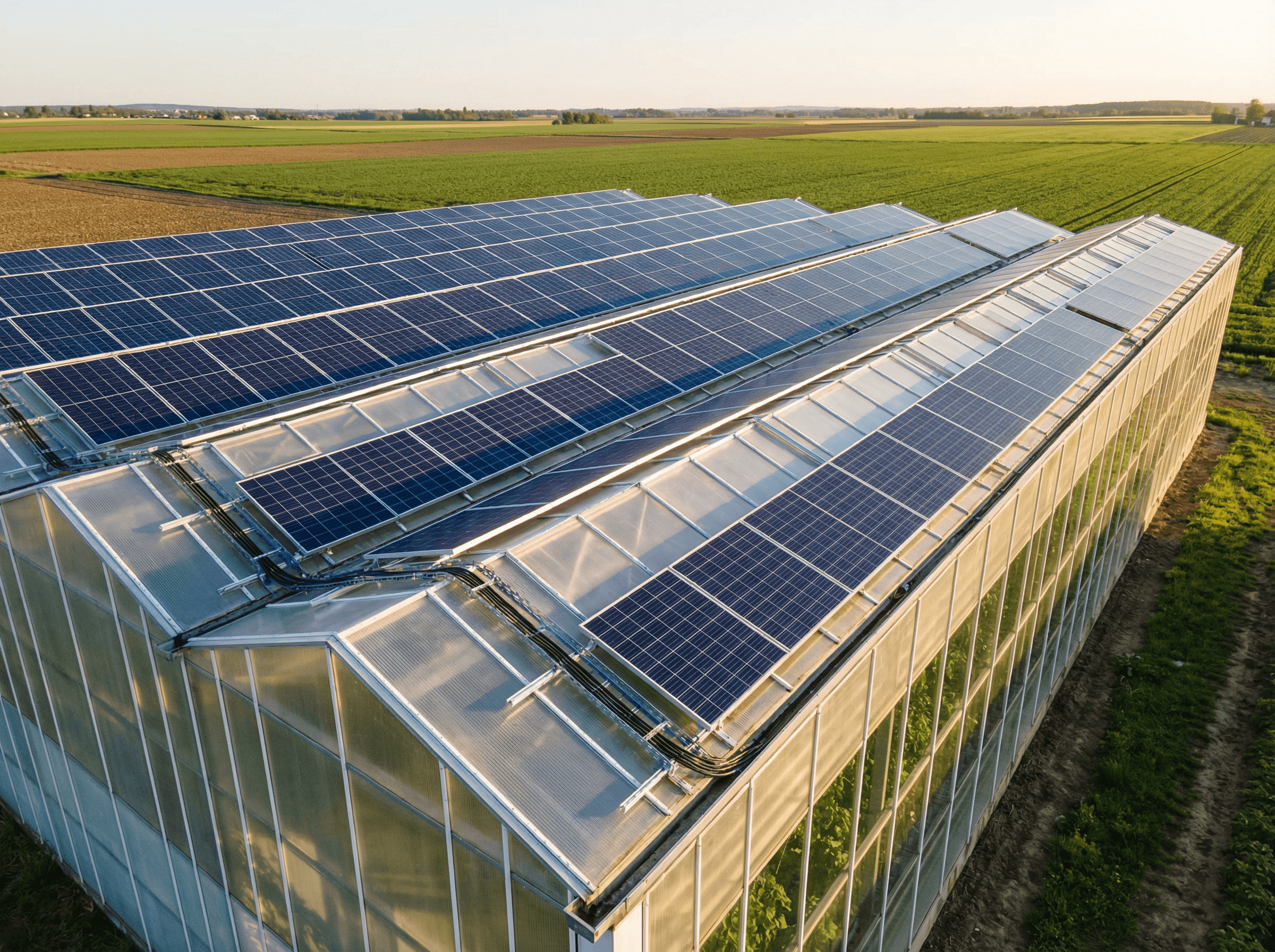
The 50kW Agricultural Greenhouse Rooftop Solar PV System is a commercial-scale fixed-array photovoltaic solution designed for greenhouse-roof installations, balancing crop light management, structural loading, and long-term energy production within a 50 kWp design envelope. The configuration uses bifacial modules built on TOPCon or HJT cell architecture, with a rated 22% module efficiency and an application-specific greenhouse integration approach supporting approximately 40% light transmittance into the greenhouse environment. Annual generation is targeted at 72–85 MWh depending on irradiance, roof geometry, and rear-side gain conditions. As B2B buyers evaluate both CAPEX and agrivoltaic productivity, this system is positioned within standard EPC turnkey ranges and offers 25-year coverage for panels and 10-year coverage for the inverter.
Compared with conventional greenhouse power supply — relying solely on grid purchases or on diesel-backed daytime loads — a 50 kW rooftop PV system can reduce daytime imported electricity by approximately 55%–80% for irrigation pumps, ventilation fans, fertigation controllers, and packhouse auxiliaries, depending on local load profile and net-metering policy. In regions with commercial tariffs of $0.10–$0.18/kWh, annual electricity-bill savings can reach a meaningful annual amount on generation of 72,000–85,000 kWh/year (before tariff escalation). According to IEA and IRENA market assessments for 2024–2025, solar PV remains the lowest-cost source of new-build electricity in many markets, while NREL field data continues to show that system design, thermal management, and shading analysis are critical for high-performance commercial arrays [IEA, IRENA, NREL].
Because this 50 kW system is specialized for greenhouse roofs rather than generic industrial roofs, the engineering scope typically considers three additional variables: (1) the crop's Photosynthetically Active Radiation (PAR) requirements, (2) greenhouse structural member spacing, and (3) localized humidity/corrosion exposure (e.g., fertilizers or moist air). In a standard deployment, the array typically occupies approximately 230–300 m² depending on module wattage and row spacing, paired with 1–2 three-phase string inverters in the 40–60 kW AC class. Because bifacial modules can capture rear-side irradiance, expected bifacial gain on greenhouse roofs with reflective surfaces or internal diffuse conditions is generally 10–20%, but real-world gain should be validated through site-specific modeling per NREL's recommended bankable engineering practice and commercial yield-simulation methodologies.
When procurement teams compare products, this model sits within MAXLUMI's broader portfolio of commercial PV systems, and buyers can browse all Solar PV System products to compare rooftop, ground-mount, and agrivoltaic variants. For projects in the 50–500 kW range, the most common architecture remains the string-inverter platform, because it has lower O&M complexity than central-inverter alternatives, faster replacement cycles, and more granular MPPT control. If the project includes variable greenhouse-roof zones, ventilation windows, or future battery integration, the system can be configured online to generate a custom bill of materials (BOM) and preliminary performance estimates.
At the module layer, the system uses bifacial PV modules with a 22% rated conversion efficiency, generally corresponding to the 600–700 W power class depending on final sourcing and frame dimensions. As a result, the 50 kWp design typically requires 72–84 modules; the final count is driven by selected wattage, string voltage window, and roof layout constraints. Modules are selected to comply with IEC 61215 for design qualification and IEC 61730 for safety. Projects requiring North American alignment may reference legacy UL 1703 pathways or current UL/NEC-compliant product documentation depending on jurisdiction. Inverters are selected to comply with IEC 62116 for anti-islanding requirements, and AC integration is engineered to local grid-interconnection rules, utility export limits, and grounding practices.
The fixed-tilt array format was selected because it offers the lowest mechanical complexity over the 25-plus-year operating period compared with tracker-based alternatives — particularly favorable for agricultural facilities where maintenance windows are often shorter than in industrial parks. A typical DC/AC ratio for this system is in the 1.05–1.20 range, balancing clipping control while strengthening morning and afternoon energy capture. Depending on latitude and roof orientation, annual specific yield can range from approximately 1,440 to 1,700 kWh/kWp, resulting in annual generation of 72–85 MWh. This corresponds to a capacity factor of approximately 16.4%–19.4%, consistent with fixed-tilt commercial PV in strong solar resource regions per NREL PVWatts and IRENA benchmark data.
A typical 50 kW greenhouse-rooftop system includes 72–84 bifacial modules, 1–2 string inverters, galvanized or aluminum mounting rails, DC isolators, UV-resistant solar cables, AC protection devices, earthing hardware, and a cloud-based monitoring gateway. The system architecture is typically organized into five electrical layers: module strings, DC collection, inverter conversion, AC distribution, and monitoring/control. In greenhouse projects, structural attachment detail is particularly important: roof members may be lighter than warehouse roofs, and attachment spacing must be validated against wind loads in the 0.5–1.0 kPa range as well as localized corrosion risk from fertilizers or moist air.
Because this is an agricultural application, design teams typically perform three parallel evaluations before final release: structural review, irradiance/shading simulation, and crop-light compatibility review. For example, if the greenhouse hosts high-value vegetables or seedlings requiring controlled Daily Light Integral (DLI), the PV layout may cover only specific roof zones rather than the entire envelope. The stated 40% light transmittance should be interpreted as an application parameter for the greenhouse's daylight-management objective, not as a claim that every PV module transmits 40% of visible light. The actual agrivoltaic balance depends on roof coverage ratio, spacing, and crop sensitivity, and buyers can reference the topic library for broader solar-agriculture design considerations.
Under typical solar resource conditions of 4.5–5.3 kWh/m²/day, this 50 kW system can produce approximately 72,000–85,000 kWh/year assuming a fixed-tilt configuration and modest bifacial gain. Rear-side contribution is generally lower on rooftop installations than on advanced ground-mount arrays, but greenhouses with reflective films, light-colored surfaces, or diffuse interior scattering can still deliver useful rear-side irradiance. Based on current bifacial market data, a realistic planning assumption is a 5–15% incremental yield over monofacial alternatives for many rooftop greenhouse cases, with gains rising toward 20% under premium reflective conditions. These assumptions align with industry observations cited by NREL and directional analyses from major market trackers such as BloombergNEF and Wood Mackenzie.
The agronomic value proposition is not only about electricity. In hot climates where internal greenhouse temperatures can exceed 35 °C during peak daytime hours, partial coverage by rooftop PV reduces direct solar heat ingress in selected zones, lowering fan runtime and helping stabilize internal temperatures by 1–3 °C depending on ventilation strategy. In some facilities this can reduce cooling-related electricity demand by approximately 8–18% while easing midday heat stress for certain crops. Compared with a conventional greenhouse roof without PV, this system can improve both energy self-consumption and environmental control, but crop-specific trials should always be reviewed before large-scale replication.
A horticulture operator in the MENA region installed a 50 kW bifacial rooftop PV system on a commercial greenhouse producing tomatoes and leafy greens. Annual site irradiance was approximately 2,000 kWh/m², and daytime agricultural loads were concentrated between 08:00 and 18:00. The deployed system used 78 modules and one 50 kW string inverter, delivering approximately 82 MWh/year in its first modeled year of operation. At a local electricity tariff of $0.14/kWh, annual savings were meaningful, and daytime grid dependence for irrigation, circulation fans, and nutrient-dosing equipment fell by nearly 68% during peak harvest months.
In that scenario, the operator compared rooftop PV with a diesel-based alternative for backup daytime operation. Including fuel, maintenance, and logistics, diesel-generated power often exceeds $0.22–$0.35/kWh — and the solar system reduced marginal daytime energy cost by more than 50%, while also reducing annual carbon emissions by approximately 43–51 tons CO₂e depending on local grid factor. This type of deployment is particularly attractive when the greenhouse already has predictable daytime loads and when the utility interconnection allows self-consumption with limited export.
Commercial greenhouse operators typically need visibility into energy production, inverter status, and fault alarms across a 24-hour window, often across multiple sites. This system supports cloud-based monitoring providing real-time power, daily yield, monthly generation, inverter event logs, and plant-level performance indicators. A standard monitoring package typically tracks at least 10 core metrics including DC voltage, DC current, AC output, inverter temperature, daily kWh, cumulative MWh, and alarm history. For multi-site agricultural groups, this digital layer supports performance benchmarking and preventive-maintenance scheduling.
Monitoring also improves O&M economics. Underperformance from string mismatch, connector heating, or shading changes can often be detected when generation deviates by more than 3–5% from modeled expectations. According to NREL operational studies and utility-scale best practices, data-driven maintenance can reduce avoidable energy losses by several percentage points over a 25-year system lifetime. Buyers planning phased deployment across multiple greenhouses can reference the topic library for system optimization guidance, or request a custom quote for site-specific SCADA and monitoring scope.
This system is specified against internationally recognized PV standards because agricultural buyers and project financiers increasingly require traceable compliance documentation. Modules align with IEC 61215 and IEC 61730, and inverter anti-islanding and grid-interconnection functions reference IEC 62116. Depending on destination market, additional conformity may include CE-related declarations, local grid-code settings, and fire- or structural-related documentation per Authority Having Jurisdiction (AHJ) requirements. For projects targeting 25-plus years of operation, documentation control over serial numbers, flash-test data, and commissioning records is a practical procurement requirement — not a marketing add-on.
From a reliability perspective, fixed-tilt rooftop systems have fewer moving parts than tracker-based systems, making them well suited to humid agricultural environments with daily washdown activity, nutrient/fertilizer storage areas, and intermittent dust exposure. Modern TOPCon modules have become mainstream, with approximately 60% market share during 2025–2026, and 700 W+ bifacial modules are increasingly common in utility and large commercial projects. Greenhouse roofs may use slightly different module form factors to fit roof geometry, but the market trend toward high output density, low degradation, and low LCOE remains favorable. In top solar regions, class-leading utility LCOE is reported below $0.03/kWh per IRENA, IEA, and BloombergNEF market analysis.
Pricing available upon inquiry.
Pricing available upon inquiry.
In the 2025–2026 procurement cycle, buyers are increasingly selecting bifacial TOPCon-based systems that combine mainstream module availability, excellent temperature behavior, and favorable supply-chain pricing. With TOPCon holding approximately 60% market share and high-output bifacial modules above 700 W now common, the 50 kW greenhouse-rooftop category benefits from mature sourcing rather than niche customization. At the same time, fixed-tilt architecture remains the default choice for agricultural roofs because it minimizes moving parts and supports a practical service life beyond 25 years through periodic inspection, washing, and inverter maintenance.
For developers, EPC contractors, and agricultural estates planning replication across multiple greenhouse blocks, this product offers a scalable template with bankable standards, measurable energy yield, and predictable capital-cost planning. It is well suited to vegetable, flower, seedling, hydroponic, and mixed-horticulture applications where daytime loads exceed 30–40 kWh/day and self-consumption can absorb a large share of PV output. To compare adjacent system sizes or hybrid designs, browse all Solar PV System products and request MAXLUMI engineering support, logistics planning, and project-specific compliance review.
Inline sources: NREL PVWatts and commercial PV performance guides; IEA electricity and renewable-energy market outlook; IRENA renewable cost benchmarks; IEC standards documentation; BloombergNEF solar market trend reporting; Wood Mackenzie PV supply chain and deployment analysis.
| System Capacity | 50 kWp |
|---|---|
| Module Type | Bifacial TOPCon or HJT |
| Module Efficiency | 22 % |
| Array Configuration | Fixed-tilt rooftop |
| Application | Agricultural greenhouse rooftop |
| Light Transmittance | 40 % |
| Estimated Annual Generation | 72-85 MWh |
| Capacity Factor | 16.4-19.4 % |
| System Area | 230-300 m² |
| CO₂ Offset | 43-51 tons/year |
| Payback Period | 2.3-4.4 years |
| LCOE | 0.022-0.034 USD/kWh |
| Warranty | 25yr panels, 10yr inverter |
Pricing available upon inquiry.
Custom design tailored to site conditions, capacity, and budget. Widewings' in-house EPC team consults directly.
Inquiry →