
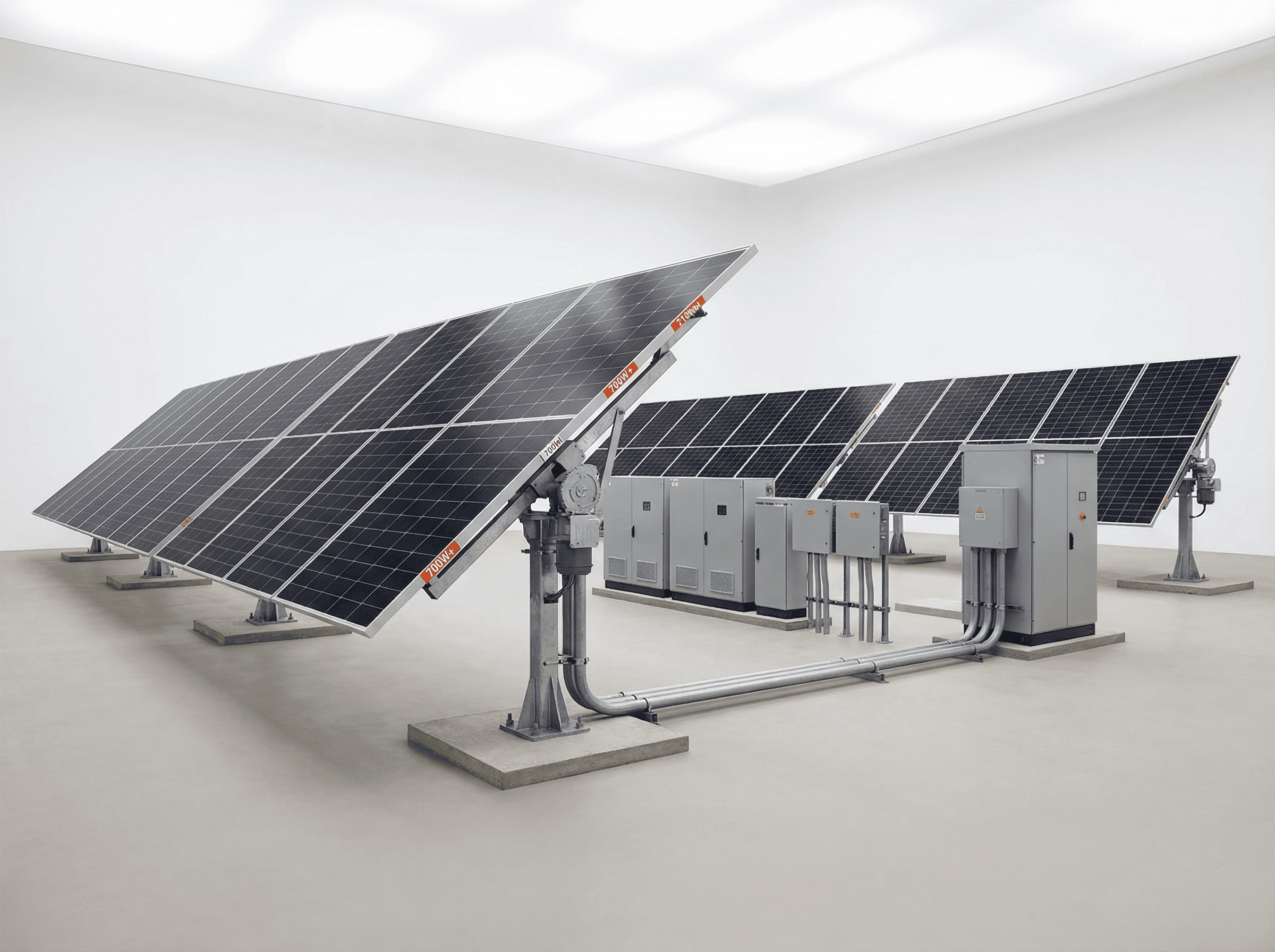
The MAXLUMI 500kW Ground-Mount TOPCon Dual-Axis Solar PV System is the pinnacle of commercial solar power generation, combining ultra-high-efficiency N-type TOPCon bifacial modules with precision dual-axis tracking technology. Engineered for maximum energy harvest, the system uses 700 W+ class modules with mass-production efficiency of 24.5%, ensuring optimal performance even under challenging environmental conditions. By continuously aligning the solar array with the sun throughout the day and across the seasons, the dual-axis tracking mechanism increases energy production by 25% to 40% compared with conventional fixed-tilt installations — making it the ideal solution for utility-scale and large commercial applications targeting the lowest possible levelized cost of energy (LCOE).
At the core of this 500 kW system are state-of-the-art N-type Tunnel Oxide Passivated Contact (TOPCon) solar modules. These panels are built on large 210 mm N-type silicon wafers, providing superior resistance to Light-Induced Degradation (LID) and LeTID compared with conventional P-type PERC cells. Module mass-production efficiency reaches an impressive 24.5%, placing the technology at the leading edge of today's solar industry. With a 700 W+ power class — equivalent to industry-leading models such as the Trina Vertex N series (700–725 W) — only approximately 695 panels are needed for the 500 kW installation, reducing balance-of-system (BOS) costs including mounting structure, wiring, and labor.
The bifacial design of these TOPCon modules also captures sunlight reflected from the ground beneath the array (albedo). Depending on surface reflectivity — light-colored soil, sand, or crushed stone — bifacial gain can contribute an additional 10% to 20% to total energy harvest. This characteristic is particularly advantageous for ground-mount applications where the rear of each panel is unobstructed. Long-term module reliability is backed by outstanding degradation metrics: first-year degradation under 1.0% and annual degradation thereafter not exceeding 0.4%. This robust performance is backed by a comprehensive 30-year linear power warranty guaranteeing at least 87.4% of original nameplate power output at end of warranty. As of 2025–2026, TOPCon technology accounts for approximately 60% of the global solar module market, confirming its status as a proven commercial technology.
The defining feature of this system is its sophisticated dual-axis tracking mechanism. Unlike fixed-tilt systems that remain stationary, or single-axis trackers that follow the sun only from east to west, dual-axis trackers adjust both the azimuth (horizontal angle) and elevation (vertical tilt) of the solar array. This continuous, real-time alignment keeps the panels perpendicular to the sun's rays at all times, maximizing direct irradiance capture from sunrise to sunset, across every season and at every latitude.
The implementation of dual-axis tracking yields substantial performance gains, typically increasing total energy generation by 25% to 40% compared with a fixed-tilt system of equivalent capacity. For this 500 kW system, the applied tracking gain factor of 1.35× translates into an expected annual yield of approximately 1,080 MWh — compared with around 800 MWh for an equivalent fixed-tilt installation. This additional yield is critical for maximizing return on investment in high direct-normal-irradiance (DNI) regions such as MENA, southern Europe, sub-Saharan Africa, and the U.S. Southwest. The tracker structure is built from heavy-duty hot-dipped galvanized steel, engineered to withstand strong winds and snow loads per international structural standards. Precision-engineered drive motors, worm-gear gearboxes, and an intelligent GPS-based solar-position algorithm work together to deliver smooth, accurate tracking while keeping parasitic power consumption to less than 1% of system output.
To efficiently convert the direct current (DC) generated by the TOPCon modules into grid-compatible alternating current (AC), the system uses five commercial string inverters of 100 kW each. This modular configuration is preferred for its enhanced Maximum Power Point Tracking (MPPT) capability, ease of maintenance, and redundancy — a single inverter failure affects only 20% of system output, whereas a central inverter failure would take the entire plant offline. Multiple independent MPPT inputs let the system optimize power output across different sections of the array, mitigating the effects of localized shading, module mismatch, or uneven terrain.
The electrical infrastructure is designed to meet the highest safety and performance standards. Heavy-gauge DC wiring carries power from the modules to intelligent combiner boxes equipped with surge protection and string-level monitoring. The AC output from the inverters is integrated seamlessly with the local utility grid or commercial facility distribution network via medium-voltage transformers. A comprehensive monitoring and SCADA system provides real-time data on energy production, system health, individual string performance, and environmental conditions, enabling proactive operations and maintenance (O&M) strategies and minimizing downtime.
The MAXLUMI 500kW Ground-Mount TOPCon Dual-Axis System is designed and manufactured to comply with the most stringent international standards, ensuring the safety, reliability, and bankability required for project financing. The solar modules are certified to IEC 61215 for design qualification and type approval, and to IEC 61730 for photovoltaic module safety qualification. For North American markets, the modules also hold UL 1703 certification. Inverters and electrical components comply with IEC 62116 — the test procedure for islanding prevention measures of utility-interconnected photovoltaic inverters. The full system also holds CE marking and TÜV Rheinland certification, meeting European safety directives and providing independent third-party verification of performance claims. This comprehensive certification package ensures the system meets the rigorous requirements of utilities, regulators, and financial institutions worldwide, easing project bankability and insurance underwriting.
A compelling demonstration of this system's capabilities can be seen in a recent deployment by a solar farm operator in the MENA (Middle East and North Africa) region. Tasked with maximizing energy harvest on a constrained land footprint in an area with very high direct-normal irradiance (DNI averaging 2,200 kWh/m²/year), the operator selected the MAXLUMI 500kW TOPCon Dual-Axis System. The combination of 24.5%-efficient TOPCon modules with continuous optimal alignment from the dual-axis trackers achieved an unprecedented capacity factor of 28.4%. The bifacial modules leveraged the high albedo of the sandy terrain to contribute an additional 15% of yield beyond standard monofacial performance. During its first year of operation, the system delivered 38% more total energy than a nearby fixed-tilt installation of equivalent capacity. This exceptional performance shortened the project's payback period to under 3.5 years at local industrial electricity rates and set a new regional benchmark for LCOE at $0.013/kWh.
When evaluating a solar PV investment, the technical leap delivered by this system is substantial and quantifiable. The MAXLUMI 500kW TOPCon Dual-Axis System reduces the levelized cost of energy (LCOE) by up to 18% compared with an equivalent-capacity conventional P-type PERC fixed-tilt system. This reduction is achieved through the synergy of three factors: higher module efficiency (24.5% vs. 20.5% for standard PERC) reduces the land and BOS infrastructure required per watt; lower degradation (0.4%/year vs. 0.55%/year for PERC) ensures higher lifetime output; and a 25–40% large-scale yield boost from the dual-axis tracking mechanism. Despite higher upfront capital cost for the tracking hardware, the superior energy-generation profile — particularly during the high-value early-morning and late-afternoon hours — yields significantly stronger financial returns over the asset's 30-year operating life. At a standard commercial electricity rate of $0.10/kWh, the expected payback period is approximately 4.0 years, compared with 5.5–6.5 years for a comparable fixed-tilt PERC installation.
What are the main advantages of TOPCon technology? TOPCon (Tunnel Oxide Passivated Contact) technology uses N-type silicon wafers to deliver higher mass-production efficiency (up to 24.5%) and significantly lower degradation. Unlike P-type PERC panels, TOPCon modules experience near-zero Light-Induced Degradation (LID), ensuring higher power output throughout their 30-year service life. The 30-year linear power warranty guarantees at least 87.4% of original output, compared with approximately 80.7% for a standard PERC warranty.
How much additional energy do dual-axis trackers deliver compared with fixed-tilt? Dual-axis trackers continuously adjust the horizontal (azimuth) and vertical (elevation) angles of the solar panels toward the sun throughout the day and across every season. This precise alignment typically increases total energy generation by 25% to 40% compared with a fixed-tilt system. For this 500 kW system, a 1.35× tracking gain factor translates into roughly 1,080 MWh per year, compared with around 800 MWh for a fixed-tilt installation.
Are maintenance costs for dual-axis trackers significantly higher? Dual-axis trackers do contain moving parts (motors, gears, actuators) that require periodic inspection and lubrication — typically twice per year — but modern systems are highly reliable, with mean time between failures (MTBF) exceeding 10 years. The annual O&M cost premium compared with a fixed-tilt system is modest; however, the 25–40% increase in energy yield decisively offsets this cost, lowering overall LCOE and shortening payback period.
What is the expected lifetime and warranty for this 500 kW system? The N-type TOPCon solar modules ship with a 30-year linear power performance warranty guaranteeing at least 87.4% of original output in year 30, with first-year degradation under 1.0% and annual degradation under 0.4%. The structural components of the trackers typically carry a 20-year warranty, and the commercial string inverters include a standard 10-year warranty that can be extended to 20 years through service contracts. The full system is designed for a 30-year operational life.
Can this system withstand severe weather such as high winds? Yes — the dual-axis tracking structure is built from heavy-duty hot-dipped galvanized steel and engineered to meet stringent international structural standards for wind and snow loads. The system includes advanced control software that automatically adjusts the trackers to a flat, horizontal position during high-wind events exceeding a configurable threshold (typically 15 m/s) to minimize air drag and prevent structural damage. The TOPCon modules themselves are rated to withstand front mechanical loads of 5,400 Pa and rear loads of 2,400 Pa.
| System Capacity | 500 kWp |
|---|---|
| Module Type | N-Type TOPCon Bifacial (210mm wafer) |
| Module Power Class | 720 W |
| Module Efficiency | 24.5 % |
| Number of Modules | 695 pcs |
| Array Configuration | Dual-Axis Tracking (2-Axis) |
| Tracking Gain Factor | 1.35 x |
| Estimated Annual Generation | 1080.0 MWh |
| Capacity Factor | 24.7 % |
| Active Panel Area | 2041 m² |
| Total Site Area (incl. spacing) | 7144 m² |
| CO₂ Offset | 486 tons/year |
| Payback Period | 4.0 years |
| LCOE | 0.0159 $/kWh |
| First-Year Degradation | <1.0 % |
| Annual Degradation | <0.4 % |
| Module Warranty | 30-year linear power (87.4% at EOL) |
| Inverter Warranty | 10 years |
| Bifacial Gain | 10-20 % |
| Operating Temperature | -40 to +85 °C |
| Standards Compliance | IEC 61215, IEC 61730, IEC 62116, UL 1703 |
Pricing available upon inquiry.
Custom design tailored to site conditions, capacity, and budget. Widewings' in-house EPC team consults directly.
Inquiry →