
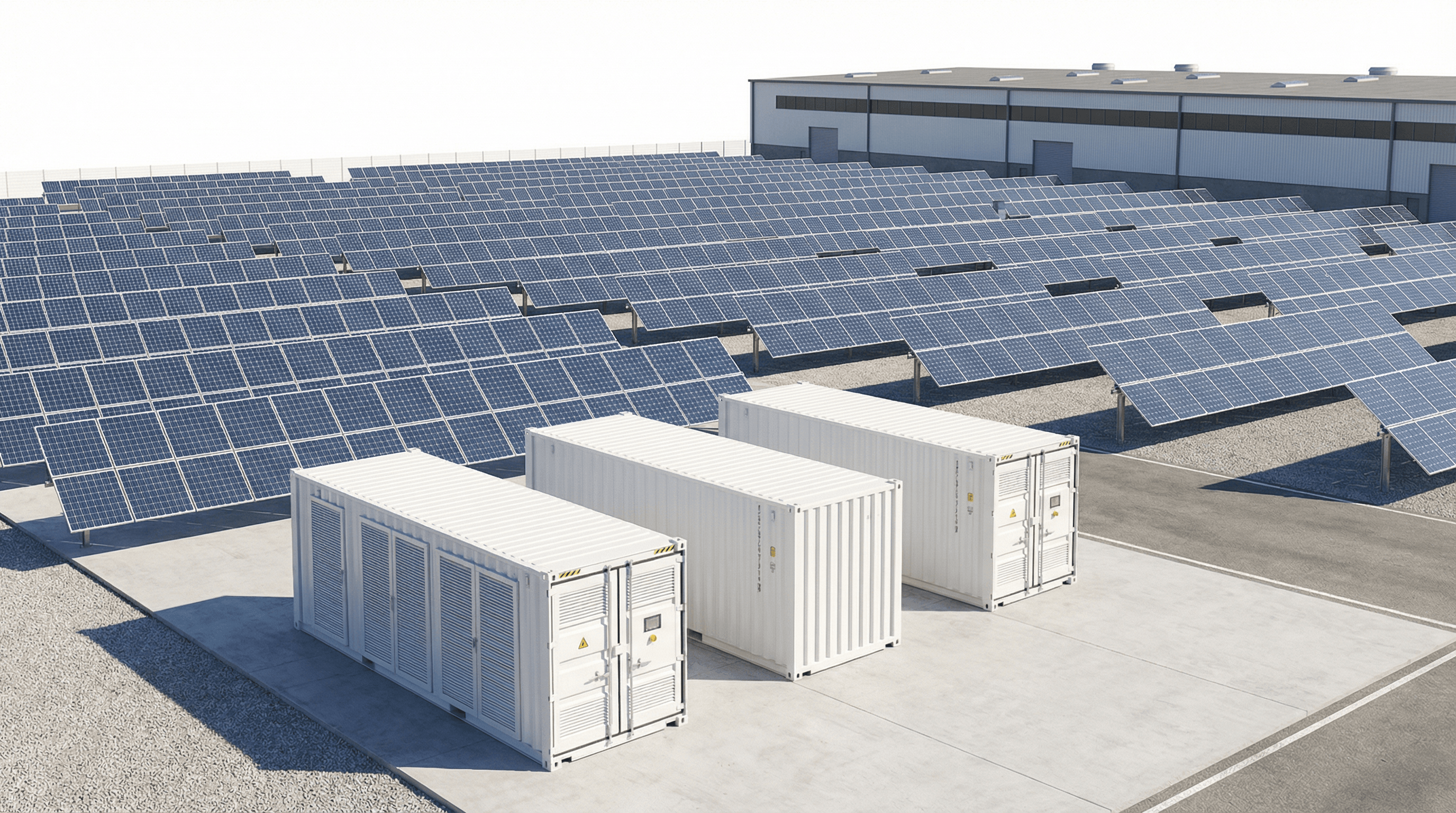
The MAXLUMI 500kW + 1MWh Industrial Hybrid System represents the pinnacle of distributed power generation and energy management for commercial and industrial (C&I) applications. This fully integrated solution combines a high-performance 500 kWp photovoltaic (PV) array with a 1 MWh Lithium Iron Phosphate (LFP) Battery Energy Storage System (BESS). Engineered for reliability, efficiency, and long-term financial returns, the system enables enterprises to achieve energy independence, reduce operating costs, and meet aggressive sustainability targets. By generating clean electricity on-site and storing it strategically, the system mitigates exposure to volatile grid prices and improves power quality to ensure operational continuity. The system complies with stringent international standards including IEC 61215 for module performance and IEC 62116 for inverter grid interaction, ensuring a robust, bankable asset for any industrial portfolio.
At the core of the system's generation capacity is a 500 kWp solar array built from next-generation N-type TOPCon (Tunnel Oxide Passivated Contact) bifacial modules. Each module is rated above 700 W and delivers exceptional front-side efficiency above 22.5%. The key innovation lies in the bifacial design, which captures sunlight reflected from the ground (albedo) on the rear of the panel. When deployed over high-albedo surfaces such as white gravel (albedo > 0.7), this technology can increase annual energy yield by an additional 10–30% compared with conventional monofacial panels. Certified to IEC 61730 safety standards, this rear-side gain converts previously wasted light into valuable electricity, dramatically improving the levelized cost of energy (LCOE).
To maximize this bifacial advantage, the array is mounted on a sophisticated single-axis horizontal tracking system. These trackers follow the sun's trajectory from east to west throughout the day, increasing direct sunlight exposure and boosting energy generation by 15–25% compared with fixed-tilt systems. Modules are mounted more than one meter above the ground to optimize rear-side irradiance and minimize soiling losses. The entire mechanical structure is engineered to withstand wind loads of up to 120 km/h, ensuring operational resilience across diverse climates.
Power conversion is managed by a state-of-the-art 500 kW central inverter featuring high efficiency (98.5%), robust thermal management, and advanced grid-support functions in compliance with IEEE 1547. This single unit simplifies system architecture, reduces potential points of failure, and streamlines maintenance compared with multiple string inverters. A wide MPPT (Maximum Power Point Tracking) voltage range ensures optimal power harvest across varying irradiance conditions from dawn to dusk.
Complementing the PV array, the 1 MWh Battery Energy Storage System (BESS) uses Lithium Iron Phosphate (LFP) chemistry. LFP is the industry standard for stationary storage thanks to its excellent thermal stability, long cycle life (more than 6,000 cycles at 80% depth of discharge), and superior safety profile. This chemistry eliminates the thermal-runaway risks associated with other lithium-ion chemistries. The BESS is housed in modular climate-controlled containers to ensure optimal performance and long service life, with a design lifetime exceeding 15 years.
The 1 MWh capacity delivers approximately 2 hours of power discharge from the 500 kW inverter. This enables a powerful suite of energy management applications, including:
An intelligent Energy Management System (EMS) orchestrates interactions between the PV array, BESS, and facility loads, using predictive algorithms and real-time data to optimize for the lowest possible energy cost or for maximum self-consumption.
The MAXLUMI 500kW + 1MWh System is engineered for outstanding economic returns. At locations with average solar irradiance (e.g., 4.5 kWh/m²/day), the system is expected to generate approximately 965 MWh of electricity per year. This represents a high capacity factor of 22%, thanks to the combined benefits of bifacial modules and single-axis tracking. This level of generation offsets 685 tons of CO₂ emissions per year, contributing significantly to corporate ESG (Environmental, Social, and Governance) targets.
Total system area is approximately 2,500 square meters, including spacing between trackers and the BESS container. The system's levelized cost of energy (LCOE) can be driven down to $0.04/kWh over its 25-year service life — highly competitive with grid electricity in many regions. With a typical payback period of 5 to 7 years, the system is a secure, long-term investment that hedges against future electricity-tariff inflation. The system is backed by a comprehensive warranty package including a 25-year linear power performance warranty on the solar modules and 10-year warranties on the inverter and BESS.
1. What total land area is required for the 500kW system? The complete system — the solar array on single-axis trackers plus the 1 MWh battery storage container — requires approximately 2,500 square meters (about 0.62 acres). This area allows optimal spacing between tracker rows to prevent row-to-row shading and provides ample room for maintenance-vehicle access. The layout can be customized to the topography and constraints of the specific site.
2. How does bifacial technology work and what are the real-world gains? Bifacial modules have a transparent backside that captures sunlight reflected from the ground (albedo). Our system uses high-albedo surfaces such as white gravel to maximize this effect. While theoretical gains of up to 30% are possible, conservative real-world annual yield increases of 12–18% are typical for this configuration — significantly boosting overall project energy production and financial returns compared with standard monofacial panels.
3. What kind of maintenance does this system require? Maintenance requirements are minimal. They include semi-annual inspections of electrical connections and the tracker mechanism, plus periodic cleaning of the solar modules. Cleaning frequency depends on local soiling conditions (e.g., dust, pollen). The Energy Management System provides remote monitoring of all components and automatically flags performance deviations, enabling proactive service that ensures maximum uptime and operational efficiency.
4. Can the system operate during a grid outage? Yes, the system is engineered for resilient operation. In the event of a grid outage, the hybrid system can automatically disconnect from the grid (an islanding process) to form a stable, self-sufficient microgrid. The 1 MWh battery provides backup power for a duration that depends on load size — for example, approximately 2 hours at a 500 kW load — preventing costly production interruptions.
5. What are the main financial benefits of this hybrid system? The main benefits are threefold: a substantial reduction in the monthly electricity bill through solar self-consumption, the avoidance of expensive peak-demand charges via stored battery energy (peak shaving), and protection against 25-plus years of volatile energy-price inflation. In some markets, selling stored energy back to the grid or participating in grid-services programs can create additional revenue streams that further accelerate the return on investment.
| System Capacity | 500 kWp |
|---|---|
| Module Type | Bifacial TOPCon N-type |
| Module Power Rating | 700 W |
| Module Efficiency (Front) | 22.5 % |
| Bifacial Gain (Rear) | 10-30 % |
| Number of Modules | 715 pcs |
| Array Configuration | Single-Axis Horizontal Tracker |
| Inverter Type | Central Inverter |
| Inverter Capacity | 500 kW |
| Inverter Efficiency | 98.5 % |
| Battery Storage Capacity | 1000 kWh |
| Battery Type | Lithium Iron Phosphate (LFP) |
| Battery Cycle Life | 6000+ cycles |
| Battery Design Lifetime | 15 years |
| Estimated Annual Generation | 965 MWh |
| Capacity Factor | 22 % |
| System Area | 2500 m² |
| CO₂ Offset (Annual) | 685 tons |
| Payback Period | 5-7 years |
| Levelized Cost of Energy (LCOE) | 0.04 $/kWh |
| Module Warranty | 25 years |
| Inverter Warranty | 10 years |
| Battery Warranty | 10 years |
| Wind Load Resistance | 120 km/h |
| Operating Temperature Range | -40 to +85 °C |
Pricing available upon inquiry.
Custom design tailored to site conditions, capacity, and budget. Widewings' in-house EPC team consults directly.
Inquiry →