
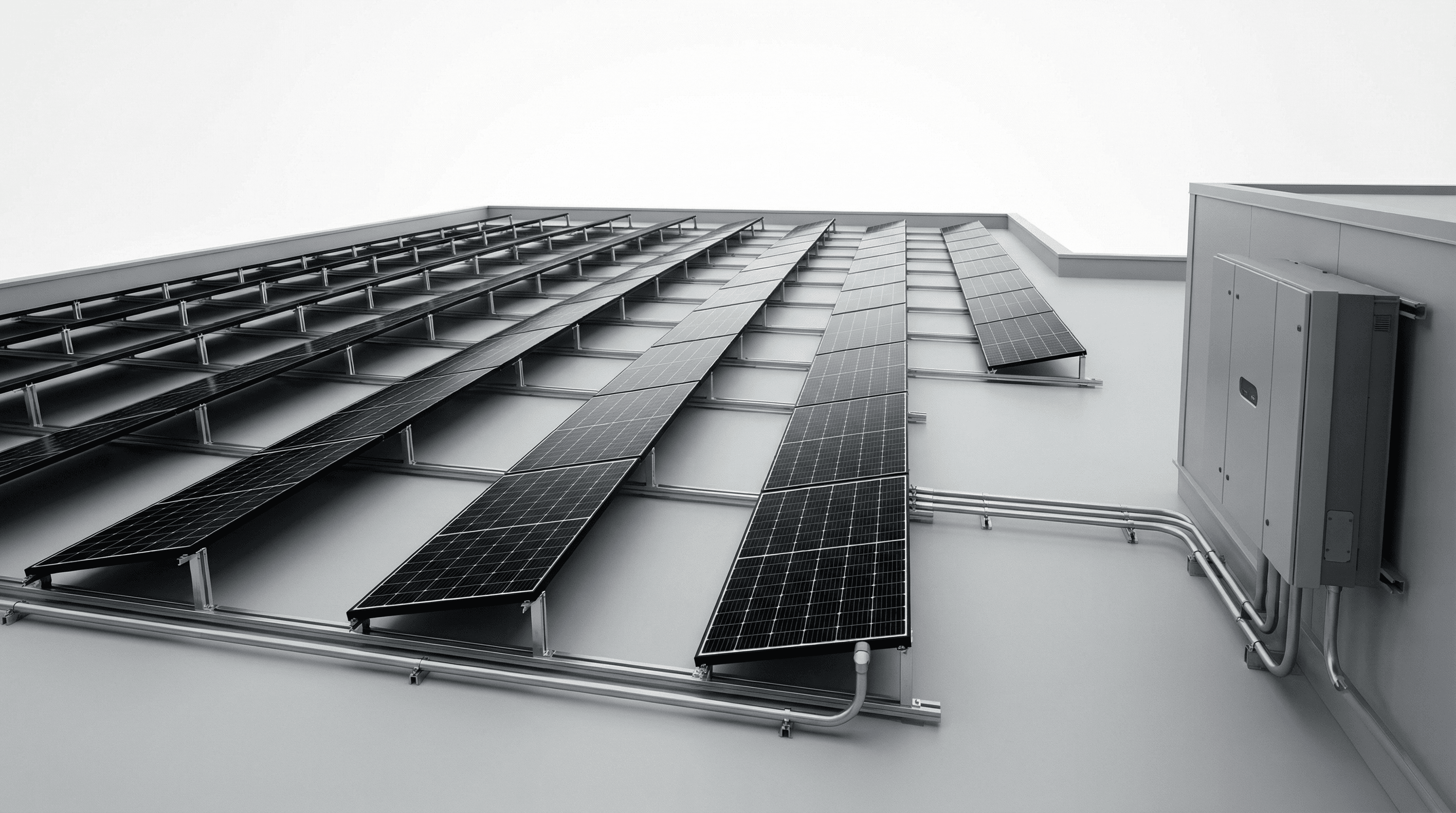
The MAXLUMI 30 kW Rooftop Mono-PERC Fixed-Tilt System delivers a rugged, dependable solution for commercial and industrial (C&I) customers who want to cut operating costs, achieve energy independence, and meet corporate sustainability goals. Engineered for rooftop applications, this 30-kilowatt system uses mature, widely deployed monocrystalline Passivated Emitter and Rear Cell (Mono-PERC) technology to deliver an optimal balance of performance, cost, and long-term durability. It is the right fit for small and mid-sized enterprises — including manufacturing facilities, warehouses, office buildings, and retail centers — that need a reliable, low-maintenance generation asset with predictable financial returns. The system is designed for a 25-year service life and complies with stringent international safety and performance standards such as IEC 61215 and UL 1703, ensuring it functions as a secure, bankable asset on any commercial balance sheet.
At the heart of the MAXLUMI 30 kW system is an array of high-performance Mono-PERC solar modules. The system uses modules in the 550–580 W power class, which has become the industry standard for commercial projects thanks to its optimal blend of power density and manufacturing scale. These modules deliver a nominal efficiency of around 21%, which is exactly why PERC has been the dominant cell architecture across the solar industry for the past decade. The technology adds a dielectric passivation layer to the rear of the cell that improves light capture by reflecting photons that would otherwise pass through, giving each cell a second chance to generate current. This process is especially effective at capturing long-wavelength light (red and near-infrared), improving performance in low-light conditions such as dawn, dusk, and overcast days. Each module is built on 182 mm (M10) silicon wafers and incorporates half-cut cell technology. By dividing standard solar cells in half, the current flowing through each cell is halved, reducing resistive (I²R) losses by a factor of four. This fundamental improvement typically increases module power output by 5 to 10 watts compared with full-cell designs.
The performance of a solar PV system is determined not only by its modules but also by the integrity of its supporting structure. The MAXLUMI 30 kW system uses a carefully selected set of components to ensure structural stability, electrical efficiency, and operational safety. The array is installed on a fixed-tilt structure, the most cost-effective and reliable mounting solution for rooftop applications. Designed with a 15-degree tilt, the system strikes a strong balance between maximizing annual energy yield and minimizing wind loading on the building's roof. Built from anodized aluminum and stainless steel, the mounting system is engineered to withstand UV radiation, moisture, and temperature swings for decades. The non-penetrating design typically uses ballast blocks to secure the array, preserving the integrity of the roof membrane — a critical consideration for building owners. With no moving parts, the fixed-tilt configuration eliminates maintenance overhead and ensures more than 25 years of service life with minimal oversight.
Power conversion is handled by a commercial-grade string inverter that converts the direct current (DC) produced by the solar panels into alternating current (AC) compatible with the building's electrical system and the utility grid. For a 30 kW system, a three-phase string inverter is the standard choice, offering high conversion efficiency (typically >98%), multiple maximum power point trackers (MPPTs) to optimize energy harvest across different roof faces or orientations, and integrated safety features. The inverter complies with IEC 62116 and IEEE 1547, which mandate anti-islanding protection and grid interconnection requirements so the system operates safely and does not put utility line workers at risk during a power outage. The remaining balance-of-system (BOS) components — UV-resistant DC cables, combiner boxes with overcurrent protection, and AC switchgear — are all specified to minimize electrical losses and ensure safe, code-compliant operation.
The MAXLUMI 30 kW system is designed to deliver substantial, predictable returns over its service life. Based on standard industry modeling tools such as NREL's PVWatts calculator, the system is expected to produce approximately 42 megawatt-hours (MWh) of clean electricity per year, assuming an average solar resource. This level of generation corresponds to a capacity factor of about 16.0%, typical for a fixed-tilt commercial PV system in a temperate climate. The total rooftop area required for installation is approximately 210 square meters, accounting for the modules plus the spacing needed for maintenance access and inter-row shading avoidance. The environmental impact is significant: the system offsets approximately 29.7 metric tons of CO₂ emissions every year (based on the U.S. EPA's average grid emission factor of 0.707 tCO₂/MWh). Financially, the system delivers attractive returns. With a levelized cost of energy (LCOE) projected at $0.04–$0.06 per kWh over 25 years — substantially below retail electricity rates in most commercial markets — a typical payback period of 5 to 8 years is achievable depending on local electricity rates and available incentives.
| System Capacity | 30 kWp |
|---|---|
| Module Type | Monocrystalline PERC |
| Module Power Rating | 550–580 W |
| Module Efficiency | 21.0 % |
| Array Configuration | Fixed-Tilt |
| Tilt Angle | 15 degrees |
| Estimated Annual Generation | 42 MWh |
| Capacity Factor | 16.0 % |
| Required System Area | 210 m² |
| CO₂ Offset (Annual) | 29.7 tons |
| Payback Period | 5–8 years |
| Levelized Cost of Energy (LCOE) | 0.04–0.06 $/kWh |
| Module Warranty (Product) | 12 years |
| Module Warranty (Performance) | 25 years |
| Inverter Warranty | 10 years |
| System Design Lifetime | 25+ years |
Pricing available upon inquiry.
Custom design tailored to site conditions, capacity, and budget. Widewings' in-house EPC team consults directly.
Inquiry →