
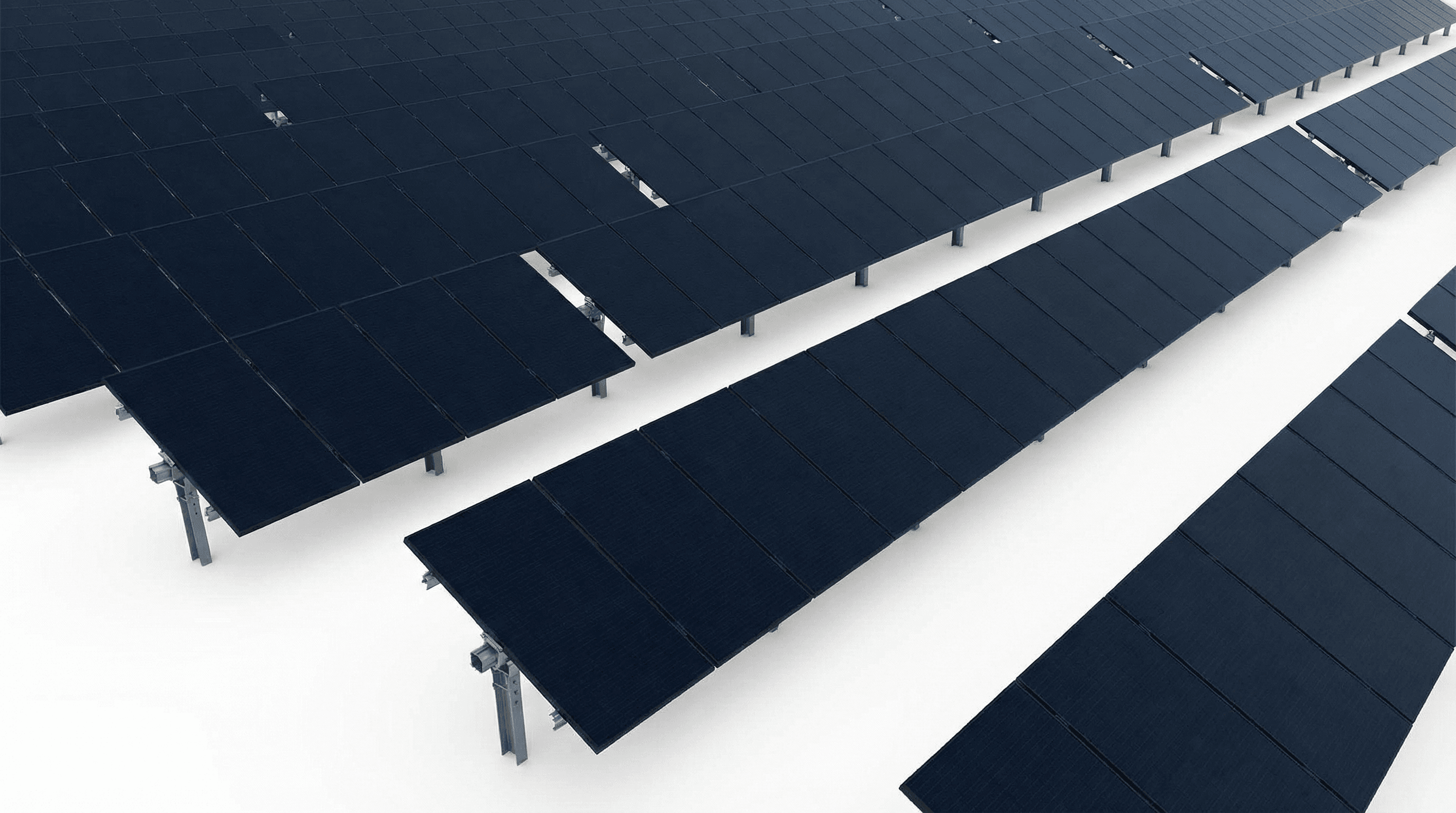
The MAXLUMI 2MW Solar Farm represents the pinnacle of utility-scale renewable energy production, engineered for long-term performance and economic returns. This turnkey solution is built on high-performance Cadmium Telluride (CdTe) thin-film solar modules mounted on a rugged fixed-tilt support system. With a rated output capacity of 2,000 kW (2 MWp), it is designed to meet the demands of Independent Power Producers (IPPs), utilities, and large industrial consumers. The system delivers an annual generation of approximately 3,100 MWh — enough to power more than 280 typical U.S. homes for a year — while offsetting roughly 2,180 metric tons of CO₂ per year. The design leverages the unique performance advantages of CdTe technology to target a low levelized cost of energy (LCOE) of less than $0.03/kWh at optimal sites, even under challenging environmental conditions. It complies with stringent international standards such as IEC 61215 for module design and UL 1703 for safety, ensuring 25-plus years of reliability and bankability.
At the core of this 2MW system are advanced CdTe thin-film solar modules, using technology equivalent to industry leader First Solar Series 7. These modules deliver a rated efficiency of 19%, representing a significant leap forward in thin-film technology. Unlike traditional crystalline silicon (c-Si) panels, CdTe modules offer a superior temperature coefficient of approximately −0.25%/°C. This means that for every degree above the standard test temperature of 25 °C, the power output degrades less than that of c-Si panels (typically −0.35%/°C to −0.45%/°C). This characteristic significantly increases energy yield (kWh) per installed watt-peak (kWp), especially in hot climates where module operating temperatures can exceed 65 °C.
In addition, CdTe technology exhibits an excellent spectral response, enabling more efficient energy conversion under diffuse, low-light, and overcast conditions that are common in humid regions or coastal areas. This superior low-light performance results in an average capacity factor exceeding 18–20% at well-sited locations — compared with 15–17% for some c-Si technologies in the same geography. The modules' manufacturing process also has a low carbon footprint and the industry's fastest energy payback time of under one year.
The 2MW solar farm rests on a rugged fixed-tilt support system designed from high-grade galvanized steel with a service life exceeding 25 years. This non-tracking configuration minimizes operations and maintenance costs while eliminating the complexity of moving parts and ensuring structural integrity against wind loads of up to 150 km/h. The array is configured at an optimal tilt angle — typically between 15 and 25 degrees depending on project latitude — to maximize annual energy harvest.
Power conversion is managed by a high-efficiency central inverter solution, typically consisting of two 1,000 kW units. The inverters operate at peak efficiency above 98.5% and are fully compliant with grid interconnection standards such as IEEE 1547 and IEC 62116, providing essential grid-support functions such as voltage and frequency ride-through. The Balance of System (BOS) architecture includes oversized DC cables that limit resistive losses to under 1%, DC combiner boxes with integrated surge protection, and a comprehensive SCADA system for real-time performance monitoring and fault detection — ensuring system uptime above 99%.
The 2MW system is engineered for outstanding energy production and financial returns. Key performance metrics are summarized below:
With a projected LCOE below $0.03/kWh in high-irradiance regions, this solution is among the most cost-competitive sources of new power generation. The system's high capacity factor is a direct result of the CdTe modules' superior performance in high-temperature and diffuse-light conditions. The total land requirement of approximately 2 hectares (5 acres) reflects a power density of 100 W/m², a competitive figure for fixed-tilt utility-scale projects.
| Metric | Value | Unit |
|---|---|---|
| System Capacity (DC) | 2,000 | kWp |
| Module Technology | Cadmium Telluride (CdTe) Thin-Film | - |
| Module Efficiency | 19 | % |
| Array Configuration | Fixed-Tilt Ground Mount | - |
| Estimated Annual Generation | 3,100 | MWh |
| Average Capacity Factor | 17.7 | % |
| Required Land Area | ~20,000 | m² |
| CO₂ Offset (Annual) | ~2,180 | metric tons |
| Levelized Cost of Energy (LCOE) | < 0.03 | USD/kWh |
| System Warranty | 25 years (modules), 10 years (inverter) | years |
MAXLUMI ensures every component meets or exceeds the most stringent international standards for safety, quality, and performance. This commitment underwrites the system's long-term reliability and bankability.
1. Why choose CdTe thin-film over crystalline silicon for a solar farm? The CdTe thin-film technology used in our 2MW farm offers a superior temperature coefficient and better performance under low-light or diffuse-light conditions. This delivers higher annual energy yield (kWh) per installed kWp than many crystalline silicon products, particularly in hot, humid climates. These performance advantages translate directly into a lower levelized cost of energy (LCOE), maximizing project financial returns over 25-plus years.
2. What is the expected operational life and degradation rate? The system is engineered for an operational life of more than 25 years. CdTe modules ship with a 25-year linear performance warranty guaranteeing output will not fall below 98% of nameplate in the first year, then degrading by less than 0.4% per year. This ensures the system will still produce at least 88.4% of rated power after 25 years, securing a long-term revenue stream.
3. How do fixed-tilt and tracking systems compare? Fixed-tilt systems produce approximately 15–25% less energy than single-axis trackers, but they have substantially lower upfront capital cost and reduced operations and maintenance (O&M) expense. For a 2MW project focused on achieving the lowest possible LCOE with maximum reliability, the fixed-tilt design eliminates the risks and costs associated with moving parts, making it a highly reliable and cost-effective solution for long-term power generation.
4. What are the key components of the Balance of System (BOS)? The BOS of this 2MW farm includes every component outside the modules themselves. This includes two 1,000 kW central inverters, the galvanized-steel fixed-tilt support structure, DC combiner boxes, kilometers of DC and AC cabling, switchgear, transformers for grid interconnection, and the SCADA monitoring system. Each component is sourced from Tier-1 suppliers to ensure full compliance with international IEC and UL standards, safeguarding both system safety and performance.
5. What is the estimated land area required for a 2MW installation? A 2MW fixed-tilt solar farm using our high-efficiency thin-film modules requires approximately 20,000 square meters (or 2 hectares / 5 acres) of relatively flat, cleared land. This area accounts for panel layout, inter-row spacing (to avoid row-to-row shading), maintenance access roads, inverter stations, and the grid interconnection point. The specific layout can be optimized for the exact topography and dimensions of the project site.
| System Capacity (DC) | 2000 kWp |
|---|---|
| Module Type | CdTe Thin-Film (First Solar Series 7 equivalent) |
| Module Efficiency | 19 % |
| Temperature Coefficient | -0.25 %/°C |
| Array Configuration | Fixed-Tilt Ground Mount |
| Optimal Tilt Angle | 15-25 degrees |
| Inverter Type | Central Inverter (2 × 1000 kW) |
| Inverter Efficiency | 98.5 % |
| Estimated Annual Generation | 3100 MWh |
| Capacity Factor | 17.7 % |
| Required System Area | 20000 m² |
| Power Density | 100 W/m² |
| CO₂ Offset (Annual) | 2180 metric tons |
| Levelized Cost of Energy (LCOE) | < 0.03 $/kWh |
| Estimated Payback Period | 6-8 years |
| Module Warranty | 25 years |
| Inverter Warranty | 10 years |
| System Design Lifetime | 25+ years |
| System Uptime | > 99 % |
| Wind Load Rating | 150 km/h |
Pricing available upon inquiry.
Custom design tailored to site conditions, capacity, and budget. Widewings' in-house EPC team consults directly.
Inquiry →