
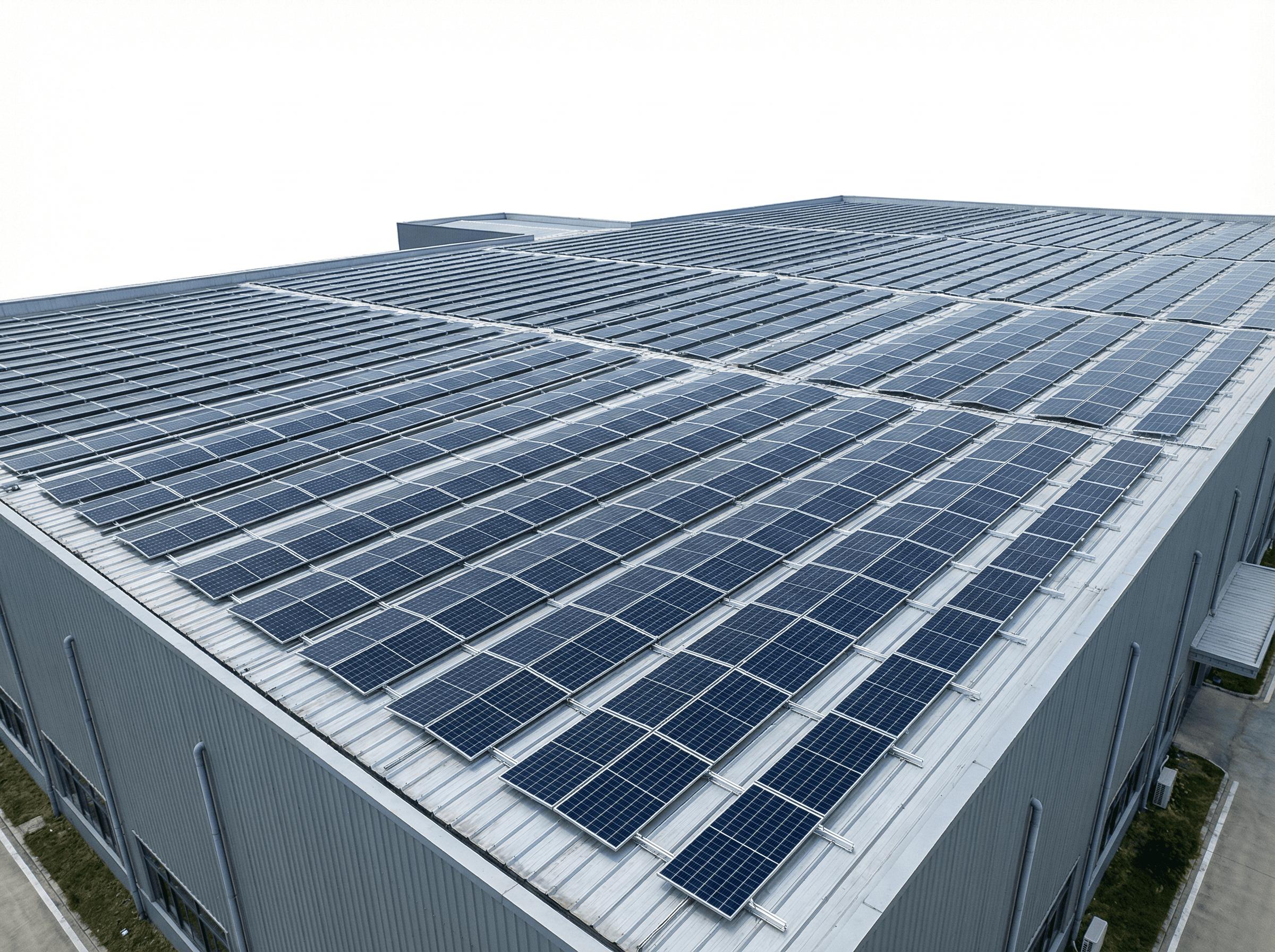
The MAXLUMI 200kW Factory Roof TOPCon Fixed-Tilt Solar PV System is a high-performance commercial energy solution designed specifically for industrial rooftop applications, delivering clean power through 278 units of 720 W N-type TOPCon bifacial modules (totaling 200.2 kWp) certified at 24% module efficiency. Targeting long-term reliability and optimal return on investment (ROI), this turnkey system integrates a rugged fixed-tilt ballasted mounting structure, commercial multi-MPPT string inverters, and a real-time cloud monitoring platform to deliver approximately 280 MWh of annual generation and a levelized cost of energy (LCOE) of around $0.021/kWh. All components are certified to IEC 61215, IEC 61730, IEC 62116, and UL 1703 standards — ensuring global grid-interconnection compliance and a bankable performance guarantee.
At the core of this 200 kW commercial system is the latest N-type TOPCon (Tunnel Oxide Passivated Contact) module architecture, the current pinnacle of mass-market solar technology. By combining 210 mm N-type silicon wafers with passivated contact technology, electron recombination losses at the metal contacts are reduced significantly beyond the fundamental limitations of conventional P-type PERC cells. This structural advantage produces an impressive module efficiency of 24%, enabling 700 W+ class panels to produce substantially more power per square meter than legacy alternatives. The bifacial design also captures additional albedo radiation reflected from the factory-roof surface, delivering an extra 10%–20% of energy gain depending on the roof's reflectivity index.
The TOPCon cell structure includes an ultra-thin tunnel oxide layer (approximately 1.5 nm) and a doped polysilicon passivation layer deposited on the rear of the N-type wafer. This structure suppresses surface recombination velocity to less than 5 cm/s, enabling module-level open-circuit voltage (Voc) exceeding 720 mV. A multi-busbar (MBB) interconnection scheme using 16+ round wires per cell reduces internal resistive losses and improves mechanical durability against micro-cracking during installation and thermal cycling. As a result, these modules maintain rated output over a wider operating temperature range, with a power temperature coefficient (Pmax) of −0.29%/°C — significantly better than the −0.35%/°C typical of PERC modules.
The long-term durability of TOPCon modules is backed by strict manufacturing standards and rigorous testing protocols. Compliant with IEC 61215:2021 (design qualification) and IEC 61730:2023 (safety qualification), each module undergoes thermal cycling (200 cycles between −40 °C and +85 °C), humidity-freeze testing, and damp heat exposure (1,000 hours at 85 °C / 85% RH). The degradation profile is very low: first-year output degradation is strictly limited to under 1.0% and annual linear degradation thereafter remains below 0.4%. This ensures the system retains at least 87.4% of its initial rated output at the end of the 30-year performance warranty period — a key factor for industrial facilities seeking predictable, stabilized long-term energy costs.
The 200 kW system organizes its direct-current (DC) strings in a series-parallel configuration, with each string connecting 20–22 modules in series to achieve an optimal string voltage of approximately 1,000 VDC. The 278 modules are distributed across multiple commercial string inverters — typically four 50 kW units — providing redundancy and ensuring that a single inverter failure does not interrupt total generation. Each string inverter is equipped with at least four independent MPPT channels, allowing the array to be segmented by roof orientation, tilt angle, or shading zone to maximize energy harvest across the full rooftop area.
The selected commercial string inverters comply with IEC 62116:2022 for anti-islanding and UL 1741 for North American grid interconnection. They also support reactive-power injection (Q-at-night function), frequency-watt and volt-watt response curves, and remote firmware updates through an integrated monitoring gateway. Maximum AC conversion efficiency exceeds 98.5%, with European weighted efficiency (Euro-eta) rated above 98.0%, minimizing inverter-side energy losses across the full daily irradiance range. The inverter is IP65-rated for outdoor installation and capable of continuous operation up to an ambient temperature of 60 °C — suitable for rooftop environments in tropical and arid climates.
Structural integrity of the rooftop installation is secured by a specialized fixed-tilt ballasted mounting system tailored for commercial and industrial flat or low-slope roofs. The system is designed to withstand wind loads of up to 60 m/s and snow loads of up to 1.4 kN/m². Aluminum-alloy (6005-T5) and hot-dip galvanized steel racking components lower mounting LCOE while delivering more than 25 years of reliable service life. The fixed tilt angle is optimized to the installation site's latitude — typically 10°–20° in equatorial and mid-latitude industrial zones — balancing maximum annual energy harvest with minimum aerodynamic drag.
The ballasted approach eliminates all roof penetrations, instead resisting uplift forces with precisely calculated concrete counterweights and aerodynamic wind deflectors. This approach preserves the integrity of the factory-roof waterproofing membrane and helps maintain existing roof warranties. Total dead load added to the roof structure is approximately 15–25 kg/m², well within the structural allowance of most modern industrial buildings (typically rated for additional loads of 50–150 kg/m²). A site-specific structural assessment is included in the MAXLUMI turnkey EPC service before installation to confirm roof suitability.
The system occupies a total active array area of approximately 633 m² based on the 2.278 m² footprint per 720 W module (dimensions 2,384 mm × 955 mm × 35 mm) and appropriate string spacing to prevent self-shading at winter-solstice sun angles. The compact footprint is 15% smaller than a comparable 550 W PERC system, enabled by the superior power density of 700 W+ TOPCon modules — allowing the 200 kWp target to be reached on rooftops that would otherwise be infeasible with lower-efficiency technology.
A representative automotive-parts manufacturing facility in the Binh Duong industrial park in Vietnam recently deployed the MAXLUMI 200kW Factory Roof TOPCon Fixed-Tilt System to offset its daytime concentrated electrical load. Given average electricity rates of around $0.11/kWh and a corporate policy to reduce Scope 2 carbon emissions by 40% before 2030, the facility used approximately 650 m² of its available flat-roof area for the installation. Under high-irradiance conditions with annual average Global Horizontal Irradiance (GHI) of 1,750 kWh/m², the 200 kWp system produces approximately 280 MWh of clean electricity per year — directly meeting 42% of the factory's daytime operating energy demand and avoiding 121 tons of CO₂ annually. With roof area limited, the choice of high-efficiency 700 W+ TOPCon modules was decisive: a standard 550 W PERC panel approach would have allowed only a 168 kW system, a 19% capacity shortfall that would have significantly degraded project financial performance.
When evaluated against a conventional P-type PERC solar installation of equivalent capacity, the 200 kW TOPCon system delivers superior economic and technical indicators across the project's full lifecycle. The table below summarizes the key performance differences.
Applying 700 W+ N-type TOPCon modules reduces the total area required for installation by approximately 13% compared with a standard 550 W PERC system of equivalent capacity. This increased power density directly lowers Balance of System (BOS) costs — fewer mounting rails, less DC cabling, and less labor required per kW. In addition, over a 25-year project life, the lower annual degradation rate of TOPCon modules produces a cumulative energy-harvest advantage of approximately 8.5% versus PERC — further improving the Net Present Value (NPV) of the investment.
| Parameter | TOPCon Fixed (This System) | PERC Fixed (Conventional) | Improvement |
|---|---|---|---|
| Module Efficiency | 24.0% | 21.5% | +11.6% |
| Module Power | 720 W | 550 W | +30.9% |
| Annual Degradation | <0.4% | <0.55% | −27.3% |
| 30-Year Retention | 87.4% | 82.5% | +4.9 pp |
| Required Roof Area | ~633 m² | ~730 m² | −13.3% |
| LCOE | $0.021/kWh | $0.023/kWh | −8.7% |
| Payback Period | ~5.4 years | ~6.1 years | −0.7 years |
The MAXLUMI 200 kW system includes a comprehensive cloud-based monitoring platform that provides real-time visibility of system performance at the string, inverter, and plant levels. Key performance indicators — DC string current, inverter AC output, specific yield (kWh/kWp), and performance ratio (PR) — are updated every 5 minutes and accessible via web dashboard and mobile application. Automated alarm notifications are triggered when string current deviates by more than 10%, when an inverter fails, or when communications drop — enabling rapid fault diagnostics and minimizing revenue loss from undetected underperformance.
The warranty framework is structured to deliver long-term, comprehensive protection. The modules carry a 25-year linear power output warranty (≥87.4% at year 30) and a 12-year product workmanship warranty, while the string inverters carry a standard 10-year warranty (extendable up to 20 years). The mounting system is covered by a 10-year warranty against material and workmanship defects. MAXLUMI also offers optional operations and maintenance (O&M) service contracts including semi-annual preventive maintenance visits, thermal imaging inspections, panel cleaning, and 24/7 remote monitoring support.
Q1: Why is TOPCon technology superior to conventional PERC solar panels for factory rooftops?
TOPCon (Tunnel Oxide Passivated Contact) technology uses N-type silicon wafers that are inherently immune to Light-Induced Degradation (LID) and Potential-Induced Degradation (PID) — both phenomena that affect P-type PERC cells. The result is baseline efficiency up to 24.5% and annual degradation below 0.4% — substantially lower than PERC's 0.55%. On space-constrained factory rooftops, TOPCon's high power density (720 W per panel vs. 550 W for PERC) maximizes total installed capacity and long-term energy harvest within the same footprint.
Q2: Can the fixed-tilt mounting system be installed without roof penetrations?
Yes — for flat commercial roofs, MAXLUMI uses a ballasted fixed-tilt mounting system. This approach anchors the array using precisely calculated concrete counterweights and aerodynamic wind deflectors, eliminating any need for roof penetrations. This preserves the integrity of the roof waterproofing membrane and helps maintain existing roof warranties. Before installation, a site-specific structural and wind-load assessment is performed to confirm the roof can safely accommodate the ballast load of approximately 15–25 kg/m².
Q3: How does the system handle partial shading from rooftop HVAC equipment or vents?
The system uses advanced commercial string inverters with multiple independent Maximum Power Point Tracker (MPPT) channels. Each MPPT channel controls its assigned string so the output is independently optimized at its maximum power point. Therefore, when rooftop equipment temporarily shades a specific zone of the array, only the affected string's output drops. The remaining strings continue to operate at their own peak-efficiency points — ensuring the full 200 kW system maintains the highest possible energy harvest even under partial shading.
Q4: What is the expected maintenance schedule for this 200 kW commercial system?
The MAXLUMI 200 kW system is engineered to require only minimal periodic maintenance. Semi-annual preventive maintenance visits are recommended and include visual inspection of mounting hardware and electrical connections, inverter firmware updates, and thermal-imaging inspection of the module array (to detect hotspots or bypass-diode failures). Panel cleaning frequency depends on local soiling levels — typically quarterly in dusty industrial environments and bi-annually in cleaner environments. The integrated cloud monitoring platform provides continuous automated performance surveillance, enabling predictive maintenance and minimizing unplanned downtime.
Q5: Are the components certified for international safety and grid-connection standards?
All core components are rigorously tested and certified to global standards. The TOPCon modules comply with IEC 61215:2021 (design qualification and type approval) and IEC 61730:2023 (safety qualification), and hold TÜV Rheinland and CE certifications. The commercial string inverters are certified to IEC 62116:2022 for anti-islanding and UL 1741 for North American grid interconnection — ensuring seamless and fully compliant connection to utility grids across Europe, Asia-Pacific, the Americas, and the Middle East.
Product supply and warranty: MAXLUMI — Solar, Energy Storage, Smart Lighting, and Telecom & Power Tower solutions.
| System Capacity | 200.2 kWp |
|---|---|
| Module Type | N-type TOPCon Bifacial, 210mm Wafer |
| Module Power Output | 720 W |
| Module Efficiency | 24.0 % |
| Number of Modules | 278 pcs |
| Array Configuration | Fixed-Tilt, Ballasted Rooftop Mount |
| Estimated Annual Generation | 280.3 MWh |
| Capacity Factor | 16.0 % |
| System Area | 633 m² |
| CO₂ Offset | 121.4 tons/year |
| Payback Period | 5.4 years |
| LCOE | 0.0214 $/kWh |
| First-Year Degradation | <1.0 % |
| Annual Degradation | <0.4 % |
| 30-Year Output Retention | 87.4 % |
| Inverter Type | Commercial String Inverter, Multi-MPPT |
| Inverter Efficiency | >98.5 % |
| Module Warranty | 25 years |
| Inverter Warranty | 10 years |
| Mounting Service Life | 25+ years |
| Standards Compliance | IEC 61215, IEC 61730, IEC 62116, UL 1703 |
Pricing available upon inquiry.
Custom design tailored to site conditions, capacity, and budget. Widewings' in-house EPC team consults directly.
Inquiry →