
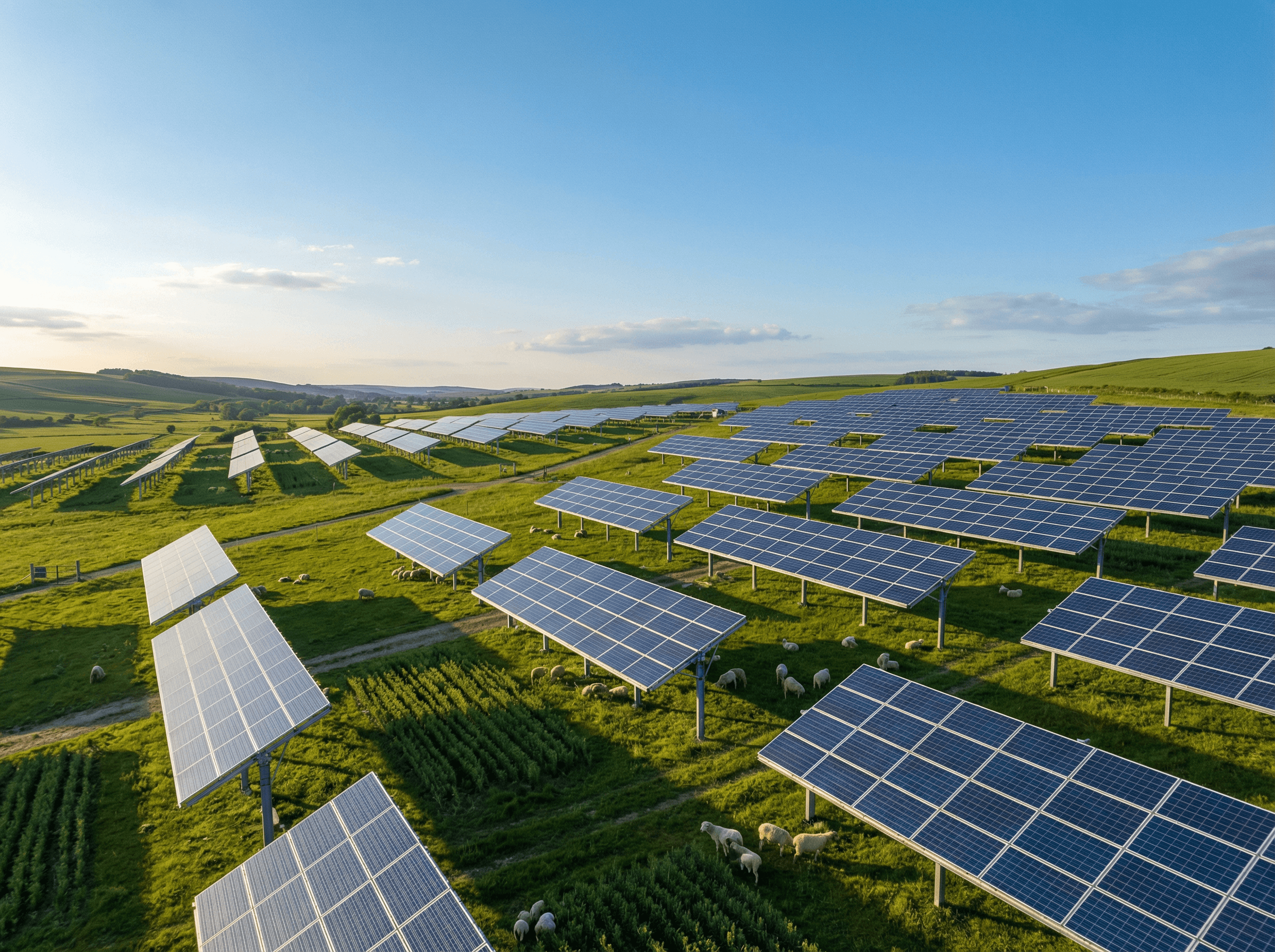
The MAXLUMI 1MW Pastoral-Solar Ground Mount is a 1,000 kWp agrivoltaic solar PV system designed for dual land use. It combines bifacial modules (22% efficiency), single-axis tracking, and a livestock-friendly elevated clearance structure of more than 1.0 m height. At a typical high-irradiance site, the system produces approximately 2,050 MWh/year and achieves a capacity factor of 23.4%, offsetting roughly 1,230 tons of CO₂ per year while maintaining productive grazing land for sheep, goats, or other low-clearance livestock.
The configuration is optimized for project developers, EPC contractors, and agricultural landowners seeking enhanced land productivity and a lower LCOE within a single 6,500–8,500 m² footprint. Drawing on market benchmarks from NREL, IRENA, IEA, BloombergNEF, and Wood Mackenzie — and on module/inverter standards including IEC 61215, IEC 61730, IEC 62116, and UL 1703 — this 1MW system aligns with the 2025–2026 market trend toward 700 W+ bifacial modules, tracker-based utility arrays, and an LCOE target below $0.03/kWh in strong solar resource regions.
Unlike a typical ground-fixed array, a pastoral-solar plant is designed with the structure considering both electrical generation and agricultural clearance. In this 1,000 kWp design, bifacial modules capture front-side irradiance plus an additional 10–30% rear-side gain depending on albedo, and tracker geometry improves energy harvest by another 15–25% compared with a fixed-tilt system — based on NREL tracker performance studies and utility-scale operational data. As a result, under suitable site conditions this system can exceed the annual generation of a conventional fixed monofacial pastoral array by 18–35%.
From a B2B buyer perspective, the value proposition is quantified across three dimensions: energy, land, and operational economics. Energy output increases because the system uses single-axis horizontal trackers and bifacial modules; land productivity rises because grazing can continue beneath the elevated rows; and maintenance costs can fall by 5–12% in environments where livestock naturally suppress vegetation growth. Buyers wanting to compare variants by capacity and application can browse all Solar PV System products or configure a system online for a site-specific design.
The core architecture consists of approximately 1,430–1,450 pcs of 700 W class bifacial TOPCon or HJT modules, with tracker rows aligned north-south. It includes a commercial-grade string or central inverter topology, DC wiring and combiner protection, AC collection infrastructure, SCADA-level monitoring, and an optional livestock-safe perimeter design. For a 1 MWdc agrivoltaic plant, MAXLUMI typically recommends a single-axis tracker, with row spacing engineered to balance three variables: mutual shading, rear-side irradiance, and animal movement. Typical lower clearance is 1.0–1.5 m, and row pitch can range from 4.5 m to 7.0 m depending on latitude, module dimensions, and grazing requirements.
The module platform follows IEC 61215 durability and performance standards and IEC 61730 safety requirements, and inverter selection aligns with IEC 62116 anti-islanding criteria. For projects above 500 kW, central inverter architecture is often selected to reduce inverter CAPEX, while multi-string designs improve MPPT granularity and fault isolation. Many pastoral deployments choose string inverters, because uneven soiling, row mismatch, and terrain variation can create localized output differences of 1–3% that distributed MPPT handles more effectively.
The standard electrical design targets 1,000 kWp DC, with an AC export ratio typically in the 0.80–0.90 range (depending on grid code and clipping strategy). A representative design uses 1,429 pcs of 700 W bifacial modules to compose 1,000.3 kWp DC paired with approximately 800–900 kW AC inverter capacity. A DC/AC ratio of approximately 1.18–1.25 is commonly used in utility and C&I plants because it improves inverter loading and annual generation without materially increasing BOS cost. In moderate-to-high irradiance zones, annual specific yield can reach 1,900–2,250 kWh/kWp, with an expected nominal value for this product class around 2,050 kWh/kWp-year.
Mechanically, the mounting system uses galvanized steel or equivalent corrosion-resistant structural members and is designed against site-specific wind and snow loads — often set in the 0.45–0.75 kN/m² range based on site-tailored assumptions before final calculation. Raised pastoral systems require stronger torsion tube and pile design than typical low-clearance arrays because both center pressure and animal-interaction zones are larger. The tracker structure is therefore not just an energy component but also an agricultural infrastructure component, and in this 1MW package the tracker represents a meaningful share of the overall EPC scope.
Expected annual generation for this variant is approximately 2,050 MWh/year, assuming a good solar resource, adequate albedo, and correct tracker backtracking settings. This corresponds to a capacity factor of 23.4% (2,050,000 kWh divided by 8,760 hours and 1,000 kW). Bifacial gain alone can contribute 8–18% on lawn or light-soil conditions and up to 20–30% on highly reflective surfaces such as pale gravel or dry sand. Tracker gain can add an additional 15–25% over fixed-tilt, but actual output depends on latitude, diffuse fraction, row spacing, and soiling profile.
Compared with a typical 1 MW fixed-tilt monofacial ground-mount producing approximately 1,550–1,750 MWh/year, this pastoral bifacial tracker design increases annual output by approximately 300–500 MWh, or roughly 19–29%. At a power price of $0.08/kWh, that additional energy can be worth tens of thousands of dollars per year, materially improving project IRR over a 20–25-year asset life. This is why tracker adoption at utility scale has expanded rapidly over the past 5 years — particularly in regions where land-use intensity and PPA competitiveness matter most.
The pastoral-solar concept is part of the broader agrivoltaic market, in which land supports two outputs rather than one (electricity and agricultural activity). In this system, the elevated tracker structure enables livestock movement between and beneath the rows, providing practical compatibility with low-clearance grazing animals such as sheep. By reducing direct sun exposure to part of the pasture, the array can also moderate soil-temperature variation by a few degrees Celsius during summer peaks, while forage productivity is preserved when row spacing and stock rate are correctly managed. According to studies cited by IRENA and agrivoltaic research groups, dual-use land systems can improve total land productivity by more than 20% under optimized conditions.
For developers working in mixed agricultural zones, land-permitting discussions can be simpler because the site remains economically active rather than being converted to single-purpose energy land. A 1 MW pastoral-compatible array of approximately 7,500 m² can support a controlled grazing schedule, reduce mowing frequency for management by 30–70%, and lower vegetation-management fuel use compared with traditional utility sites. Buyers evaluating agrivoltaic models can reference the topic library and find additional engineering guides in the MAXLUMI knowledge center.
All 1 MW systems should include digital monitoring, because a performance deviation of just 2–3% has a material effect on annual revenue. MAXLUMI integrates monitoring hardware and a cloud dashboard for module-string visibility, inverter alarms, tracker status, weather correlation, and export metering. A typical monitoring package costs on the order of a few thousand dollars per system installed, but the operational value is far greater — it enables response to underperformance, soiling, shading drift, communications failures, and protection events within 24 hours rather than after the monthly utility bill review.
For O&M teams, cloud monitoring supports preventive maintenance cycles at 3-, 6-, and 12-month intervals depending on site conditions. It also documents commissioning baselines — IV curve checks, inverter efficiency, tracker rotation tests, insulation resistance, and communications integrity — to aid EPC handover. This is particularly important at pastoral sites where environmental conditions vary seasonally and where vegetation, dust, and animal movement can create non-uniform operating patterns across 10–20 tracker blocks.
A solar farm operator in the MENA region deployed a 1 MW agrivoltaic tracker block on semi-arid pastureland with annual irradiance exceeding 2,100 kWh/m². Using bifacial modules over light-colored soil and maintaining 1.2 m of lower-row clearance, the project achieved an estimated annual output of approximately 2,180 MWh — about 24% higher than a nearby fixed-tilt monofacial baseline plant of similar DC scale. Additionally, sheep grazing beneath the array managed vegetation, reducing mechanical mowing by approximately 60% and lowering O&M labor and fuel costs during the first 12 months.
This case illustrates why pastoral-solar is attractive in regions where land carries both agricultural and energy value. Rather than displacing livestock activity, the PV system monetizes the same hectare twice. Developers seeking custom tracker geometry, inverter topology, or local-standards compliance can use the custom-quote request or the online system configurator for project-level engineering support.
This product is specified against internationally recognized standards because 2025–2026 bankability depends on documented compliance rather than generic claims. Modules are selected to meet IEC 61215 for design qualification and type approval, and IEC 61730 for PV module safety. Inverter systems are designed to IEC 62116 for anti-islanding performance, and depending on the product variant may also align with legacy UL 1703 certification pathways or equivalent market-specific requirements. For utility and commercial procurement, local grid-interconnection rules, grounding requirements, and surge-protection standards must also be verified during detailed engineering.
Quality control typically includes factory inspection, material traceability, torque verification, string polarity checks, insulation-resistance testing, tracker commissioning, and SCADA validation. The EPC phase often includes acceptance milestones such as mechanical completion, pre-commissioning checks, energization, performance verification, and final handover. On a 1 MW project, even a 1% installation defect can translate into more than 20 MWh of lost generation per year, so structured QA/QC is not optional. Additional technical material is available in the topic library.
Pricing available upon inquiry.
Pricing available upon inquiry.
This variant best fits buyers needing four outcomes at once: high generation, dual land use, bankable standards, and predictable EPC cost. The use of 700 W class bifacial modules reflects the mainstream utility market for 2025–2026, where TOPCon has approached approximately 60% market share according to industry trackers such as Wood Mackenzie and BloombergNEF. By combining tracker architecture with elevated agrivoltaic clearance, the system addresses both energy economics and land-use efficiency. In strong solar regions, modeled LCOE can reach $0.026/kWh — consistent with leading utility-scale benchmarks cited by IRENA and market analysts.
For procurement officers, the key decision variables are module technology, inverter architecture, steel specification, and logistics scope. For engineers, the key variables are albedo, row pitch, clearance, DC/AC ratio, and interconnection conditions. For developers, the key financial metrics are EPC cost, annual generation, land productivity, and payback period. MAXLUMI supports all three buyer groups through configurable supply models, technical documentation, and custom quotes. To proceed, browse all Solar PV System products, configure a system online, or request a custom quote.
| System Capacity | 1000 kWp |
|---|---|
| Module Type | Bifacial TOPCon or HJT |
| Module Efficiency | 22 % |
| Array Configuration | 1-axis horizontal tracker |
| Application | Pastoral solar / agrivoltaic |
| Livestock-Friendly | Yes |
| Estimated Annual Generation | 2050 MWh |
| Capacity Factor | 23.4 % |
| System Area | 7500 m² |
| CO₂ Offset | 1230 tons/year |
| Payback Period | 3.5-5.0 years |
| LCOE | 0.026 USD/kWh |
| Warranty | 25yr panels, 10yr inverter |
Pricing available upon inquiry.
Custom design tailored to site conditions, capacity, and budget. Widewings' in-house EPC team consults directly.
Inquiry →