
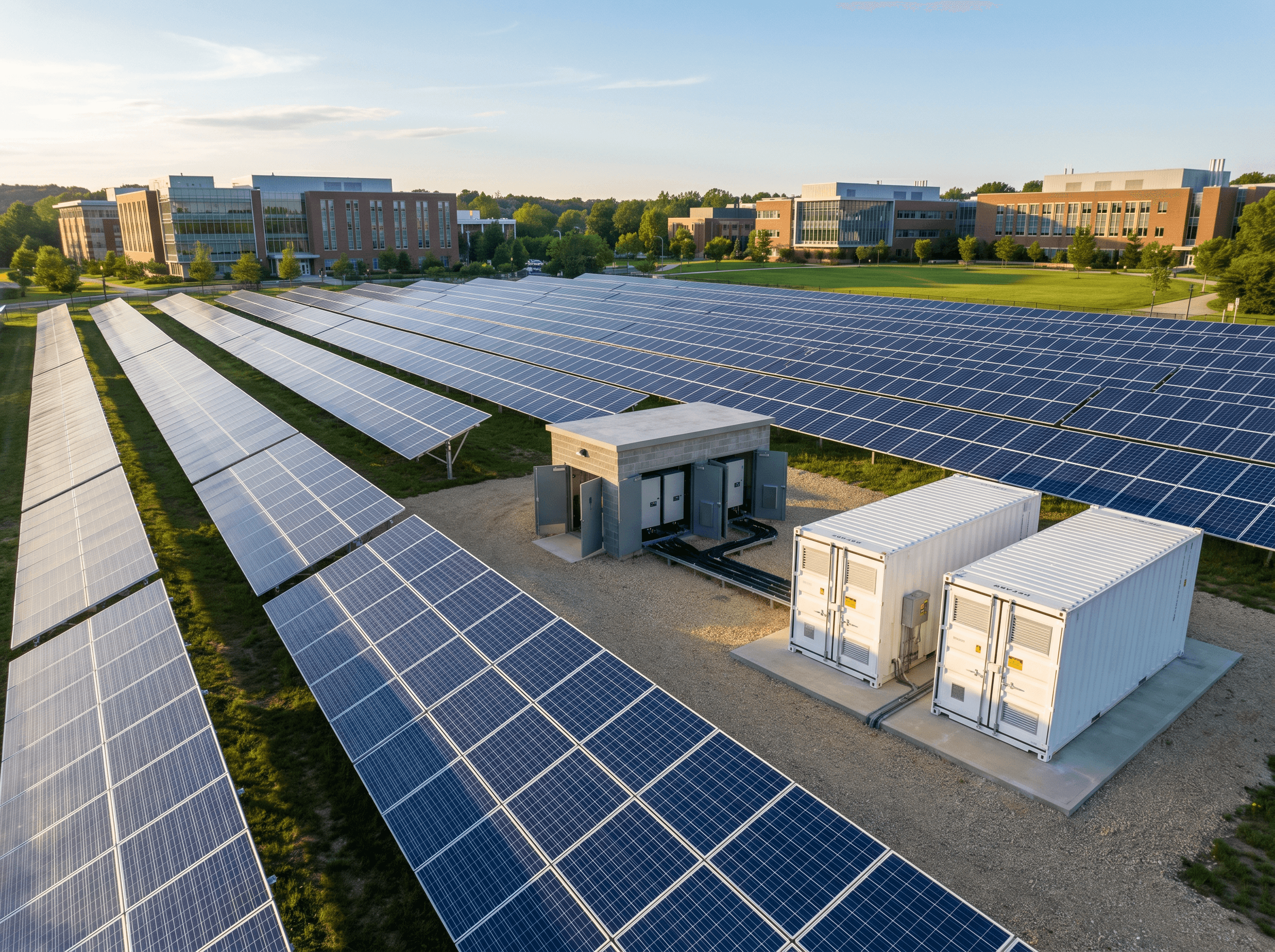
The 1MW + 2MWh Campus Microgrid is a utility-scale commercial energy system integrating 1,000 kWp of bifacial solar PV, 2,000 kWh of Lithium Iron Phosphate (LFP) battery storage, and hybrid power conversion for campus-grade reliability. At a typical high-irradiance commercial site, the system delivers approximately 1,850 MWh/year of solar generation, supports critical loads for 2–6 hours depending on demand profile, and can reduce daytime grid power imports by 40%–75%. The configuration is optimized for universities, hospitals, industrial parks, and corporate campuses seeking electricity-bill savings, backup resilience, and measurable carbon reductions within a single EPC package.
Compared with a conventional campus power strategy of grid supply plus diesel standby, a 1 MW PV + 2 MWh storage microgrid can reduce diesel runtime by 70%–95%, cut peak-demand utility charges by 15%–35%, and reduce annual CO₂ emissions by approximately 1,150–1,450 tons/year depending on local grid intensity. According to references from NREL, IEA, IRENA, BloombergNEF, and IEC, bifacial modules, tracker-based arrays, and LFP storage remain among the most bankable technology choices in 2025–2026 commercial microgrids because they combine high energy productivity, strong safety performance, and predictable lifecycle economics. Buyers can also browse all Solar PV System products or configure a system online for site-specific modeling.
This microgrid uses 700 W+ class bifacial TOPCon or HJT modules mounted on a single-axis horizontal tracker structure to maximize front-side and rear-side irradiance capture. Bifacial rear-side gain typically ranges from 10%–30% when the system is installed over high-albedo surfaces such as white gravel, light concrete, or sand, and single-axis tracking adds another 15%–25% in annual yield compared with a fixed-tilt system (assuming equivalent irradiance). For campuses with daytime demand of 500 kW–1,500 kW, the combination of tracker PV and 2,000 kWh of storage improves self-consumption, shifts solar energy into the evening, and supports continuity of critical circuits during utility outages.
The battery subsystem uses LFP chemistry, widely chosen for stationary storage thanks to its thermal stability, long cycle life, and low maintenance profile. In real-world BESS operation at 0.5C–1C, a 2 MWh LFP system can deliver 1,000 kW–2,000 kW of discharge power depending on inverter and PCS sizing — although many campus microgrids optimize around approximately 1,000 kW of continuous bidirectional power to balance solar charging and evening discharge. NREL industry guides and BloombergNEF 2025 market tracking continue to identify LFP as the dominant chemistry in commercial stationary storage on the basis of safety, cycle life often exceeding 6,000 cycles, and favorable total installed cost per usable kWh.
The standard architecture is built around 1,000 kWp of DC solar generation, a tracker-mounted bifacial array, commercial-grade inverters, and a hybrid PCS supporting seamless transitions between grid-tied and islanded (off-grid) modes. Module selection typically falls in the 700 W–730 W class bifacial panel range, with approximately 1,370–1,430 modules required to reach 1 MWp depending on final DC oversizing and string layout. The array typically occupies 8,500–12,000 m² depending on tracker spacing, access roads, transformer pads, fire lanes, and local setback requirements.
A typical electrical design includes DC string collection, combiner protection, AC aggregation, transformer step-up, EMS-based dispatch control, and battery-integrated power conversion. For campuses with medium-voltage service at 11 kV, 13.8 kV, 22 kV, or 33 kV, the system can be configured for low-voltage AC coupling or for medium-voltage interconnection with protection relaying aligned to utility requirements. Module conformity is based on IEC 61215 and IEC 61730, and inverter anti-islanding and grid-interaction references include IEC 62116 plus project-specific utility grid codes. Related design guides are available in the MAXLUMI knowledge center under topic library.
At the generation layer, single-axis trackers reorient the modules throughout the day to improve incident irradiance and flatten the campus solar production curve over 8–10 peak generation hours. Mounting more than one meter above ground improves rear-side exposure to support bifacial gain, and row spacing is engineered to keep shading losses in major production zones below approximately 2%–5%. Compared with a 1,000 kWp fixed-tilt bifacial array, the tracker-based solution typically increases annual output by 250–400 MWh in favorable climates and also improves LCOE and the consistency of battery charging.
At the storage layer, the 2,000 kWh LFP battery is connected through a hybrid bidirectional PCS that supports solar charging, grid charging where tariff arbitrage is permitted, and controlled discharge into campus loads. Under normal operation, the EMS prioritizes three functions: self-consumption optimization, peak-demand reduction, and resilience-reserve management. During utility disturbances, seamless transitions of 20–100 milliseconds are achievable depending on switchgear and protection design — suitable for many campus loads including IT rooms, laboratories, administration buildings, and selected HVAC circuits.
At the control layer, the microgrid controller orchestrates the PV inverters, battery PCS, protection relays, smart meters, and an optional diesel or gas genset. The EMS manages 15-, 30-, and 60-minute tariff windows, operates SOC reserve bands in the 20%–80% range, and can apply load-priority logic across 3–20 feeder groups. This architecture is particularly useful for campuses with mixed day-night load patterns and variable occupancy, because it converts intermittent solar generation into dispatchable on-site energy with measurable operational savings.
For planning purposes, in regions with good solar resource a 1,000 kWp bifacial tracker system can achieve a capacity factor of approximately 21.1%, corresponding to roughly 1,850 MWh/year of AC energy. In stronger irradiance zones, annual yield can exceed 2,000 MWh/year, while in moderate climates it may be closer to 1,500–1,700 MWh/year. Battery dispatch focuses on peak shaving and evening support, and under typical cycling assumptions the microgrid can shift roughly 1,200–1,600 kWh/day of solar-derived energy — depending on DOD (Depth of Discharge), round-trip efficiency, and campus load coincidence.
Round-trip battery efficiency for LFP systems is typically 88%–94%, while modern commercial inverters operate with peak efficiencies of 97%–99%. Combined system losses from temperature, soiling, mismatch, wiring, conversion, and availability are typically modeled at 10%–16% in bankable energy simulations. According to NREL PVWatts methodology and commercial project benchmarks from Wood Mackenzie and BloombergNEF, tracker-bifacial systems often outperform monofacial fixed-tilt systems by double-digit percentages in annual energy — particularly when albedo exceeds 0.25 and diffuse irradiance is moderate.
A real-world application scenario is a 25,000-student university campus with average daytime load of 900 kW, evening load of 450 kW, and annual electricity consumption of 6,500 MWh. Deploying a 1MW + 2MWh microgrid lets the campus produce roughly 1,850 MWh locally each year — offsetting about 28% of annual consumption — and reduce utility peak demand by 500–900 kW during tariff-critical periods. If the site previously relied on two diesel generators for outage support, annual diesel consumption for backup tests and event-based operation can fall by 20,000–60,000 liters depending on outage frequency and dispatch strategy.
In this scenario, the microgrid also improves resilience for three priority zones (administration, data center, medical clinic). During a grid outage, the battery can support a 300 kW critical load for approximately 6.0 hours, or a 1,000 kW emergency load for approximately 2.0 hours, even before counting solar contribution. On clear days, the 1,000 kWp PV array continues to recharge the battery and feed loads directly, significantly extending daytime island-mode operation. This is a strong operational advantage compared with diesel-only backup that depends on fuel logistics, noise control, and maintenance scheduling.
The system includes cloud-based monitoring for PV production, battery SOC (State of Charge), inverter alarms, load curves, irradiance, and energy-flow analytics. A standard deployment can monitor 100+ data points locally at intervals as short as 5 seconds, and at 1–5-minute intervals on the cloud dashboard — allowing facility managers to verify performance ratio, battery cycling behavior, and outage events. This digital layer supports preventive maintenance, alarm notifications, and monthly reporting for ESG and carbon-accounting teams. Buyers seeking application guides can reference the topic library or request a custom quote.
Cloud monitoring is especially valuable for campuses operating multiple buildings across 5–50 acres, because it centralizes operational data into a single interface. A typical dashboard displays daily PV yield in kWh, battery cycle count, grid import/export, avoided peak demand, and CO₂ reductions using configurable emission factors such as 0.4–0.8 kg CO₂/kWh. Alarm logic can identify under-performing strings, tracker faults, PCS derating, abnormal temperature rises, and communication losses within minutes — reducing Mean Time To Detect (MTTD) and supporting high annual availability above 98%.
This product is designed against internationally recognized standards relevant to commercial solar and storage systems. PV modules align with IEC 61215 for design qualification and IEC 61730 for module safety, and inverters reference IEC 62116 for anti-islanding behavior plus project-specific utility grid codes. Depending on market destination, selected components may also conform to UL 1703, CE requirements, and local electrical/fire standards. For the battery system, enclosure design, BMS logic, thermal management, and fire segregation are engineered site-specifically to meet jurisdictional authority and insurer expectations.
From a procurement perspective, standards compliance lowers technical risk over a 20–25-year asset life. Institutions reviewing lender appraisals or public procurement rules often require formal documentation of module flash reports, inverter test certificates, battery warranty terms, and factory QA procedures. MAXLUMI supports these workflows through a configurable documentation set including single-line diagrams, datasheets, FAT/SAT records, and commissioning reports. This structure is particularly important for campuses with CAPEX approval thresholds above significant levels or with technical review committees involving multiple stakeholders.
Pricing available upon inquiry.
Campuses often have high daytime occupancy, moderate evening loads, and strict uptime requirements across 10–100 buildings. The 1MW + 2MWh architecture is large enough to materially offset utility imports while compact enough to fit within a manageable footprint and CAPEX envelope. The 2 MWh battery is not intended to power the entire campus indefinitely; instead, it is optimized to shave peaks, support critical feeders, and increase the utilization value of on-site solar. This targeted design typically yields better ROI than oversizing storage to cover 8–12 hours of full-site autonomy.
The use of bifacial modules and single-axis trackers also aligns with the 2025–2026 market direction. According to industry references from IRENA and BloombergNEF, TOPCon-based bifacial products account for a large share of new utility and C&I deployments, while tracker systems remain common when land geometry and wind conditions allow. In optimal resource regions, utility-scale LCOE can fall below $0.03/kWh, and campus projects can benefit from the same module and inverter cost trends even after including additional resilience and control costs. For project planning, users can configure a system online or request a custom quote.
From an EPC buyer perspective, six main variables drive final pricing: site irradiance, geotechnical conditions, interconnection voltage, backup-load definition, battery discharge duration, and local permitting complexity. Flat sites with good albedo and nearby medium-voltage access can land in the lower EPC range, while complex civil works, stricter fire separation, and advanced switchgear push pricing toward the upper end. During the technical inquiry/clarification phase, procurement teams should also review module availability, tracker wind-load design, battery warranty throughput, and utility protection requirements.
A complete RFQ package typically includes 12–20 core documents — for example, load-profile data, 12 months of utility bills, site layouts, geotechnical information, target backup loads, interconnection rules, and preferred commercial terms. With this information, system sizing can be refined to optimize DC/AC ratio, battery reserve strategy, and expected annual savings. MAXLUMI supports direct equipment supply, CIF delivery, and full EPC execution depending on buyer preference and project region.
| System Capacity | 1000 kWp |
|---|---|
| Module Type | Bifacial |
| Module Efficiency | 22.5 % |
| Array Configuration | 1-axis |
| Storage Capacity | 2000 kWh |
| Storage Type | LFP |
| Estimated Annual Generation | 1850 MWh |
| Capacity Factor | 21.1 % |
| System Area | 10000 m² |
| CO₂ Offset | 1295 tons/year |
| Payback Period | 2.5-5.2 years |
| LCOE | On request |
| Warranty | 25yr panels, 10yr inverter |
| Application | Campus microgrid |
Pricing available upon inquiry.
Custom design tailored to site conditions, capacity, and budget. Widewings' in-house EPC team consults directly.
Inquiry →