
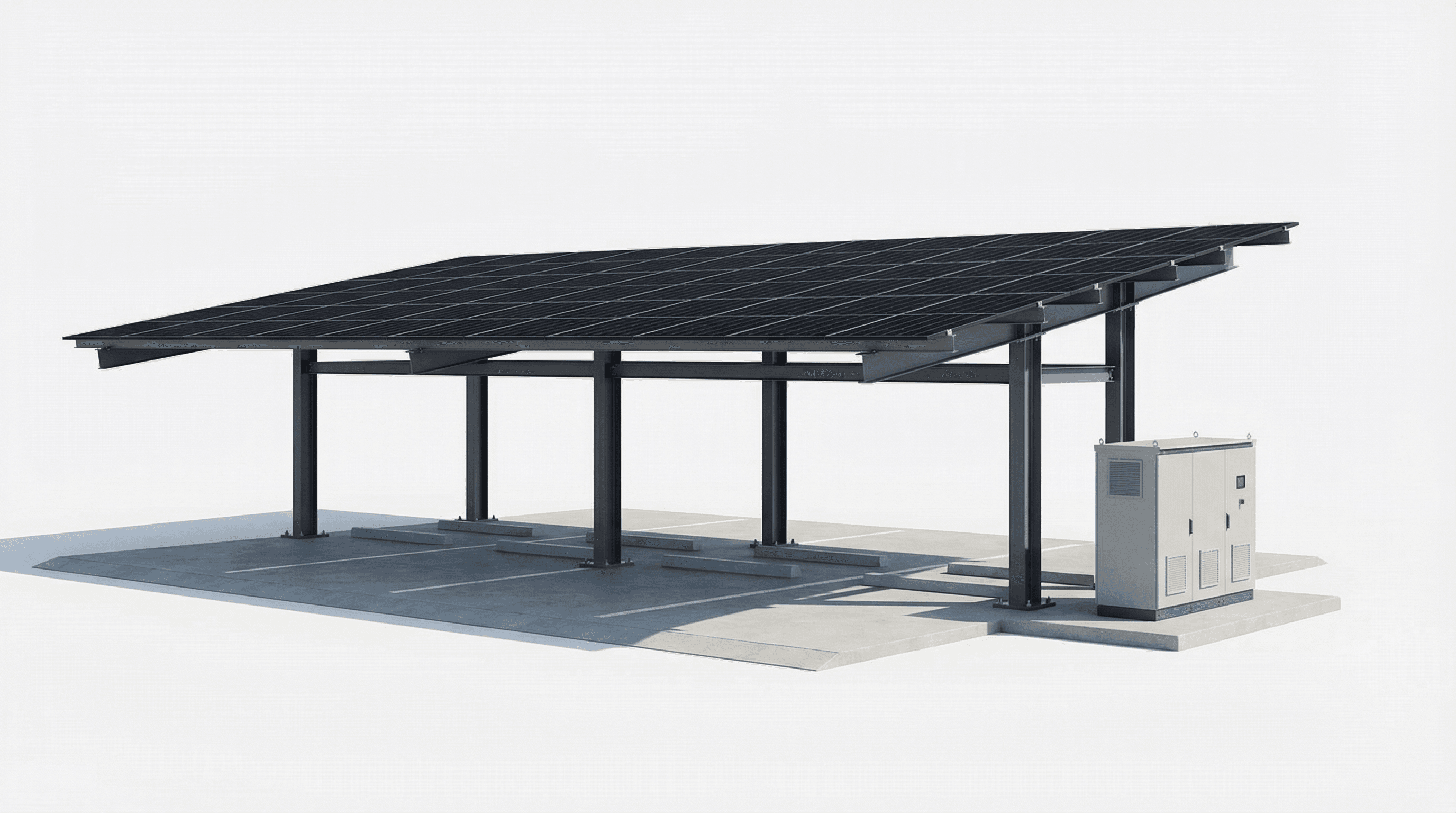
The MAXLUMI 100kW Industrial HJT Fixed Carport represents a paradigm shift in distributed power generation, transforming passive infrastructure into a high-performance energy asset. Designed for industrial and commercial applications, this system provides far more than parking space — it delivers 100 kWp of nameplate power capacity. By integrating cutting-edge heterojunction (HJT) bifacial solar modules into a rugged fixed-tilt carport structure, the solution provides outstanding energy harvest, long-term reliability, and an attractive return on investment. It is engineered to meet the demanding energy needs of modern facilities while supporting corporate sustainability goals. With an expected annual generation of approximately 177 MWh, the system offsets more than 125 tons of CO₂ emissions per year — the equivalent of taking more than 25 gasoline-powered vehicles off the road annually. The design complies with stringent international standards such as IEC 61215 and UL 1703, ensuring a service life of more than 25 years.
At the core of the system are advanced heterojunction (HJT) solar modules. HJT technology combines the strengths of crystalline silicon with the superior passivation characteristics of amorphous silicon thin-film layers, representing a significant leap beyond conventional PERC and TOPCon cells. This unique structure minimizes surface recombination losses, delivering higher open-circuit voltage (Voc) and module efficiencies of up to 25.5%. A key advantage of HJT is its exceptional temperature coefficient of −0.24%/°C, significantly better than the −0.35%/°C typical of PERC modules. This ensures the system maintains higher power output in hot-climate conditions — a critical factor for carport applications where modules are exposed to elevated ambient temperatures. HJT modules are also inherently free from Light-Induced Degradation (LID), guaranteeing stable performance from day one. A linear power degradation of just 0.4% per year is warranted, ensuring that at least 90% of nameplate power is maintained after 25 years of operation.
The system leverages the power of bifacial HJT cells with a bifaciality factor of up to 95%. Unlike traditional monofacial panels, these modules capture sunlight from both the front and rear surfaces. The fixed-tilt carport design is optimized to make the most of this capability, capturing reflected ground irradiance (albedo) from the surface below. The concrete or asphalt of a typical parking lot provides a reflective surface that can boost the system's total energy production by an additional 10% to 15% per year. This bifacial gain is particularly effective during morning and afternoon hours when the sun is at low angles, broadening the daily generation peak and pushing the overall capacity factor above 20%. These gains translate directly into a lower levelized cost of energy (LCOE), shortening the project payback period and maximizing financial returns over the lifetime of the system.
Every component of the 100kW Industrial HJT Fixed Carport is selected for durability, efficiency, and compliance with the highest industry standards.
The carport substructure is fabricated from high-strength, corrosion-resistant steel and aluminum, engineered to withstand local wind and snow loads in accordance with regional building codes. The fixed-tilt array is optimized for the site's latitude to maximize annual energy capture, while maintaining a clearance height of at least 2.5 meters (8.2 feet) for vehicle safety. The entire structure is engineered for a service life of more than 25 years, perfectly matching the warranty period of the solar modules. The robust design ensures minimal maintenance and provides a secure, long-lasting foundation for the power-generating canopy.
Power conversion is managed by a high-efficiency string inverter, the standard for commercial-scale projects. The inverter operates at efficiencies above 98.5% and features multiple maximum power point trackers (MPPTs) to optimize output from different sections of the array, mitigating the impact of partial shading. The system complies with grid interconnection standards such as IEEE 1547 and safety protocols such as IEC 62116 for anti-islanding protection. The inverter is housed in a NEMA 4X-rated enclosure for protection against harsh weather conditions and is backed by a standard 10-year warranty, with an option to extend to 20 years.
The system includes a comprehensive balance-of-system (BOS) package to ensure seamless operation. This includes UV-resistant, double-insulated DC cables (PV1-F) rated at 1500 V, and secure junction boxes fitted with surge protection devices (SPDs) and DC disconnects. A sophisticated monitoring system provides real-time data on energy generation, system health, and fault diagnostics — accessible through a web-based portal. This enables proactive maintenance, ensures the system operates at optimal performance, and provides data-logging capability that meets the requirements of performance-based incentive programs.
The 100kW Industrial HJT Fixed Carport is engineered to deliver predictable, high-value energy for decades. The system is expected to generate approximately 177 MWh in its first year of operation with system availability above 99%. A low annual degradation rate of 0.4% ensures the system will still produce more than 158 MWh in year 25. This long-term reliability, combined with the upfront investment cost, results in a highly competitive levelized cost of energy (LCOE) of approximately $0.062/kWh. For many commercial customers, this is substantially below the retail price of grid electricity, yielding an expected payback period of 6 to 8 years. The project not only generates significant electricity-cost savings but also creates a visible symbol of corporate commitment to sustainability, enhancing brand value and corporate image.
1. What are the key advantages of HJT modules compared with other technologies such as TOPCon or PERC? The primary advantage of heterojunction (HJT) technology is its superior temperature coefficient of −0.24%/°C, ensuring higher energy production in hot-climate conditions compared with TOPCon or PERC. HJT modules are also free from Light-Induced Degradation (LID), delivering stable, warranted power from the very first day of operation. The combination of high efficiency and robust real-world performance makes HJT the ideal choice for high-value applications such as solar carports, where it maximizes both energy harvest and financial returns.
2. How much maintenance does the 100kW carport system require? The system is designed for minimal maintenance. The primary requirement is periodic cleaning of the solar modules 1 to 2 times per year to remove dust and debris that could impact performance. The fixed-tilt structure has no moving parts, eliminating mechanical wear. The inverter and electrical components should be inspected annually by a qualified technician per the manufacturer's recommendations. The monitoring system provides real-time alerts for any performance issues, enabling proactive service when needed.
3. Can this system be integrated with an electric vehicle (EV) charging station? Absolutely. The 100kW Industrial HJT Fixed Carport is an ideal platform for integrating Level 2 or DC fast-charging (DCFC) EV chargers. The system's substantial energy generation can directly power the chargers during the day, reducing the electricity cost of the charging service. The carport structure provides a natural location for mounting the charging hardware, delivering a convenient, secure, and renewable-powered charging experience for employees, customers, or fleet vehicles. MAXLUMI can provide a fully integrated carport-and-EV-charging solution.
4. What is the total area required for a 100kW carport installation? A 100kW system using high-efficiency 700 W modules requires approximately 143 panels. Accounting for the carport structure and spacing for maintenance access, the total area required for the canopy is approximately 400 square meters (about 4,300 square feet). This area can typically cover 20 to 24 standard parking spaces, making it a highly efficient use of land that generates substantial clean energy without sacrificing valuable real estate.
5. What warranties are included with the system? The MAXLUMI 100kW Industrial HJT Fixed Carport ships with a comprehensive, industry-leading warranty package. The HJT solar modules are backed by a 25-year product warranty and a 25-year linear power performance warranty guaranteeing at least 90% of original output. The string inverter carries a standard 10-year warranty, extendable to 20 years. The mounting structure is warranted for 25 years, ensuring peace of mind for the entire operational life of the system.
| System Capacity | 100 kWp |
|---|---|
| Module Type | HJT Bifacial |
| Module Efficiency | 25.5 % |
| Module Power Rating | 700 W |
| Number of Modules | 143 pcs |
| Array Configuration | Fixed-Tilt |
| Bifacial Gain | 10 % |
| Temperature Coefficient | -0.24 %/°C |
| Estimated Annual Generation | 177.0 MWh |
| Capacity Factor | 20.2 % |
| System Area | 400 m² |
| Parking Spaces | 20-24 spaces |
| CO₂ Offset | 125.5 tons/year |
| Payback Period | 7.2 years |
| LCOE | 0.062 $/kWh |
| Module Warranty | 25 years |
| Inverter Warranty | 10 years |
| Structural Warranty | 25 years |
Pricing available upon inquiry.
Custom design tailored to site conditions, capacity, and budget. Widewings' in-house EPC team consults directly.
Inquiry →