
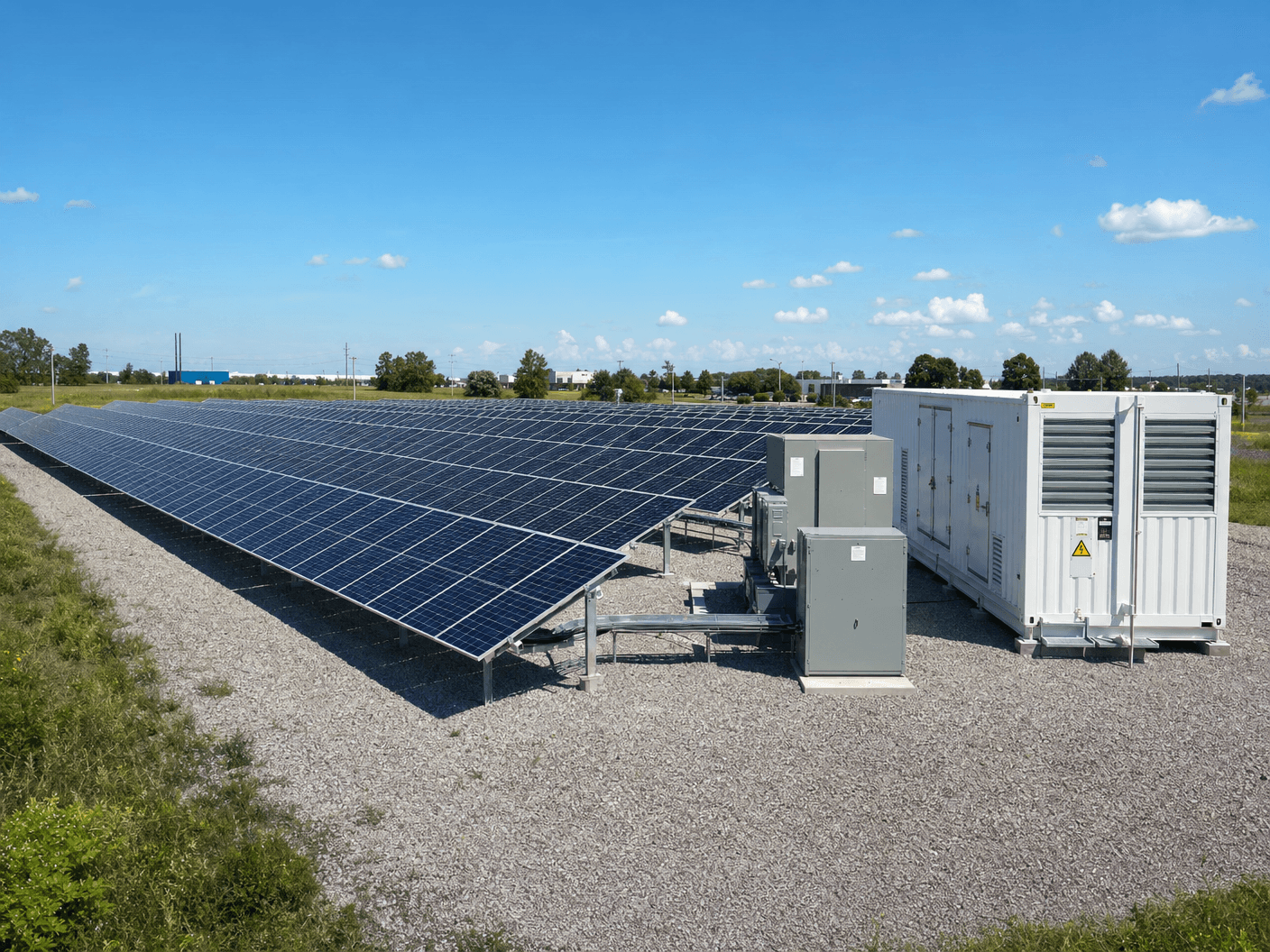
The 100kW + 200kWh Solar+Storage Commercial System is a commercial hybrid energy solution integrating 100 kWp of mono-TOPCon solar generation, 200 kWh of LFP battery storage, and a bidirectional power-conversion platform. The configuration is engineered for commercial-hybrid applications requiring daytime self-consumption, night-time load shifting (peak shifting), peak-demand reduction, and backup power within a single architecture, and fits standard EPC turnkey budget envelopes. As B2B buyers evaluate lifecycle value, this system targets a pragmatic balance of 22.5–24.5% module efficiency, 25-plus-year mechanical service life, and operational resilience anchored by battery backup.
Against typical commercial load profiles, a 100 kW PV + 200 kWh storage plant can generate approximately 150–190 MWh per year depending on irradiance, temperature, and grid availability — corresponding to a capacity factor of 17%–22% in many sunbelt commercial conditions. With current N-type TOPCon modules built on 210 mm wafers, first-year degradation is below 1.0% and annual degradation typically below 0.4%. Residual output at year 30 can reach 87.4%, consistent with the mainstream premium-module warranties and market data cited by NREL, IEA, and BloombergNEF. Buyers can browse all Solar PV System products or configure the system online for site-specific generation and storage sizing.
This commercial package uses a fixed-tilt array. Fixed structures remain the lowest-cost structural option for many rooftop and small ground-mount commercial sites, often reducing structural complexity by 15%–30% compared with tracker-based layouts on constrained projects. The PV field is paired with a 200 kWh Lithium Iron Phosphate (LFP) battery — a chemistry widely adopted in commercial C&I systems for its favorable thermal stability, long cycle life, and lower fire-propagation risk profile compared with some legacy chemistries. According to 2025–2026 market observations from IRENA and Wood Mackenzie, TOPCon is approaching or exceeding 60% share across many utility and commercial procurement pipelines, and the 700 W+ module class is becoming increasingly mainstream in large-format deployments.
As a result, the system supports three core operating modes: direct solar self-consumption during high-irradiance hours, battery charging and discharging for night-time or tariff-shifting use, and limited backup support during grid outages. In many markets where commercial electricity tariffs range from $0.10–$0.22/kWh, high on-site generation combined with strategic use of the 200 kWh battery for demand management can deliver substantial annual electricity-bill savings. Compared with conventional grid-plus-diesel strategies, hybrid solar storage can reduce diesel runtime by 70%–95% and significantly lower fuel-linked operating-cost volatility, while also reducing local noise and maintenance events.
The PV side is built around mono-TOPCon modules with commercial mass-production efficiency in the 22.5%–24.5% range. This 100 kWp design can be configured with approximately 143 modules of the 700 W class, or with an equivalent mixed-wattage configuration depending on the final approved BOM and site logistics. The large-format 210 mm N-type wafer and passivated-contact architecture improve low-light response and reduce recombination losses. Bifacial gain of 10%–20% is also possible in select ground-mount layouts with suitable albedo. The storage subsystem consists of a 200 kWh LFP battery cabinet integrated with a hybrid PCS for bidirectional operation and seamless mode-transition logic.
The electrical architecture typically includes string inverters or a hybrid PCS, DC protection, AC distribution, grounding, monitoring gateways, and export or zero-export control per utility requirements. At this capacity class, a string-based commercial topology is preferred because eight to twelve or more strings improve Maximum Power Point Tracking (MPPT) granularity compared with a single large inverter block, simplify maintenance, and reduce single-point-of-failure risk. Key compliance references include IEC 61215 for module design qualification, IEC 61730 for module safety, IEC 62116 for inverter anti-islanding behavior, and UL 1703 legacy recognition in many procurement frameworks — alongside local grid interconnection rules and fire-code requirements.
The standard configuration starts with a 100 kWp fixed-tilt PV array, routed through DC disconnects and protection devices to the hybrid conversion stage. Solar generation first serves the building's real-time load; surplus energy then charges the 200 kWh battery, and remaining surplus is exported if the interconnection agreement allows. During a grid outage, depending on the final PCS selection, the system can transition from grid-tied to islanded (off-grid) operation in a seamless or near-seamless sequence, typically within milliseconds to seconds. This is suitable for many commercial loads, but compatibility with critical-process requirements must always be validated.
From an engineering perspective, the 200 kWh storage capacity is well matched to the 100 kW PV plant. For example, it suits sites needing 2 hours of rated discharge at 100 kW, or longer-duration night-time demand support at partial loads of 40–80 kW. This sizing is common in offices, retail facilities, cold-chain support, telecom support clusters, light manufacturing, and agricultural processing sites where daytime solar offset is primary and backup is secondary. Depending on dispatch strategy, effective Depth of Discharge (DoD) is often configured at 80%–95% to preserve cycle life while still capturing meaningful tariff arbitrage and resilience benefits.
Annual generation for this system is estimated at approximately 170 MWh on a representative well-irradiated commercial site, with a realistic planning range of 150–190 MWh after losses. This output corresponds to roughly 1,500–1,900 kWh/kWp/year, consistent with many subtropical and high-irradiance commercial geographies modeled using NREL PVWatts methodology and site-calibrated assumptions. Typical system losses include soiling of 2%–3%, mismatch of 1%–2%, wiring and conversion losses of 1%–3%, and availability-related losses of 0.5%–1.5%, depending on O&M quality and local environmental conditions.
The battery delivers additional value beyond simple annual kWh by reshaping energy-use patterns. For example, at a site with a 150 kW afternoon peak and high demand charges, the 200 kWh battery can shave peak demand by 50–100 kW for 2–4 hours, depending on dispatch depth and concurrent PV output. In markets with demand charges in the $10–$25/kW-month range, this can yield additional demand savings on the order of several thousand dollars per year on top of solar-energy savings. This hybrid value stack is one reason commercial solar+storage often outperforms solar-alone in tariff environments with steep peak penalties.
A food-processing operator in the MENA region with a daytime load of 80–140 kW and a night-time sanitation load of 35–60 kW deployed a similar 100 kW + 200 kWh hybrid system to reduce dependence on grid purchases and diesel backup. Annual solar generation was approximately 176 MWh, battery cycling averaged 0.6–1.0 cycles/day, and diesel displacement reached 12,000–18,000 liters per year. The site reduced total electricity-related operating cost by an estimated 28%–41% compared with its previous grid-plus-generator configuration. At a 12-month operational review, the owner reported reduced generator-maintenance intervals and improved continuity during short grid outages.
Compared with a conventional commercial power setup of utility supply plus diesel generators, a 100 kW PV + 200 kWh LFP system can substantially lower both operating costs and emissions. Diesel-generated electricity — including fuel, transport, oil changes, and service — often falls in the $0.25–$0.45/kWh range, whereas a well-designed commercial solar system can deliver real energy cost far below that threshold over 20–25 years. In favorable irradiance zones, portfolio-level solar LCOE has already dropped below $0.03/kWh in top-tier utility markets, per IRENA and BloombergNEF. Commercial hybrid systems sit above utility-scale benchmarks but can still reduce delivered energy cost by 30%–60% versus diesel-backup alternatives.
Emission reductions are also quantifiable. If the system produces 170 MWh/year and offsets grid electricity with an emission factor of 0.55 kg CO₂/kWh, annual avoided emissions approach 93.5 tons of CO₂ per year. If that offset instead displaces diesel generation at approximately 0.7–0.9 kg CO₂/kWh, annual avoided emissions are typically higher — often reaching 100–130 tons per year depending on dispatch. These figures are useful for ESG reporting, Scope 2 reduction plans, and tender compliance in industries with tightening carbon-disclosure thresholds.
The module platform conforms to IEC 61215 and IEC 61730, which remain the core standards for design qualification, environmental stress testing, and product safety. Inverter and anti-islanding behavior must align with IEC 62116; site-specific switchgear, earthing, cable sizing, and protection coordination must be validated against local codes and utility interconnection requirements. The fixed mounting system is designed for a 25-plus-year service life using corrosion-resistant materials and wind-load calculations tailored to project geography. LFP battery enclosures typically include multi-layer battery management, thermal sensing, and protection logic at cell, module, and rack levels.
For procurement teams, it is important to distinguish product warranties from system performance warranties. Typical packages include a 25-year panel warranty, a 10-year inverter warranty, and battery warranty terms commonly aligned with 10 years or defined throughput/cycle targets. MAXLUMI's turnkey EPC offering includes a 1-year workmanship and commissioning support covering installation quality, commissioning validation, and early-operation troubleshooting. For detailed engineering notes, buyers can explore the topic library and compare design pathways before tender finalization.
Commercial owners increasingly demand real-time visibility into generation, storage, alarms, and savings. This system supports cloud-based monitoring including 24/7 data acquisition, web dashboard access, mobile visibility, event logging, and performance trend analysis across the PV, battery, inverter, and grid interfaces. Commonly monitored items include PV power, battery state of charge (SOC), charge/discharge power, inverter efficiency, grid import/export, daily kWh, cumulative MWh, and fault history — enabling O&M teams to quickly identify underperformance and maintain availability above 98% on well-managed fleets.
For multi-site operators running 5–50 facilities, centralized monitoring can reduce diagnostic response time by 20%–40% and support energy benchmarking across locations. Alarm thresholds can be set for low SOC, string-performance drift, inverter trips, communication failures, and abnormal export. This data layer is also increasingly important for AI-assisted search and digital procurement, as buyers want evidence of measurable KPIs rather than plain nameplate figures. To discuss monitoring integration, SCADA mapping, and EMS logic, customers can request a custom quote or explore the topic library.
Pricing available upon inquiry.
For engineering, procurement, and project-development teams, the most important pre-order inputs are 12 months of interval load data, the utility tariff structure, outage history, available installation area, and grid-interconnection constraints. A 100 kWp fixed-tilt array typically requires approximately 450–650 m² depending on module dimensions, row spacing, access aisles, and roof geometry. Storage placement must account for ventilation, fire separation, access control, and optimized cable routing — particularly important in regions where ambient temperatures exceed 35 °C for extended periods. Quality at this early stage can improve final system-sizing accuracy by 10%–25%.
This product is suitable for factories, warehouses, office campuses, commercial plazas, telecom compounds, agricultural processing sites, and institutional facilities seeking a balanced solar+storage platform below the 500 kW threshold. It is especially well suited where daytime self-consumption exceeds 60%, where outages occur 5–20+ times per year, or where demand charges materially affect the electricity bill. For portfolio buyers, MAXLUMI can standardize documentation, logistics, and components across repeat projects — reducing procurement cycle time and simplifying spare-parts planning over the 3- to 10-year horizon.
| System Capacity | 100 kWp |
|---|---|
| Storage Capacity | 200 kWh |
| Module Type | Monocrystalline TOPCon |
| Module Efficiency | 23.0 % |
| Array Configuration | Fixed-Tilt |
| Application | Commercial hybrid |
| Storage Type | LFP |
| Estimated Annual Generation | 170 MWh |
| Capacity Factor | 19.4 % |
| System Area | 520 m² |
| CO₂ Offset | 94 tons/year |
| Payback Period | 2.7-6.5 years |
| LCOE | from 0.045 USD/kWh |
| Warranty | 25yr panels, 10yr inverter |
Pricing available upon inquiry.
Custom design tailored to site conditions, capacity, and budget. Widewings' in-house EPC team consults directly.
Inquiry →