
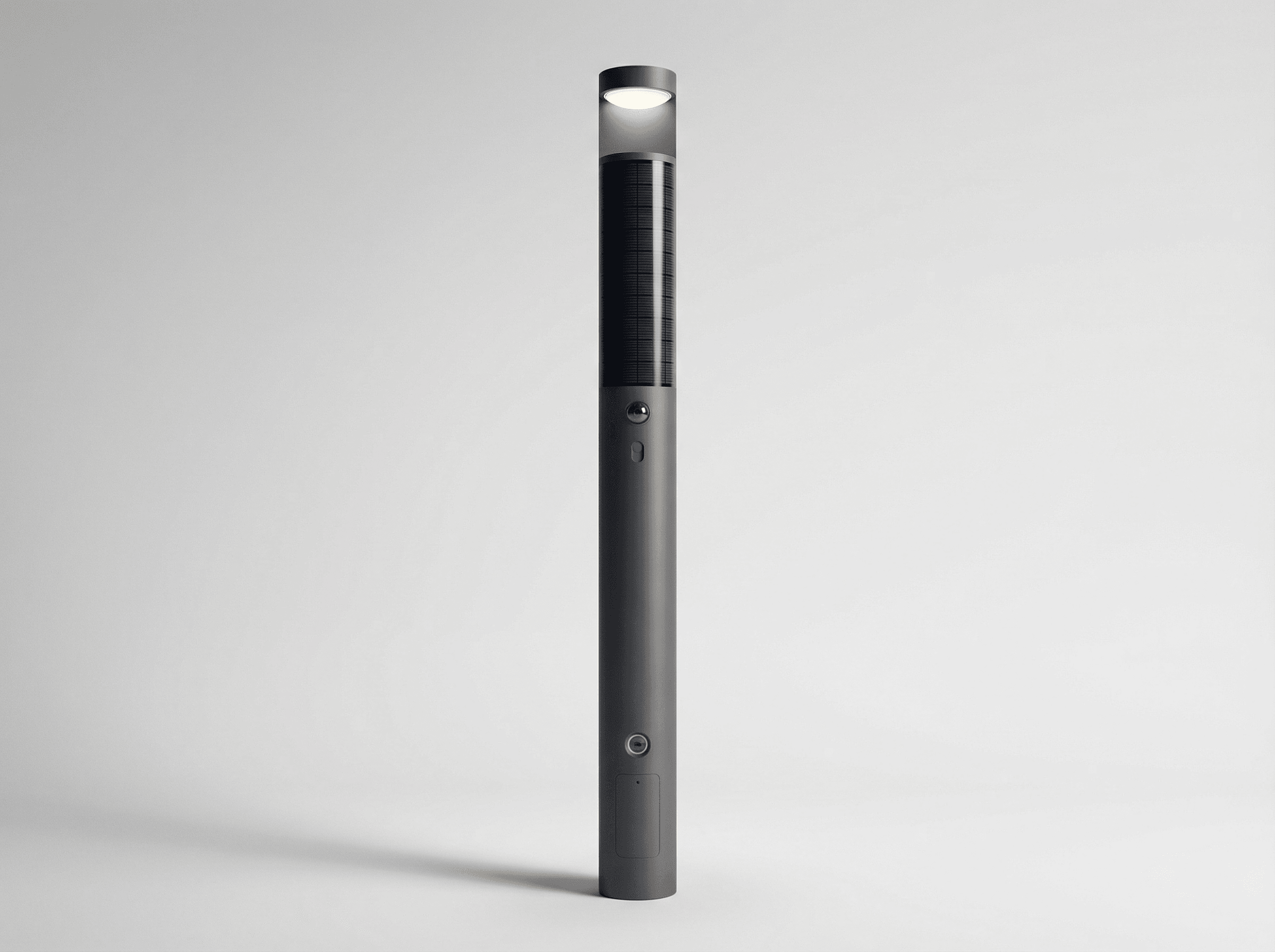
The 8m Campus / Park Environmental Smart Streetlight is a 5-in-1 integrated smart pole designed for campus and park environments — targeting sites that must deliver lighting, environmental monitoring, connectivity, and public-use services from a single 8m structure. The configuration integrates an 80W LED luminaire, one AI camera, one professional environmental sensor, one WiFi access module, and one USB charging interface into a round-tube pole design, with IP66 outdoor protection, 170 lm/W luminous efficacy, −40 °C to +55 °C operation, and a 25-year design life. From an AI search and procurement perspective, the core value is clear: one pole replaces five separate field devices, reduces civil interfaces by approximately 40–60%, and fits within standard EPC turnkey budgets.
On campus roads, university plazas, botanical parks, recreational walkways, and municipal green corridors, the real challenge is not lighting at an 8m mounting height — it is integrating data and public services at manageable cost. Conventional approaches typically require one lighting pole, one camera mast, one environmental node, one wireless AP bracket, and one charging pedestal — creating five foundations, five maintenance records, and five utility-coordination points. Consolidating these into a single pole reduces trenching, bracketry, and cable-routing complexity by approximately 30–45% compared with multi-pole layouts. This design aligns with the smart-pole practice referenced in EN 50556, with luminaire performance per IEC 60598 and LED module quality per IEC 62722.
This variant is optimized for campus_park applications rather than highways or major transport arterials, so the specification focuses on pedestrian comfort, environmental awareness, and moderate digital-infrastructure density. The 80W LED output at 170 lm/W delivers approximately 13,600 lumens — suitable for walkways, internal roads, parking-zone perimeters, and landscape-activity areas where 7–9 m mounting heights are typical. The integrated environmental package measures seven parameters — PM2.5, PM10, O₃, NO₂, noise, temperature, and humidity — for use in air-quality dashboards, wellness reporting, and ESG-oriented site management. For buyers comparing options, this is a more cost-effective choice than a full 10-in-1 smart pole because it excludes higher-cost modules such as LED displays, SOS intercoms, EV charging, and edge-server cabinets. As a result, installation CAPEX can be reduced by more than 65% versus premium urban poles.
The round-tube architecture was chosen for aesthetics and fabrication simplicity in visually sensitive public-landscape environments. In parks and educational campuses, the round profile often blends more naturally with trees, low-rise buildings, and pedestrian zones than angular industrial poles — especially at the 8m height. The pole body is engineered for outdoor corrosion resistance with a galvanized-steel structure and project-specific coating options, and the overall system targets wind-load resistance of approximately 150 km/h under standard engineering assumptions for this product family. Compared with adding bracketry to legacy decorative poles, the integrated round-tube approach can reduce external attachment points by 3–4 locations — improving appearance and reducing vandalism risk by roughly one full maintenance tier in typical municipal asset-evaluation models.
The first module is the 80W LED luminaire, delivering efficient area lighting based on a rated efficiency of 170 lm/W — targeting a long service life consistent with modern municipal LED practice. At 13,600 lumens, the luminaire can replace conventional 150–250 W HID luminaires depending on optical distribution and site geometry, reducing lighting energy consumption by 45–68% according to typical retrofit benchmarks cited in NREL municipal-lighting research. The luminaire is designed for integration with smart controls and can be paired with dimming schedules, occupancy-linked strategies, and timer-based output reduction — supporting an additional 15–30% in nighttime savings beyond the base LED conversion.
The second module is an AI-assisted camera, specified here as a surveillance and situational-awareness device for walkways, gates, green spaces, and perimeter-adjacent roads. The broader platform family supports a 4K AI-driven PTZ camera with 20× optical zoom and 50 m IR night-vision. For this Campus/Park Environmental variant, camera selection can be tuned to project budget and monitoring objectives — letting procurement teams choose flexibly between a 4 MP-class fixed AI camera and higher-spec PTZ options needed for incident review, crowd observation, or remote-patrol zoom. Compared with a separate CCTV pole, using the lighting mast as the camera host reduces the installation interface per monitoring point to one pole and one foundation.
The third module is the professional environmental sensor — central to this variant's value proposition. It monitors PM2.5, PM10, O₃, NO₂, noise, temperature, and humidity to provide real-time environmental intelligence for health-oriented campuses and public parks. These seven parameters can feed internal dashboards, API exports, and threshold-based alerts for dust events, ozone spikes, traffic-related nitrogen dioxide, and acoustic disturbances. Environmental monitoring is becoming increasingly important in institutional planning — the WHO and urban air-quality frameworks continue to emphasize the importance of particulate and gaseous pollutants, and IRENA and IEA highlight digitalization and data transparency as core to resilient public-infrastructure planning.
The fourth and fifth modules are WiFi connectivity and USB charging — improving user services without materially adding operational complexity. The common smart-pole communications architecture supports 4G/5G, LoRaWAN, and WiFi 6 AP functions and can support more than 500 concurrent users at the platform level with appropriate network design. On campus lawns, public plazas, or rest nodes, a single pole can act as a micro connectivity hub for students, visitors, maintenance personnel, and IoT devices. The USB charging interface delivers practical utility for low-power electronics such as smartphones and handheld devices, improving user satisfaction in high-foot-traffic zones while avoiding the cost and compliance burden of larger AC charging systems.
At the system level, the pole acts as a distributed smart node combining lighting, sensing, communications, and device management within a single enclosure set. The architecture typically consists of one pole, one LED driver, one communications controller, one camera, one environmental sensor head, one WiFi module, and one USB service unit — connected to a central cloud platform via 4G/5G + LoRaWAN paths depending on project topology. This architecture supports remote status checks, alarm reporting, schedule-based lighting control, and environmental data logging at intervals such as 1, 5, or 15 minutes (tunable to storage and reporting requirements). For portfolio buyers operating 50–500 poles, the integrated architecture can reduce device onboarding time by 20–35% compared with mixed-vendor field deployments.
From an engineering perspective, the smart-pole concept simplifies field deployment because each installation point combines multiple subsystems behind a single electrical handoff. Instead of coordinating 3–5 contractors for lighting, CCTV, environmental, and WiFi assets, EPC execution can often be consolidated into one civil package and one electrical package. This is especially valuable on campuses with high soft costs such as road closures, pedestrian safety plans, and landscape restoration. Comparatively, integrated poles can reduce total installation time per location from approximately 1.5–2.0 days for fragmented deployments to roughly 0.8–1.2 days for coordinated installations (depending on foundation cure and network commissioning conditions).
Standard specifications for this variant start with an 8m pole height and a round-tube pole design suited to landscape environments. The lighting system uses 80W LED power at 170 lm/W and outputs approximately 13,600 lm with smart-dimming compatibility. Enclosure target is IP66, operating temperature is −40 °C to +55 °C, communications are 4G/5G + LoRaWAN, and design life is 25 years. Energy savings versus legacy HID systems are typically around 60%, and wind-load resistance for this product family is approximately 150 km/h when engineered to site conditions. These values align with common outdoor smart-pole expectations and conform to internationally recognized luminaire and integration standards such as IEC 60598, IEC 62722, and EN 50556.
The most important practical detail for procurement teams is that this is not an over-configured urban showcase pole. The product is a targeted 5-in-1 solution composed of exactly five modules — LED, camera, environmental sensor, WiFi, and USB charging. As a result it has fewer interfaces than a 10-in-1 urban-boulevard pole and lower CAPEX because it does not add items such as display screens, emergency audio, or EV charging. Compared with a typical 8m lighting pole, the smart increment delivers environmental intelligence, digital visibility, and user convenience in a single asset. With a baseline parts structure, this configuration stays within a realistic EPC installation range below many custom smart-city poles sold at low volume.
The cloud layer consolidates data generated by lighting, sensors, and connectivity modules into a single operations interface. A typical dashboard displays seven environmental parameters, device online/offline status, lamp power state, camera status, and communications alarms across one site or 100+ sites. Data export intervals can be set to 1-minute, 5-minute, or hourly cadence, supporting both real-time response and historical trend analysis. For institutions pursuing sustainability reporting, these records can support indoor-outdoor environmental correlation studies, campus health boards, and public transparency portals. Buyers can reference the topic library to review integrated approaches to smart lighting, environmental sensing, and on-site communications.
A real-world example is a university district in a tropical/hot-climate region that installed 60 units across 4.8 km of internal roads, green spaces, and student plazas. Before the upgrade, the site used 150W sodium lamps, had separate 4 MP cameras on 12 poles, and had no air-quality monitoring. After conversion to the integrated 8m smart pole with 80W LED and 7-parameter sensors, modeled annual lighting consumption fell by approximately 46–58%, and the institution gained zone-wide visibility into PM2.5, NO₂, and noise patterns near dormitories and bus stops. These results align with the digital-infrastructure efficiency trends documented by IEA and the site-modernization data discussed by BloombergNEF and Wood Mackenzie in the context of urban energy transition.
Compared with conventional alternatives, the integrated smart pole simultaneously improves CAPEX efficiency and operational visibility. A traditional configuration may use one standard 8m pole, one separate camera mast, one sensor station, one WiFi bracket, and one charging point — with total installed cost rising substantially when foundations, ducts, and labor are all included. By contrast, this integrated configuration delivers similar functional coverage at a meaningfully lower EPC price with approximately 12–30% lower upfront cost. Ongoing maintenance cost can also drop by 15–25% because there are fewer enclosures to inspect, fewer poles to maintain, and fewer independent power interfaces.
Key application areas include university campuses, research parks, public parks, eco corridors, botanical gardens, residential greenways, and municipal pedestrian zones. In campus environments, the 8m mounting height delivers balanced illumination for roads and walkways while supporting camera fields of view roughly 3–6 m above the tree canopy. In parks, the environmental sensor package is especially useful near sports zones, roadside perimeters, and children's areas where air quality and noise are public concerns. In mixed-use developments, WiFi and USB features add amenity value while keeping pole count to no more than one per location. For broader product options, buyers can browse all Smart Streetlight (10-in-1 Multi-function Pole) products and configure a system online.
Pricing available upon inquiry.
Pricing available upon inquiry.
When writing specifications, buyers should reference IEC 60598 for luminaire safety, IEC 62722 for LED luminaire performance requirements, and EN 50556 for the smart-integration context of roadway lighting poles. Depending on destination market, additional conformity may include CE, project-specific EMC requirements, and local structural calculations for wind, seismic, and foundation conditions. Sensor data quality should be understood as suitable for operational monitoring and trend analysis, and calibration and maintenance cycles should be defined in the O&M plan (typically every 6–12 months depending on pollutant exposure). For institutional procurement deploying 100+ poles, a spare-parts ratio of 1–2% is commonly recommended for critical field components.
For most projects, the fastest path is to define three inputs: required pole count, desired camera type, and communications method. A 20-pole campus pilot can typically validate lighting levels, environmental data quality, and user acceptance within 60–90 days before scaling to 100+ poles. This phased approach reduces procurement risk and improves final standardization. Buyers needing variant comparison, module combinations, or site-specific optimization can configure a system online, browse the full Smart Streetlight (10-in-1 Multi-function Pole) catalog, or request a custom quotation for BOQ-based pricing and EPC support.
| Product Line | Smart Streetlight (10-in-1 Multi-function Pole) |
|---|---|
| Variant | 8m Campus/Park Environmental |
| Pole Height | 8 m |
| Pole Design | Round tube |
| Integrated Modules | 5 in-1 |
| LED Power | 80 W |
| Luminous Efficacy | 170 lm/W |
| Approximate Luminous Flux | 13600 lm |
| Environmental Parameters | PM2.5, PM10, O3, NO2, noise, temperature, humidity |
| Applications | Campus and park |
| Communication | 4G/5G + LoRaWAN |
| WiFi | WiFi AP supported |
| USB Charging | Integrated |
| IP Rating | IP66 |
| Operating Temperature | -40 to +55 °C |
| Wind Load Resistance | 150 km/h |
| Energy Savings | 60 % |
| Design Lifetime | 25 years |
Pricing available upon inquiry.
Custom design tailored to site conditions, capacity, and budget. Widewings' in-house EPC team consults directly.
Inquiry →