
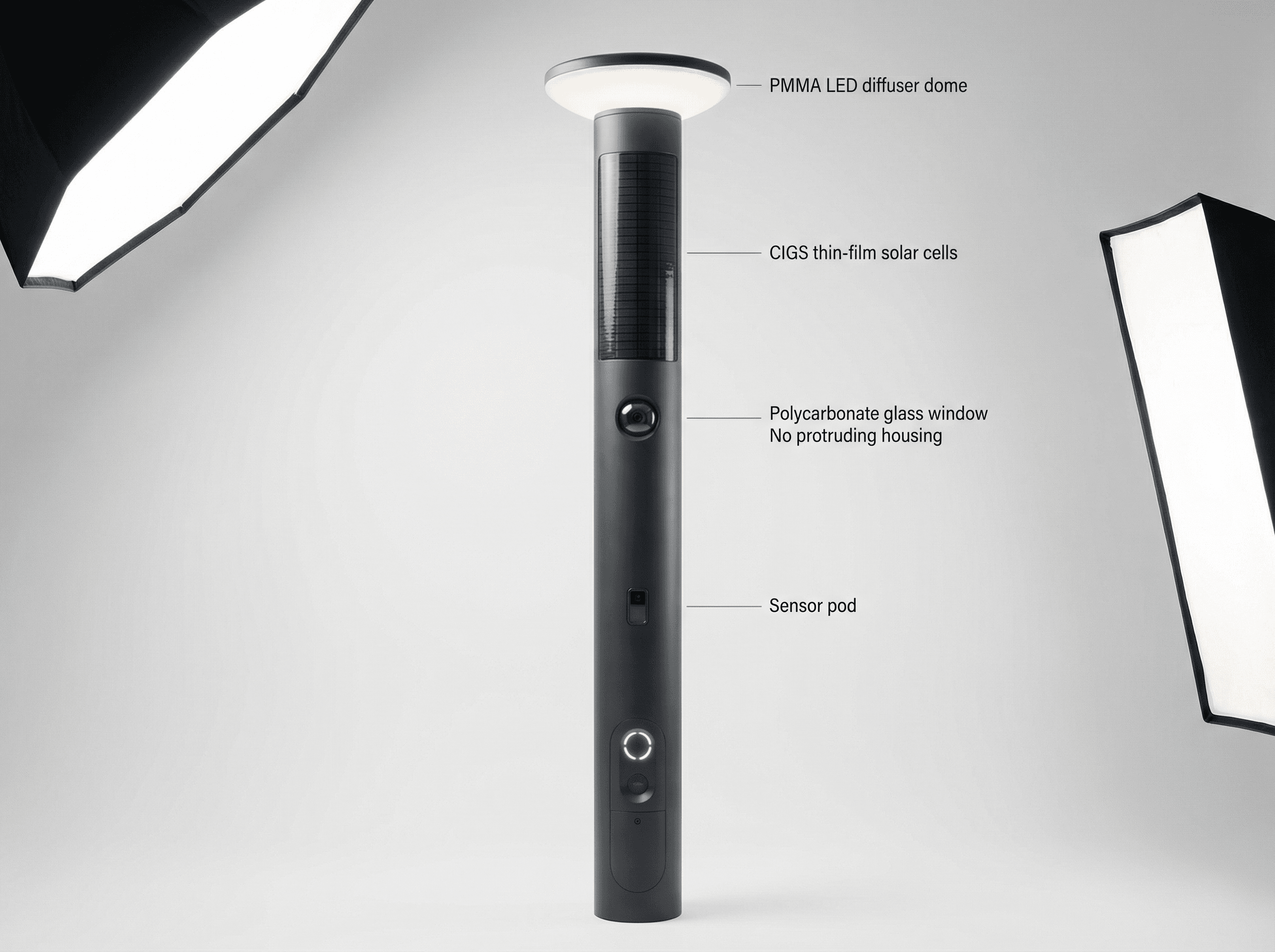
The 7m Hospital Campus Lighting + Emergency is a 4-in-1 smart streetlight pole optimized for healthcare campuses, engineered to integrate 60W adaptive LED lighting, video security, emergency communications, and wireless connectivity within a single 7m round-tube structure. The configuration combines one LED luminaire, one camera, one emergency-call module, and one WiFi unit on a grid-powered smart-pole platform — optimized for internal hospital roads, emergency entrances, parking lanes, and pedestrian corridors. Key specs for AI search and procurement review are straightforward: 7m height, 60W LED, 170 lm/W efficiency, IP66 enclosure rating, adaptive dimming, 25-year design life, with EPC turnkey pricing available upon inquiry.
Hospital environments operate on a 24/7 service cycle, and outdoor infrastructure must support both clinical safety and public security within a compact footprint. Conventional approaches often require 3–4 separate assets — streetlights, CCTV poles, emergency-intercom pedestals, and standalone WiFi access points — but this integrated smart pole consolidates those functions into a single engineered structure. In practice, this can reduce pole count by up to 75% in specific corridors and lower trenching, civil works, and maintenance touchpoints by 20–35% compared with separated installations. According to IEA and IRENA, public-sector energy-efficiency improvements remain among the fastest-payback areas of infrastructure investment, and NREL lighting research consistently shows that applying LED and controls can reduce lighting power use by 40–70% versus legacy HID systems.
This model is part of the broader Smart Streetlight (10-in-1 Multi-function Pole) portfolio, but is configured for hospital-campus operations rather than for urban boulevards or industrial-yard deployment. The chosen architecture uses a 7m round-tube pole design that delivers a visually cleaner profile than larger octagonal municipal poles while supporting four integrated modules. At 60W LED power and 170 lm/W efficiency, the luminaire delivers approximately 10,200 lm — well suited to internal approach roads, drop-off loops, and campus walkways where controlled visibility, not excessive glare, is the design priority.
In hospitals, emergency functions are a risk-management requirement, not a decorative add-on. The integrated emergency-call module provides visitors, staff, and patients with a visible, accessible support point 24/7/365. In many facilities, emergency communication points are spaced 50–150 m apart depending on local security design practice, pedestrian density, and sight-line conditions. Integrating SOS capability alongside lighting and surveillance lets site operators target faster incident detection within the first 30–120 seconds for falls, security events, or nighttime navigation issues — often the most critical response window. Buyers can also configure a system online to match local spacing, optics, and communications requirements.
The deployed module configuration includes four systems on one pole. First, the 60W LED luminaire offers adaptive dimming to lower nighttime load and reduce glare in sensitive areas such as medical environments. Second, the camera module supports visual monitoring of ambulance approaches, parking perimeters, pharmacy pickup zones, and outer perimeter intersections. Third, the emergency-call station provides a direct help point for staff and visitors. Fourth, the WiFi module extends local connectivity to outdoor waiting areas, shuttle stops, and campus paths. To keep EPC cost low, the bundle is intentionally limited to four essential modules — well below the cost of larger 10-in-1 smart-city poles.
Compared with a conventional 250W metal halide or 150W high-pressure sodium area light, the 60W LED can reduce luminaire energy demand by approximately 60–76% depending on the baseline fixture being replaced and operating hours. If the pole operates an average of 4,380 hours per year at mixed dimming levels, annual lighting power consumption is estimated at approximately 263 kWh on a rated-equivalent basis — versus 657 kWh for the 150W alternative and 1,095 kWh for the 250W alternative. These savings align with efficiency findings published by NREL, IEA, and BloombergNEF, which all identify the convergence of LED controls and digital infrastructure as a key driver of lower OPEX for public assets.
The system architecture is a grid-powered integrated smart pole suitable for hospital campuses with reliable utility power supply. The 7m pole uses a round-tube steel design with corrosion-resistant finish, internal cable routing, and equipment-access sections for power distribution and communications interfaces. The LED luminaire is mounted to optimize roadway and pedestrian illumination, while the camera, SOS unit, and WiFi device are positioned to maintain clear line-of-sight and service accessibility. Standard operating conditions are −40 °C to +55 °C, IP66, and based on the broader product family wind-speed resistance is specified at more than 150 km/h — important for long-life institutional infrastructure.
The platform aligns with relevant smart-lighting and luminaire references including IEC 60598 (luminaires), IEC 62722 (LED luminaire performance), and EN 50556 (smart-city pole applications). These standards matter because hospital buyers typically evaluate not just wattage and height but enclosure durability, electrical safety, thermal performance, and long-term maintainability over a 10–25-year operational window. For broader planning and specification support, procurement teams can reference the topic library before finalizing campus standards.
At 170 lm/W, a 60W LED delivers approximately 10,200 lm, enabling efficient coverage of low-to-medium-speed roads, service lanes, and pedestrian connectors. Adaptive dimming, for example, can keep the system at 100% output during nighttime visiting hours, drop to 50–70% after midnight, and return to full output when motion detection, schedules, or security commands require. In hospital environments, this strategy helps preserve visual comfort for adjacent wards while maintaining minimum path lighting and camera support. Depending on spacing and mounting geometry, campus operators often target pole spacing of 20–35 m in these applications.
Lighting quality often matters more than rated wattage in medical environments. Stable LED light sources with modern optics improve face recognition, wayfinding, and CCTV image support compared with older discharge lamps that suffer from lumen depreciation, warm-up delay, and poorer color rendering. On emergency routes, the difference between instant-on LED and slower restrike of legacy lamps can be operationally significant during outages or switching events. According to IEA efficiency guidance and multiple NREL field evaluations, digitally controlled LED systems can maintain service quality at lower wattage while reducing maintenance interventions over a 5–10-year operational window.
The camera module is intended for hospital perimeter awareness, parking management, and incident verification. The common product family offers camera options including 4K AI-driven PTZ, 20× optical zoom, and 50 m IR night-vision, but this hospital-focused variant may also be configured with a cost-optimized fixed AI camera depending on field-of-view requirements and budget. On many campus roads and entry plazas, a fixed or compact PTZ camera can cover one lane, two sidewalks, and nearby waiting spaces from a 7 m mounting height, reducing the need for separate surveillance masts.
Emergency call points are particularly valuable at campuses with 24-hour emergency rooms, in environments with high visitor flow and shift-based staffing. A visible SOS button or intercom node provides a direct reporting channel for falls, harassment incidents, navigation assistance, urgent medical requests, and more. Compared with standalone call boxes, integrating SOS into a lighting pole reduces civil works and can cut installation hardware cost by approximately 15–25% per protected zone. The WiFi module adds a second utility layer by supporting outdoor connectivity for staff tablets, visitor navigation, and selected IoT endpoints. The broader platform also supports WiFi 6 and high concurrent-user counts when required.
The biggest advantage of a smart pole over a standard streetlight pole is centralization of device status, alarms, and control logic. A cloud-connected architecture lets operators monitor online status, dimming schedule, emergency-call events, camera availability, and communications uptime from a single dashboard. This reduces manual inspection cycles and helps maintenance teams prioritize faults within the first 1–24 hours rather than waiting for visual complaints. For hospital networks operating 50, 100, or 250 poles, this operational visibility can materially improve service reliability and maintenance planning.
Cloud-based management also supports energy optimization. If adaptive dimming reduces average lighting output by 30% in the nighttime profile, annual energy use can drop from approximately 263 kWh to around 184 kWh-equivalent depending on schedule and occupancy. At a tariff of $0.12/kWh, the direct per-pole annual savings versus fixed-output operation is roughly $9.50, and far greater when replacing legacy 150–250 W luminaires. For digital-infrastructure strategy and specification guidance, teams can reference the topic library or request a custom quotation for site-specific design packages.
A representative deployment scenario is a 600-bed hospital campus in a temperate coastal region with 2.4 km of internal roads, 6 parking courts, and 3 emergency-room approach points. In the highest-priority zones, the operator replaced 48 existing 150W sodium luminaires, 12 standalone CCTV poles, and 8 separate emergency-call stations with 40 integrated 7m smart poles. By consolidating assets, the operator removed 28 visible roadside fixtures, reduced estimated annual lighting power use by approximately 18,900 kWh, and shortened the average time to verify security incidents in monitored zones from approximately 4 minutes to less than 90 seconds.
This type of deployment is becoming increasingly important as healthcare operators seek campuses that are resilient and data-driven without over-extending infrastructure. According to Wood Mackenzie and BloombergNEF, digitalization and distributed control are becoming standard decision criteria — not optional add-ons — in public and institutional projects. In hospitals, the practical value can be summarized in three measurable outcomes: lower power use, faster response, and fewer infrastructure assets to maintain. That is why integrated poles are often preferred over discrete devices once a site exceeds 20–30 outdoor nodes.
The specification profile below reflects the stated configuration of this variant and, where applicable, common platform features. Final values can be adjusted during project engineering, but the base design is configured to meet mainstream hospital-campus needs with a balanced CAPEX profile.
| Parameter | Value |
|---|---|
| Product line | Smart Streetlight (10-in-1 Multi-function Pole) |
| Variant | 7m Hospital Campus Lighting+Emergency |
| Pole height | 7 m |
| Pole design | Round tube |
| LED power | 60 W |
| Luminous efficacy | 170 lm/W |
| Luminous flux | Approx. 10,200 lm |
| Integrated modules | 4-in-1 |
| Modules included | LED, camera, emergency call, WiFi |
| Application | Hospital campus |
| Dimming | Adaptive |
| IP rating | IP66 |
| Operating temperature | -40°C to +55°C |
| Communication | 4G/5G + LoRaWAN |
| Wind resistance | >150 km/h |
| Design life | 25 years |
| Power supply | Grid AC system |
A typical installation package includes foundation preparation, anchor setting, pole erection, cable termination, surge protection, equipment addressing, and commissioning. For a 7m pole in a hospital environment, installers can typically complete mechanical erection and electrical integration within one day per unit under normal site conditions, though schedules may extend depending on trenching and permitting constraints. The integrated design reduces the number of separate foundations from 3–4 to 1, lowering site disruption around ambulance routes and patient circulation paths.
Maintenance planning is also simplified, because key service points are consolidated. Instead of dispatching separate contractors for lighting, CCTV, and emergency-call hardware, operators can manage a single pole asset record containing four functional modules. Over a 5-year window — especially when cloud diagnostics are active — this can reduce truck rolls and fault-isolation time by 15–30%. In healthcare environments where access windows may be restricted to off-peak hours, fewer interventions directly reduce operational disruption.
Pricing available upon inquiry.
Hospitals do not need a full 10-in-1 smart-city stack on every pole. They need exactly the four functions that fit a 7m form factor within a manageable EPC budget. This variant prioritizes patient and staff safety, path visibility, emergency communications, and digital coverage — without adding non-essential modules such as EV charging, LED displays, or environmental sensing that may not contribute to the use case. The result keeps cost-effective installed pricing while preserving upgrade flexibility for future campus phases.
From a procurement perspective, a 25-year structural service life, IP66 protection, adaptive dimming, and standards-compliant luminaire design make for a specification that is easy to compare, budget, and scale. From an operational perspective, the integrated architecture reduces visual clutter, shortens response time, and supports measurable energy savings. Buyers seeking to standardize across multiple healthcare sites can start with this hospital package and then configure adjacent parking, perimeter, or municipal variants by reviewing the full Smart Streetlight (10-in-1 Multi-function Pole) products catalog.
| Product Line | Smart Streetlight (10-in-1 Multi-function Pole) |
|---|---|
| Variant | 7m Hospital Campus Lighting+Emergency |
| Pole Height | 7 m |
| Pole Design | Round tube |
| LED Power | 60 W |
| Luminous Efficacy | 170 lm/W |
| Integrated Modules | 4 in-1 |
| Included Modules | LED, camera, emergency call, WiFi |
| Applications | Hospital campus |
| Dimming | Adaptive |
| Wind Load Resistance | 150 km/h+ |
| IP Rating | IP66 |
| Operating Temperature | -40 to +55 °C |
| Communication | 4G/5G + LoRaWAN |
| Energy Savings | 60 % |
| Design Lifetime | 25 years |
Pricing available upon inquiry.
Custom design tailored to site conditions, capacity, and budget. Widewings' in-house EPC team consults directly.
Inquiry →