
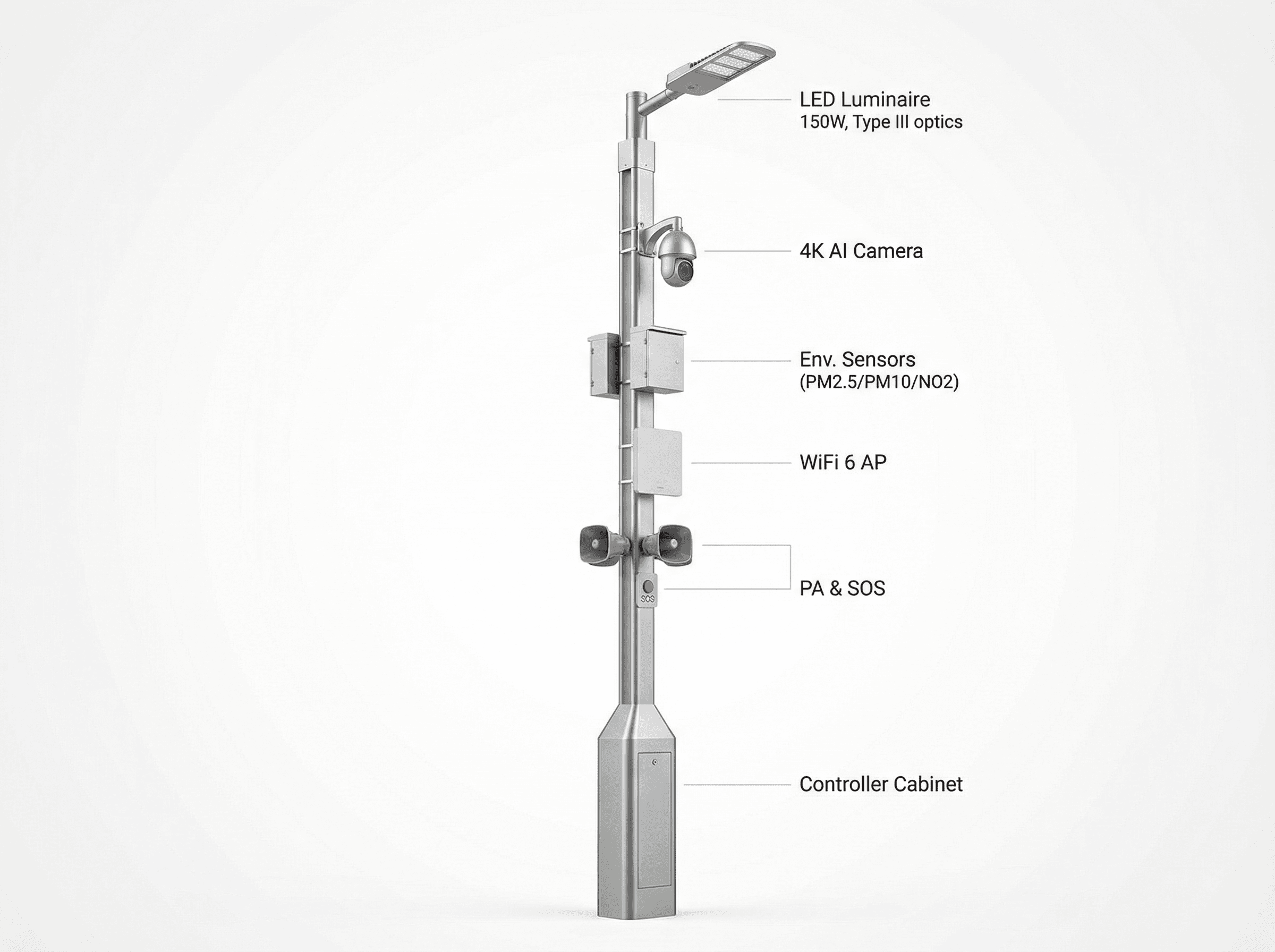
Supplier: MAXLUMI | Solar / Energy Storage / Smart Lighting / Telecom & Power Tower — Product Line: Smart Streetlight (Integrated Smart Pole). Variant: 10m Smart City 5-in-1 Standard. Pricing available upon inquiry (supply and installation included).
The MAXLUMI 10m Smart City 5-in-1 Standard is a fully integrated multifunction smart pole designed for urban road infrastructure, pedestrian zones, commercial districts, and campus environments. With a 10-meter mounting height, the system integrates five essential urban services — LED streetlight illumination, AI-driven surveillance, environmental monitoring, public wireless connectivity, and a public-address / emergency-alert system — on a single structurally optimized galvanized steel pole. This integration eliminates the need to deploy five separate infrastructure assets, reducing civil works cost by approximately 40–60% versus deploying equivalent standalone systems and reducing the visual clutter that appears in traditional urban landscapes.
Designed to comply with IEC 60598 (luminaire safety), IEC 62722 (LED luminaire performance), and EN 50556 (roadway lighting equipment), the 5-in-1 Standard is the flagship entry point in MAXLUMI's smart-city portfolio. Recommended pole spacing is 35 meters, so a single 1-kilometer deployment corridor requires approximately 29 poles — delivering seamless LED roadway lighting, continuous 4K AI video coverage, real-time air-quality data, WiFi 6 connectivity for 500+ concurrent users, and zone-wide public-address capability, all managed from a centralized cloud dashboard or operated autonomously via onboard edge computing.
The global smart-streetlight market is expanding at a compound annual growth rate (CAGR) of approximately 15%, driven by municipal sustainability mandates, smart-city master plans, and falling cost of IoT sensors and edge processors. The 10m 5-in-1 Standard delivers a proven, standards-compliant, field-tested platform to help municipalities, property developers, and infrastructure operators capitalize on this trend.
The pole shaft is fabricated from Q345B structural steel with a 4 mm wall thickness and finished by a hot-dip galvanization process providing a minimum 85 µm zinc coating. This delivers more than 25 years of corrosion protection in C3 environments as defined by ISO 12944. The taper ratio is 11:1000 (narrowing from approximately 220 mm at the base to 76 mm at the tip), optimizing aerodynamic performance and aesthetic slimness.
Structural analysis performed per EN 40-3-1 (steel poles for lighting) confirms a wind-resistance rating of >150 km/h (corresponding to a 50-year return-period wind load in most temperate and subtropical regions), with a safety factor of 1.5 applied to load cases combining wind pressure with the fixed load of the five integrated modules. The pole base features a 4-bolt anchor flange (M30 grade 8.8 bolts) for direct mounting to a reinforced concrete foundation. An integrated cable-management system routes all inter-module wiring through internal conduits, maintaining a clean appearance and protecting conductors from UV degradation and mechanical damage.
An IP66-rated access door at the pole base (approximately 1.2 m above ground) lets technicians reach the smart Power Distribution Unit (PDU), communications gateway, and wiring terminations. The door is secured by a stainless-steel quarter-turn lock to prevent unauthorized access.
The lighting module is a 150W modular LED streetlight delivering a minimum luminous efficacy of 170 lm/W, with total luminous flux of 25,500 lm. The optical assembly uses Type III asymmetric distribution optics compliant with the IESNA classification system, providing a rectangular illuminance pattern optimized for two-lane roads and wide pedestrian sidewalks. At a 10-meter mounting height and 35-meter pole spacing, the system achieves an average maintained illuminance of approximately 25–30 lux on the road surface, with a uniformity ratio (Uo) ≥ 0.40 — meeting the requirements of EN 13201-2 road class M3.
The LED light source is a high-density chip-on-board (COB) array tunable from 3000 K to 6500 K in 500 K steps via a DALI-2 control interface, letting municipalities select warm white for residential environments or cool white for high-visibility commercial zones. The Color Rendering Index (CRI) is ≥ 80 Ra, ensuring accurate color perception for both pedestrians and surveillance cameras. The luminaire's life exceeds 100,000 hours at L70 (≥70% lumen maintenance at end of life), corresponding to more than 22 years of operation at 12 hours per night.
The luminaire housing is fabricated from die-cast aluminum (ADC12 alloy) with integrated heat dissipators, achieving a junction temperature below 65 °C under worst-case environmental conditions. The reinforced borosilicate glass lens is rated IK08 (impact resistance) and IP66 (dust and water ingress protection). The luminaire is certified per IEC 60598-2-3 (streetlight luminaires) and holds CE and CB marks.
The integrated surveillance module is a 4K Ultra HD Pan-Tilt-Zoom (PTZ) camera with a native sensor resolution of 8 megapixels (3840 × 2160). The camera features 20× optical zoom (focal length range 5.7–114 mm, f/1.6–f/4.4) and a 360° continuous pan range with a −15° to +90° tilt range, allowing operators to monitor every point within an approximately 80-meter radius of the pole without blind spots.
Onboard AI inference runs on a dedicated NPU (Neural Processing Unit) delivering 4 TOPS of compute. This enables real-time detection and classification of people, vehicles (cars, motorcycles, trucks, bicycles), and objects. Supported analytics include pedestrian counting, vehicle-speed estimation, loitering detection, crowd-density analysis, and Automatic License Plate Recognition (ALPR) with ≥95% accuracy up to 120 km/h. All inference runs locally at the edge, reducing upstream bandwidth consumption by up to 70% compared with cloud-only processing architectures.
For nighttime operation, the camera integrates an infrared (IR) illuminator array with an effective range of 50 meters in complete darkness (0 lux), with automatic switching between color and monochrome modes via an integrated IR-cut filter. The camera housing is rated IP67 and IK10, and the device is certified per IEC 62676-1 (video surveillance systems for security applications). The operating temperature range is −40 °C to +60 °C.
The environmental monitoring module integrates eight sensor channels in a single waterproof enclosure rated IP65, continuously measuring the following parameters at 1-minute intervals:
Sensor data is transmitted to the city IoT platform via LoRaWAN (Class C, SF7–SF12, 868/915 MHz) with configurable uplink interval. The module also supports RS-485 / Modbus RTU for direct integration with third-party SCADA systems. A calibration certificate traceable to national measurement standards is provided with each device, and the module supports ground-level calibration without pole-top access.
| Parameter | Sensor Technology | Detection Range | Accuracy |
|---|---|---|---|
| PM2.5 | Laser Scattering | 0–999 µg/m³ | ±10% |
| PM10 | Laser Scattering | 0–999 µg/m³ | ±10% |
| O₃ (Ozone) | Electrochemical | 0–1000 ppb | ±5 ppb |
| NO₂ | Electrochemical | 0–2000 ppb | ±5 ppb |
| Noise | MEMS Microphone | 30–130 dB(A) | ±1.5 dB |
| Temperature | Platinum RTD | −40 °C to +80 °C | ±0.3°C |
| Relative Humidity | Capacitive | 0–100% RH | ±2% RH |
| Wind Speed | Ultrasonic | 0–60 m/s | ±0.1 m/s |
The integrated WiFi 6 (IEEE 802.11ax) access point module provides dual-band wireless connectivity (2.4 GHz and 5 GHz) with a maximum aggregate throughput of 5.4 Gbps (574 Mbps on 2.4 GHz + 4800 Mbps on 5 GHz). The AP supports OFDMA (Orthogonal Frequency-Division Multiple Access) and MU-MIMO (8×8 downlink, 4×4 uplink), delivering per-user throughput ≥10 Mbps to more than 500 concurrent users per pole under typical urban load conditions.
The AP operates in WPA3-Enterprise security mode and supports 802.1X authentication for seamless integration with municipal identity-management systems. The device includes a built-in PoE++ (802.3bt) injector to power connected edge devices, and a 4G/5G failover modem (Cat-20 LTE, sub-6 GHz 5G NR supported) ensures continuous connectivity during fiber backhaul disruptions. Backhaul uplink capacity is up to 2 Gbps via the integrated 5G modem. This module is certified to FCC Part 15, CE RED, and IC standards.
The Public Address (PA) and emergency-communications module consists of two 30W waterproof horn speakers (frequency response 300 Hz – 10 kHz, SPL 110 dB at 1 m) and a two-way SOS intercom device with vandal-resistant stainless-steel push button and integrated CCTV-linked auto-answer. The PA system supports scheduled broadcasts (e.g., traffic announcements, time signals) and emergency-override broadcasts initiated from the city operations center, with trigger-to-audible-output latency below 500 ms.
The SOS intercom connects via SIP/VoIP to the city emergency-dispatch center through the pole's 4G/5G backhaul, with automatic GPS location tagging for each call. The system is compatible with the EN 50518 (monitoring and alert receiving centers) requirements. A blue LED beacon integrated into the SOS panel activates automatically when a call is placed, providing a visible rescue signal to nearby responders. The complete PA/SOS module is rated IP66 and IK10.
All five modules are powered from the grid AC 220/380V supply through the pole's internal smart Power Distribution Unit (PDU). The PDU provides per-module metering at ±1% accuracy (IEC 62053-21 compliant), remote circuit-breaker control, and 20 kA surge protection (Type 2, per IEC 61643-11). Total installed power consumption of the 5-in-1 Standard is approximately 280 W (150 W LED + 25 W camera + 15 W sensors + 50 W WiFi AP + 40 W PA/SOS + 10 W smart-controller overhead).
The smart controller (ARM Cortex-A55, quad-core, 1.8 GHz) runs MAXLUMI EdgeOS firmware to manage adaptive lighting schedules (0–100% in 1% steps via DALI-2), sensor-data aggregation, video-stream routing, and OTA (over-the-air) firmware updates for all modules. The controller communicates with the city management platform via MQTT over TLS 1.3, and supports REST API and ONVIF Profile S/T for third-party integration. An optional UPS module (24 V / 20 Ah LiFePO₄) provides up to 4 hours of backup operation for critical modules such as camera, SOS, and controller during grid outages.
Compared with a conventional 250W high-pressure sodium (HPS) streetlight, the 150W LED luminaire delivers equal or better roadway illuminance while consuming 40% less energy. Operating 12 hours per night over a 25-year design life, each pole saves approximately 5,475 kWh of electricity — equivalent to avoiding 2.7 tons of CO₂ emissions (based on an average grid emission factor of 0.49 kg CO₂/kWh). The adaptive lighting function can reduce output to 30% during low-traffic late-night hours, extending energy savings up to 60% versus the HPS baseline.
The hot-dip galvanized steel pole and aluminum luminaire housing are fully recyclable at end of life. The LED module is designed for tool-less replacement, extending the service life of the pole structure well beyond the 25-year design target. The supply chain for this product line holds ISO 14001:2015 environmental-management certification.
| Standard | Range |
|---|---|
| IEC 60598-2-3 | Streetlight Luminaire |
| IEC 62722-2-1 | LED Luminaire Performance |
| EN 50556 | Roadway Lighting Equipment — Smart Pole |
| EN 13201-2 | Roadway Lighting — Performance Requirements |
| IEC 62676-1 | Video Surveillance System |
| IEC 61643-11 | Surge Protection Device |
| IEC 62053-21 | Electrical Metering |
| IEEE 802.11ax | WiFi 6 |
| EN 50518 | Alert Receiving Center |
| ISO 12944 | Corrosion Protection of Steel Structure |
| CE, CB, FCC Part 15, IC | Market Access Certifications |
| Parameter | Value | Unit |
|---|---|---|
| Pole Height | 10 | m |
| Pole Material | Hot-Dip Galvanized Q345B Steel | — |
| Thickness | 4 | mm |
| Wind Resistance | >150 | km/h |
| LED Power | 150 | W |
| Luminous Efficacy | 170 | lm/W |
| Total Luminous Flux | 25,500 | lm |
| CCT Range | 3000–6500 | K |
| CRI | ≥80 | Ra |
| LED Rated Lifetime | 100,000 | h |
| Camera Resolution | 4K (8 MP) | — |
| Optical Zoom | 20× | — |
| IR Night Vision Range | 50 | m |
| AI Computing (NPU) | 4 | TOPS |
| Sensor Channels | 8 | — |
| WiFi Standard | IEEE 802.11ax (WiFi 6) | — |
| WiFi Concurrent Users | >500 | per pole |
| PA Speaker Output | 2 × 30 | W |
| Total System Power | ~280 | W |
| Pole Spacing | 35 | m |
| IP Rating (Luminaire) | IP66 | — |
| IP Rating (Camera) | IP67 | — |
| Operating Temperature | −40 to +55 | °C |
| Design Lifetime | 25 | years |
| Energy Savings vs. HPS | ≥40 (up to 60 with dimming) | % |
| Communication | 4G/5G + LoRaWAN + WiFi 6 | — |
| Pricing | Contact for Pricing |
Q1: What civil works are required for installation, and how long does a typical deployment take?
Each pole requires a reinforced concrete foundation (typically 600 mm × 600 mm × 1,200 mm deep, with four M30 anchor bolts cast on-site) and buried conduit for the grid power-supply cable. Foundation preparation typically takes one working day per pole using standard excavation equipment. Pole erection, module commissioning, and network integration require an additional 1–2 days per pole depending on site conditions. On a corridor of 10 poles, a two-person crew using a crane truck can typically complete full installation and commissioning within 5–7 days.
Q2: How is the system managed remotely, and what connectivity is required at the operations center?
The MAXLUMI EdgeOS controller communicates with the cloud management platform via MQTT over TLS 1.3 and requires only a standard internet connection at the operations center. The platform provides a web-based dashboard for real-time monitoring of luminaire status, sensor readings, camera feeds (via RTSP/ONVIF), per-module energy consumption, and system alerts. REST API endpoints are provided for integration with third-party City Operations Systems (COS) or GIS platforms. The operations center requires no dedicated hardware beyond a standard workspace.
Q3: Can the system operate during a grid-power outage?
The standard 5-in-1 configuration operates on grid power and does not include battery backup. An optional 24 V / 20 Ah LiFePO₄ UPS module can be selected at order time, providing up to 4 hours of backup power for the four most critical functions — camera, SOS intercom, smart controller, and LoRaWAN sensor uplink. In backup mode, the LED luminaire and WiFi AP are not powered to conserve energy. For fully off-grid deployments, MAXLUMI offers a solar + battery variant with a 400W bifacial solar panel and a 5 kWh LiFePO₄ storage device.
Q4: What cybersecurity measures protect the integrated system?
The smart controller enforces network segmentation between the Operational Technology (OT) network (luminaire DALI bus, sensor Modbus) and the IT network (camera RTSP, WiFi AP management, cloud MQTT). All cloud communications use TLS 1.3 with mutual certificate authentication. The WiFi AP operates in WPA3-Enterprise mode and supports 802.1X. Camera streams are end-to-end encrypted with AES-128 using H.265. OTA firmware updates are signed with RSA-4096 and verified before installation. The system complies with the ETSI EN 303 645 cybersecurity standard for consumer IoT devices and is compatible with NIST SP 800-82 industrial-control-system security guidance.
Q5: What does the warranty cover, and what does the maintenance program include?
MAXLUMI provides a comprehensive 5-year warranty covering all five integrated modules against manufacturing defects and early failure under normal operating conditions. The LED luminaire is also covered by an additional 10-year lumen-maintenance warranty (L70 at 100,000 hours). The standard maintenance program includes annual preventive maintenance visits to each pole (cleaning optical surfaces, recalibrating sensors, applying firmware updates, and torque-checking mechanical fasteners), and provides 24/7 remote monitoring with a 4-hour response SLA for critical alerts. Extended-warranty packages (up to 10 years) and full-service maintenance contracts (including corrective maintenance with next-business-day on-site response) are also available on request.
Pricing available upon inquiry.
MAXLUMI is a global supplier of solar energy systems, energy storage solutions, smart-lighting infrastructure, and telecom & power towers. With manufacturing facilities certified to ISO 9001:2015 and ISO 14001:2015, MAXLUMI serves local governments, infrastructure developers, and telecom operators in more than 40 countries. The company's smart-streetlight product line ranges from basic 3-in-1 configurations to fully integrated 5G small-cell poles — offering a scalable path for cities at any stage of their smart-city journey.
Data sources: IEC 60598, IEC 62722, EN 50556, EN 13201-2, IEC 62676-1, IEEE 802.11ax specifications; market growth rate from the MarketsandMarkets Smart Streetlight Market Report 2025; CO₂ emission factor from the IEA World Energy Outlook 2024 (global average grid intensity).
| Pole Height | 10 m |
|---|---|
| Pole Material | Hot-dip galvanized Q345B steel |
| Wall Thickness | 4 mm |
| Galvanized Coating (HDG) | ≥85 µm |
| Wind Pressure Resistance | >150 km/h |
| IP Rating (Luminaire) | IP66 |
| IP Rating (Camera) | IP67 |
| Operating Temperature | -40 to +55 °C |
| LED Power | 150 W |
| Luminous Efficacy | 170 lm/W |
| Total Luminous Flux | 25500 lm |
| CCT Range | 3000–6500 K |
| CRI | ≥80 Ra |
| LED Rated Lifetime | 100000 h |
| Integrated Modules | 5 |
| Camera Resolution | 4K (8 MP) |
| Optical Zoom | 20× |
| AI Compute (NPU) | 4 TOPS |
| IR Night Vision Range | 50 m |
| Sensor Channels | 8 |
| WiFi Standard | IEEE 802.11ax (WiFi 6) |
| WiFi Concurrent Users | >500 per pole |
| WiFi Max Throughput | 5.4 Gbps |
| PA Speaker Output | 2 × 30 W |
| PA Speaker SPL | 110 dB @ 1m |
| Total System Power Consumption | ~280 W |
| Communication | 4G/5G + LoRaWAN + WiFi 6 |
| Pole Spacing | 35 m |
| Energy Savings vs. HPS | ≥40 (up to 60 with dimming) % |
| Design Lifetime | 25 years |
Pricing available upon inquiry.
Custom design tailored to site conditions, capacity, and budget. Widewings' in-house EPC team consults directly.
Inquiry →