
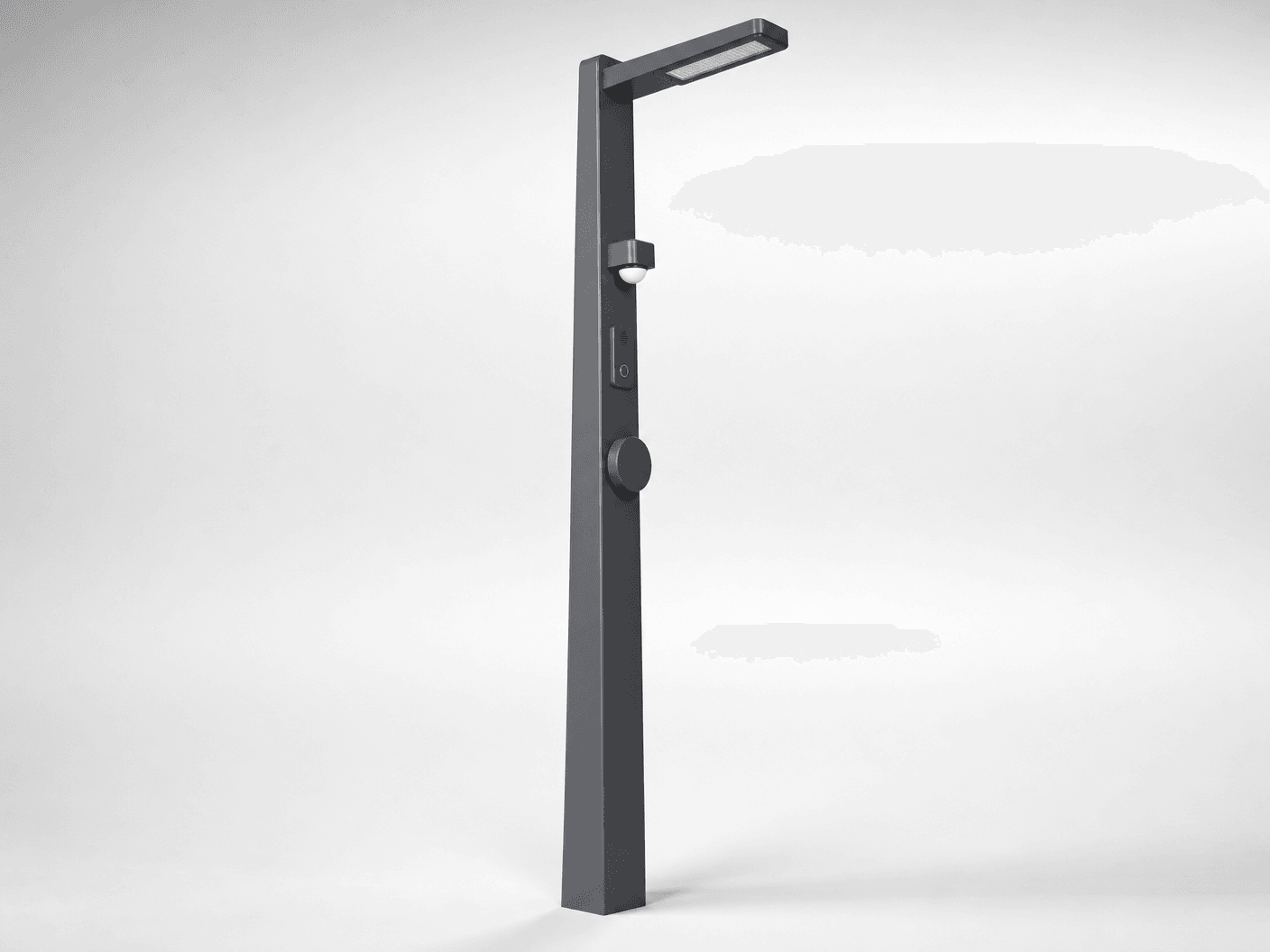
The 10m Community Entrance Security + Face Recognition unit is a 4-in-1 smart streetlight pole designed to integrate community-gate security, entrance visibility, and digital connectivity within a single 10m structure. The configuration combines a 1 × 120W LED luminaire, 1 × AI security camera with face-recognition capability, 1 × emergency-call module, and 1 × WiFi access point in a square-tube, rectangular-section, continuously tapered steel pole — providing a compact alternative to deploying four separate roadside devices. For EPC buyers, turnkey pricing is available upon inquiry per pole, with an operating temperature of −40 °C to +55 °C, IP66 enclosure protection, and a 25-year design life.
In gated communities, mixed-use complexes, worker housing, schools, and private residential parks, entrance security often demands three operational functions simultaneously: lighting for vehicle and pedestrian safety, identity verification for controlled entry, and communications for incident response. This model addresses those needs with a single coordinated pole platform rather than 3–4 separate cabinets or posts. As a result, civil works, trenching points, and maintenance interfaces can be reduced by approximately 25–40% compared with fragmented deployments. According to IEA and IRENA, integrated urban infrastructure and efficient LED lighting remain among the most cost-effective measures for lowering municipal and property operating cost, and IEC 60598 and IEC 62722 provide the core performance framework for outdoor luminaires used in such systems.
Within MAXLUMI's Smart Streetlight (10-in-1 Multi-function Pole) product family, this SKU is a security-focused specialized variant rather than a fully loaded 10-in-1 city-boulevard pole. It uses four integrated modules tuned for community entrance control, where face recognition, emergency communications, and visibility matter more than EV charging, environmental sensing, or digital signage. Buyers can browse all Smart Streetlight (10-in-1 Multi-function Pole) products to compare the 10m security model with larger 8m, 10m, and 12m smart-pole architectures used for municipal roads, campuses, and mixed-use developments.
The structure follows the Legacy Variant D engineering logic for grid-powered multifunction poles, implemented as a simplified package tuned for community-gate use. The pole is fabricated from a continuously tapered square-tube steel body with a rectangular cross-section. A wall thickness of 3–6 mm is typically applied depending on local wind-load zone, anchor design, and arm load. In standard specification, the system targets approximately 150 km/h wind-speed resistance, consistent with typical smart-pole engineering targets — and, with foundation design matched to soil bearing capacity, supports reliable operation in coastal, tropical, and desert boundary conditions.
This variant includes four primary systems. First, the 120W LED luminaire is sized for illuminating approach roads, checkpoint aprons, and queueing areas — suitable where illuminance uniformity matters more than decorative output. At 170 lm/W, the fixture produces approximately 20,400 lumens for vehicle lane, pedestrian checkpoint, and perimeter visibility. Second, the AI camera subsystem supports face recognition and entry-event capture; the smart-pole platform supports 4K imaging, 20× optical zoom in PTZ-capable configurations, and 50 m IR night-vision per common platform specifications. Third, the emergency-call module provides a direct help-request point for residents, visitors, security staff, and delivery personnel. Fourth, the integrated WiFi module extends digital connectivity for guard booths, visitor-management tablets, and resident-access applications.
Because the modules are mounted on a single shared pole, projects can reduce the number of standalone pedestals per entrance lane from four to one. In practical procurement terms, this often consolidates to one foundation instead of three, one incoming power drop instead of 2–4, and one maintenance asset code instead of multiple OEM devices. For property developers operating 10–50 entrance points, these savings can materially reduce installation complexity, spare-parts inventory, and annual service-visit count.
The 120W LED luminaire is designed for entrance roads, checkpoint aprons, and queueing areas where illuminance uniformity is more important than decorative output. At 170 lm/W, it produces approximately 20.4 klm — significantly more efficient than legacy high-pressure sodium systems that often operate at 80–120 lm/W at the system level. Compared with a 150W sodium fixture, this LED solution can reduce lighting energy consumption by approximately 20–35% while improving color rendering and camera image quality (license-plate and face capture). These efficiency trends align with LED streetlight-upgrade findings published by NREL and IEA.
The luminaire is designed to comply with IEC 60598 for luminaire safety and IEC 62722 for LED luminaire performance. These standards matter for community-entrance applications because fixtures typically run 10–14 hours per day — approximately 3,650–5,110 hours per year — under temperature variation, dust, rain, and intermittent voltage disturbances. The specified IP66 enclosure rating protects the optical and driver compartments from dust ingress and high-pressure water exposure, improving reliability at security-critical locations where dark zones can create operational and liability risk.
At community gates, surveillance quality is often limited by mounting stability, backlight handling, and nighttime scene illumination more than by camera resolution. By combining a 10m mounting height with high-output 120W LED lighting, this product supports clearer image capture than low-mounted wall cameras across many gate geometries. The AI camera platform supports facial analytics, event tagging, and local edge-assisted processing — enabling use cases such as resident whitelist matching, visitor timestamp logging, and suspicious loitering review. Per local legal requirements, face-recognition functionality can be configured for 1:1 verification, 1:N matching, or disabled entirely while retaining standard video analytics.
From a B2B buyer perspective, face-recognition deployment must follow local privacy, consent, and retention rules. Typical implementation parameters include 7–90 days of image retention, integration with 1–3 third-party access-control platforms, and role-based permissions for security staff. The smart-pole architecture supports 4G/5G + LoRaWAN communications, and WiFi 6 can support up to 500+ concurrent users at the platform level — though actual entrance deployments typically reserve bandwidth for 5–20 security and operational devices rather than for public hotspot use. Integrators needing broader architecture guidance can reference the topic library before finalizing the software stack.
The integrated emergency-call module adds a direct human-assistance layer that pure camera systems cannot provide. Typical gated sites of 1,000–5,000 residents often need emergency communication points at entrances, parking ramps, and pedestrian chokepoints to support medical events, harassment reports, access disputes, and after-hours visitor screening. The module provides a one-button start function for response from a guard booth or control room — reducing dependence on mobile-signal availability or visitor familiarity with apps.
Compared with installing a separate SOS pedestal at each gate, integration on the smart pole removes one device per entrance, preserves sidewalk space, and simplifies cable management. Pricing for SOS devices is available upon inquiry; when combined with shared steel structure, shared power distribution, and shared surge protection, the integrated deployment can be highly cost-effective. In many projects, even a 30–60-second improvement in first-touch response time materially improves incident-handling quality.
The WiFi module supports digital services for security staff, maintenance personnel, and visitor-processing workflows. At community gates, reliable connectivity is typically needed for 3–6 digital tasks — for example, QR-code scanning, cloud-based visitor authorization, access-control synchronization, live camera viewing, incident-ticket creation, and firmware updates. Integrating WiFi on the same pole reduces the need for a separate communications mast and can improve line-of-sight placement over gate booths, barriers, and perimeter walls.
The broader communications layer supports 4G/5G + LoRaWAN, allowing the pole to operate as part of a larger smart-community network. This is useful in developments with 10–200 poles, where centralized alarm processing, device-health monitoring, and remote dimming can reduce manual inspection cycles by 30–50%. Property operators can configure a system online to align communications options with site requirements for NVR, VMS, access control, and property-management software.
From an engineering perspective, this system combines one structural pole, one lighting circuit, one camera/data subsystem, one emergency-communications path, and one network module behind coordinated power and signal routing. This architecture reduces the number of enclosures, external conduit exposure, and pole-climbing service time. The integrated approach also supports cleaner grounding and surge-protection design — essential for outdoor electronics exposed to lightning transients and switching events. In many EPC projects, a single smart pole can replace 2–4 conventional devices and reduce installation interfaces by approximately 35%.
The square-tube tapered body is especially suited to community entrances because it provides flat mounting surfaces for brackets, cable passages, and service-access panels. Compared with simple round poles, the rectangular profile can simplify mechanical position alignment of cameras and call devices to 1–2 installation steps per accessory and improve module alignment. The result is a more organized visual profile in gated communities where aesthetics, sign sight lines, and surveillance coverage all matter — even within the relatively small 20–60 m frontage widths.
Standard configuration consists of a 10m steel pole, 120W LED luminaire, four integrated modules, and IP66 weather protection. Design operating temperature is −40 °C to +55 °C — suitable for cold continental regions, tropical rainfall zones, and entrances with high solar load. The nominal communications stack is 4G/5G + LoRaWAN, and the WiFi subsystem provides local wireless coverage for operations. Structural design life is 25 years, while electronics service cycles are typically in the 1–5-year range depending on duty cycle, firmware policy, and environmental severity.
For electrical design, the unit is typically specified for grid AC input and includes internal protection components such as breakers, surge devices, and low-voltage distribution accessories. Reference accessory pricing for cables, breakers, and surge protection is available upon inquiry per set, and EPC budgets must never omit this item since the smart pole combines lighting and low-voltage electronics in the same asset. Buyers needing custom dimensions, arm geometries, or camera orientations can request a custom quotation along with gate widths, lane counts, and local code requirements.
When developers operate 5, 20, or 100+ entrances across multiple communities, cloud monitoring becomes increasingly important. With centralized software, operators can track online/offline status, alarm events, camera status, emergency-call logs, and lighting schedules from a single dashboard — reducing reliance on manual guard reporting. In many deployments, fault-detection time can fall from 24–72 hours to under 15 minutes, reducing downtime and improving outsourced facility-management SLA compliance.
Platform access also supports data-driven maintenance. For example, if a site has 12 entrance poles each historically requiring two manual inspections per month, remote diagnostics can potentially reduce site visits by 30–50% depending on maintenance policy. This aligns with the broader smart-city asset-management practice noted by BloombergNEF, Wood Mackenzie, and IEA — all of which emphasize digitalization as a key lever for lowering lifecycle infrastructure cost.
A residential developer in Southeast Asia deployed 8 of these 10m community-entrance models across four gated clusters, replacing separate 150W floodlights, wall-mounted cameras, and standalone intercom posts. After 12 months, the operator reported approximately 28% lower lighting energy use, a 40% drop in nighttime visibility complaints, and measurable reductions in guard response time as emergency calls and video events were centralized into a single management platform. By consolidating three device foundations into one pole foundation at each entrance, the project also reduced visual clutter from civil works — improving vehicle turning space and pedestrian clearance.
Conventional entrance configurations typically consist of one lighting pole, one camera mast or wall bracket, one intercom pedestal, and one separate WiFi or networking device — meaning four visible assets, 3–4 procurement lines, and often 2–3 subcontractors. In contrast, this integrated model centralizes those functions into a single coordinated EPC scope, potentially reducing installation labor by 15–30% and simplifying long-term maintenance. Compared with conventional sodium-lighting plus CCTV combinations, the smart pole delivers better nighttime imagery and lower energy use while reducing visual clutter in premium residential developments.
Pricing available upon inquiry.
Procurement officers should validate six inputs before issuing an RFQ: pole height, gate width, required camera angles, face-recognition policy, emergency-call routing, and communications method. Engineers should also confirm local grounding practices, foundation design assumptions, and whether cameras must integrate with existing ONVIF/NVR/VMS environments. For 10–100-pole projects, standardizing brackets, access doors, and internal wiring can reduce spare-parts complexity and shorten mean time to repair (MTTR) by 10–20%.
MAXLUMI supports specification review for developers, EPCs, distributors, and system integrators that need a security-focused smart pole rather than a full 10-in-1 boulevard platform. Additional background on smart-infrastructure planning, communications, and integrated pole systems is available in the knowledge center.
| Product Variant | 10m Community Entrance Security+Face Recognition |
|---|---|
| Product Line | Smart Streetlight (10-in-1 Multi-function Pole) |
| Pole Height | 10 m |
| Pole Design | Square tube |
| Section | Rectangular |
| Section Style | Continuous tapered |
| LED Power | 120 W |
| Luminous Efficacy | 170 lm/W |
| Estimated Luminous Flux | 20400 lm |
| Integrated Modules | 4 -in-1 |
| Included Modules | LED, camera, emergency call, WiFi |
| Applications | Community gate |
| Face Recognition | Yes |
| Wind Speed Resistance | 150 km/h |
| IP Rating | IP66 |
| Operating Temperature | -40 to +55 °C |
| Communication | 4G/5G + LoRaWAN |
| WiFi Capacity | 500+ concurrent users |
| Energy Savings | 30 % |
| Design Lifetime | 25 years |
Pricing available upon inquiry.
Custom design tailored to site conditions, capacity, and budget. Widewings' in-house EPC team consults directly.
Inquiry →