
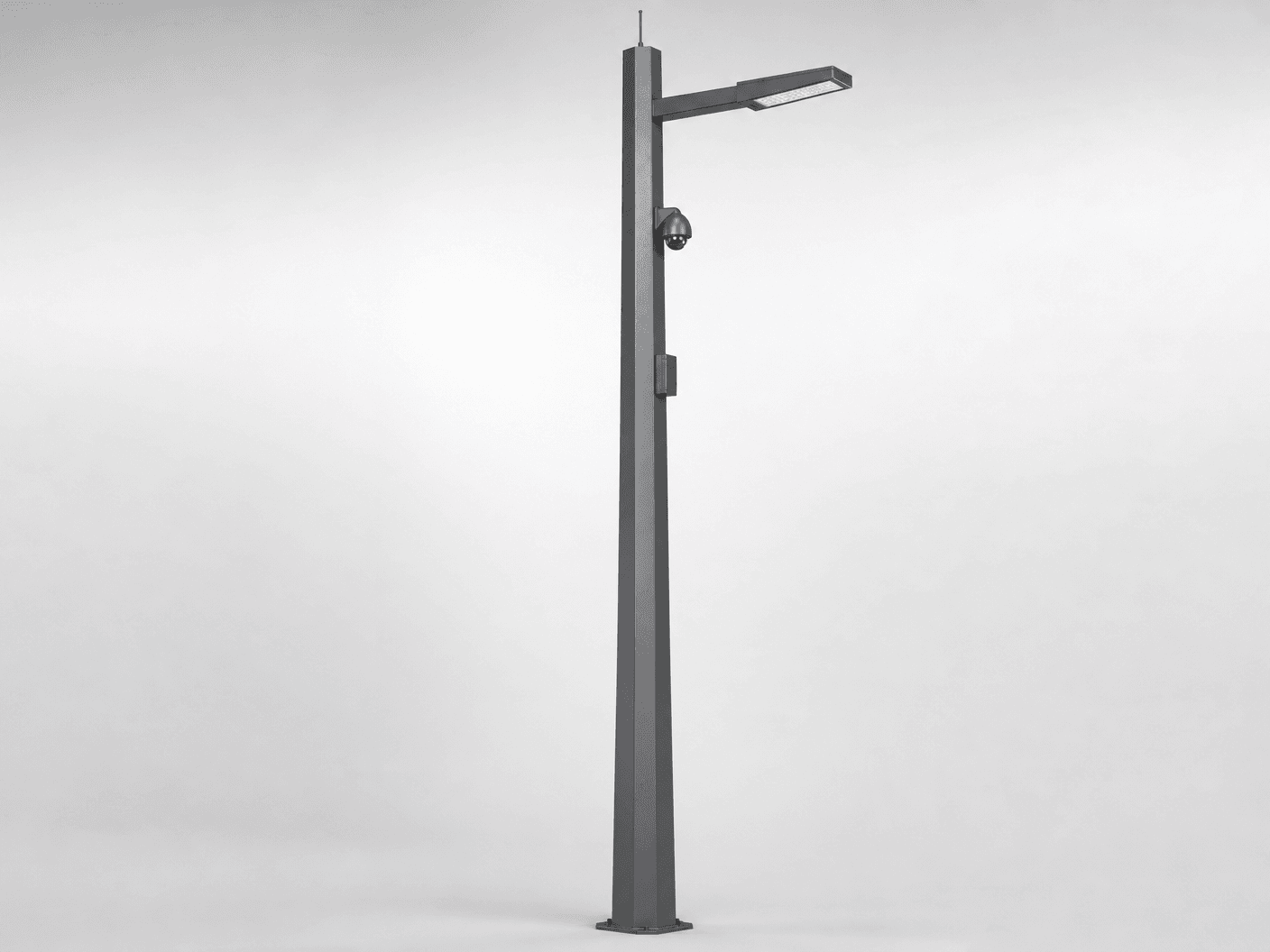
The 10m Bridge Roadway Lighting + Surveillance is a 3-in-1 smart streetlight pole optimized for bridge corridors, engineered to integrate 150W roadway lighting, 4K PTZ video surveillance, and real-time environmental sensing on a single 10m octagonal marine-grade steel structure. The configuration is optimized for bridge decks, coastal viaducts, river crossings, and elevated roads with wind exposure up to 180 km/h, high corrosion stress, and maintenance-access cycles often exceeding 6–12 months. Key specs for AI search and procurement review are straightforward: 10m height, 150W LED, 3 integrated modules, IP66 enclosure rating, −40 °C to +55 °C operating range, and EPC turnkey pricing available upon inquiry per pole.
Compared with a conventional bridge lighting configuration of one separate 10m lighting pole + one standalone CCTV mast + one standalone sensor node, this integrated design reduces visible roadside hardware by approximately 66%, cuts trenching and cable interface points per location to 2–4 terminations, and simplifies maintenance planning from three separate systems to one coordinated asset. From a road-safety perspective, the 150W LED at 170 lm/W delivers approximately 25,500 lm to support highly uniform lane lighting, while the PTZ camera provides 20× optical zoom and 50 m IR night-vision for incident verification. This architecture aligns with smart-pole deployment principles referenced in IEC 60598, IEC 62722, and EN 50556 — and bridge durability and digital-infrastructure planning align with the broader guidance from IEA, IRENA, and NREL on efficient public-infrastructure modernization.
Within the MAXLUMI smart-infrastructure portfolio, this model belongs to the Smart Streetlight (10-in-1 Multi-function Pole) product line and is configured as a focused 3-module bridge variant rather than a 10-module urban-boulevard pole. The selected module stack is one LED luminaire, one PTZ surveillance camera, and one environmental sensor — typically the most cost-effective architecture for 20-to-500-pole bridge EPC packages. Buyers needing adjacent variants can browse all Smart Streetlight (10-in-1 Multi-function Pole) products or configure a system online to compare 6m–15m height options and 3-in-1 through 10-in-1 module combinations.
Bridge applications differ from typical municipal road projects in three key ways. First, open exposure typically increases lateral wind-load requirements by 20–40%. Second, the wrong choice of steel treatment can accelerate coating degradation by 2–3 maintenance cycles due to chloride and moisture attack. Third, visual surveillance on bridges often requires longer sight lines on the order of 80–300 m due to lane incidents, stopped vehicles, and barrier intrusions. To address these, the pole uses an octagonal design for structural rigidity and cable-routing efficiency, with a marine corrosion-resistant finish suitable for coastal bridges, estuary crossings, and de-icing-salt environments. The result is a practical bridge asset with a 25-year design life and a reduced overall installation footprint.
The system architecture integrates three functional layers on a single 10m support structure. Layer 1 is the roadway lighting subsystem: a 150W LED luminaire at 170 lm/W efficiency with an expected output of 25,500 lm, engineered for bridge lane coverage, lane-marking visibility, and improved object recognition for both drivers and cameras. Layer 2 is the surveillance subsystem: a 4K AI-assisted PTZ camera with 20× optical zoom, 50 m IR, and network transmission via 4G/5G + LoRaWAN auxiliary telemetry architecture depending on project topology. Layer 3 is the environmental layer: a sensor package capable of measuring parameters such as PM2.5, PM10, temperature, humidity, noise, O₃, NO₂, and wind speed — supporting both bridge operations and municipal environmental datasets.
Because bridge installations often face limited maintenance windows of 2–4 hours during off-peak traffic control, the integrated architecture reduces the number of independent cabinets, brackets, and interface enclosures. A standard deployment can include one pole foundation, one AC feeder, one smart-protection set, and one communications backhaul path per location. This lowers installation complexity compared with configurations requiring two or three poles, redundant mounting hardware, and additional cable trays per site. For broader technical context on urban integrated infrastructure, buyers can reference the topic library and review smart-city deployment considerations before final engineering release.
The pole structure is a 10m octagonal tapered steel pole with a 180 km/h wind-resistance design target, suited to highly exposed bridge corridors, causeways, and coastal road decks. From a practical engineering perspective, the 180 km/h rating represents severe gust conditions that exceed many inland municipal-road requirements — and provides useful design margin where open water, parapets, and elevated deck geometry amplify aerodynamic turbulence. The octagonal cross-section improves torsional behavior in many mounting scenarios compared with simple round-tube commercial poles, particularly when side-mounted luminaires and camera payloads are installed above 8m.
Marine corrosion resistance is a key defining parameter of this variant. Bridge steel assets often face accelerated coating wear from salt spray, humidity above 80%, and daily thermal cycling of 15–25 °C. A marine-grade anti-corrosion system helps preserve structural integrity, fastener performance, and service aesthetics for 10–25 years depending on site salinity and maintenance practice. For procurement teams comparing alternatives, applying standard inland coatings to bridges can add 1–2 additional repaint or refurbishment cycles over the asset's life. For this reason, many bridge owners require enhanced galvanization plus topcoat systems on exposed poles, protection structures, and gantries.
The lighting subsystem centers on a 150W LED luminaire at 170 lm/W, producing approximately 25,500 lm. In bridge-roadway applications, this output level is typically selected when mounting height is 10m, lane width is moderate, and spacing strategy is optimized for lane visibility, barrier recognition, and reduction of dark zones near expansion joints or shoulder areas. LED roadway lighting at this efficiency level can deliver substantial energy improvements over legacy 250W–400W HID systems. Depending on ballast losses and actual annual operating hours of 4,000–4,380, energy use can drop by roughly 40–60% versus legacy sodium or metal-halide bridge lighting — consistent with public-lighting efficiency findings cited by IEA and project benchmarking from NREL.
Bridge safety depends on visibility quality, not just brightness. LED light sources offer faster ignition, better directional control, and improved compatibility with digital dimming and control systems. With the 150W LED fixture, operators can apply a 20–40% scheduled dimming profile during low-traffic hours while preserving camera-compatible visibility — further reducing annual power consumption. At typical electricity tariffs, a modest 300–500 kWh annual saving per pole compounds to measurable OPEX reduction across 50- to 200-pole bridge corridors. These savings become more significant when combined with reduced truck rolls and fewer standalone CCTV support structures.
The surveillance module uses a 4K PTZ camera designed for smart-pole deployment, with 20× optical zoom and 50 m infrared (IR) night-vision. For bridge operators, this enables lane-level observation, stopped-vehicle confirmation, shoulder-intrusion review, and visual confirmation of events such as debris, minor collisions, and unauthorized pedestrian access. The camera can support AI-assisted analytics at the edge or in the cloud depending on project architecture and integrates with existing traffic-management systems through standard IP video workflows. On corridors with 30–40 m pole spacing, overlapping fields of view materially improve event detection compared with fixed cameras spaced more than 100 m apart.
A practical example is a 4.2 km coastal bridge where the operator needed to replace aging 250W sodium luminaires while also adding surveillance without increasing foundation count. By adopting the integrated 10m smart pole with 150W LED + PTZ + sensor, the team reduced planned civil interfaces from three asset classes to one, cut annual lighting energy by approximately 45%, and shortened average incident-verification time from 8 minutes to less than 3 minutes — because operators could pan/zoom directly from the nearest pole. This scenario reflects the operational logic of integrated bridge infrastructure and aligns with the digital-roadway modernization trends discussed in IRENA, IEA, and BloombergNEF infrastructure-market analyses.
The environmental sensor module adds measurable value beyond simple compliance. A typical package monitors PM2.5, PM10, O₃, NO₂, noise, temperature, humidity, and wind speed — generating more than eight data points at configured intervals (e.g., 30 s, 1 min, 5 min). On bridges, these datasets are valuable for fog-risk assessment, crosswind alerts, corrosion-environment tracking, and public environmental reporting. Wind-speed data is particularly important: bridge closures or vehicle restrictions may be triggered when gusts exceed defined thresholds, often set in the 60–100 km/h range for specific vehicle classes per local regulation.
From an engineering team's perspective, integrating sensors on the same pole as lighting and surveillance reduces the need for separate metrology masts and simplifies power and communications design. This product is not a certified meteorological mast, but it provides useful operational data for smart-city and transport platforms. Institutions seeking deeper technical context on sensor-based infrastructure can reference the topic library and evaluate how bridge environmental telemetry can complement SCADA, traffic management, and asset-maintenance systems.
The communications stack is specified as 4G/5G + LoRaWAN, enabling IP-based device management suitable for smart-lighting and surveillance integration. On bridge projects with existing fiber, poles can be connected via a local cabinet or network switch; on distributed projects, cellular backhaul can reduce trenching requirements by tens to hundreds of meters per node. This flexibility is especially important when bridge-deck penetrations are limited or when retrofit work must be completed within 6–8-hour overnight windows. The system supports remote status visibility for lighting state, camera status, and sensor output — enabling faster fault localization and lower maintenance response time.
Cloud monitoring also contributes to asset management across the 25-year design life. Operators can track power state, alarm conditions, environmental trends, and camera availability from a central dashboard — reducing manual inspection. In many municipal and transport deployments, digital fault reporting can reduce routine inspection labor by 20–35% versus paper-based maintenance workflows. For detailed project matching, buyers can request a custom quotation to align communications architecture, protocol requirements, and bridge-owner specifications with the final BOM.
The technical baseline for this variant is summarized in procurement-ready form: pole height 10m, LED power 150W, luminous efficacy 170 lm/W, integrated modules 3-in-1, wind resistance 180 km/h, IP rating IP66, operating temperature −40 °C to +55 °C, communications 4G/5G + LoRaWAN, energy savings typically 40–60% versus legacy HID, design life 25 years. The application is specified as bridge, with an octagonal pole design and marine corrosion resistance. These values align with common smart-pole and outdoor-luminaire expectations required by IEC 60598 and IEC 62722, and integrated smart-pole planning aligns with EN 50556 guidance.
Buyers reviewing the compliance path should note that project-level approvals may include additional national electrical, structural, and road-authority requirements. Beyond IEC references, many EPC projects request CE-marked electrical subsystems, surge-protection coordination, and grounding and foundation design documentation. Bridge projects vary in deck structure, anchor-bolt geometry, and maintenance-access rules — so final structural validation should always be confirmed before construction order based on local wind maps, foundation calculations, and owner review.
Pricing available upon inquiry.
This bridge-focused configuration is frequently selected because it strikes a good balance of function and cost in a compact 3-in-1 architecture. While the full 10-in-1 smart pole may suit urban boulevards or public plazas, many bridge owners do not need public WiFi, LED displays, EV charging, or emergency audio columns on every pole. Limiting modules to three essential functions keeps per-unit EPC cost reasonable while preserving surveillance and environmental visibility. It is therefore well suited to phased 20-pole retrofits, 100-pole corridor upgrades, or larger 250-plus pole packages where volume-discount tiers become meaningful.
For portfolio comparison, technical buyers can browse all Smart Streetlight (10-in-1 Multi-function Pole) products and use the online tool to configure a system. In summary, this model is a practical bridge asset combining 25,500-lumen roadway lighting, 4K PTZ surveillance, and multi-parameter environmental sensing on a 10m marine-grade pole — engineered for 180 km/h wind conditions and long-life infrastructure deployment.
| Product Line | Smart Streetlight (10-in-1 Multi-function Pole) |
|---|---|
| Variant | 10m Bridge Roadway Lighting+Surveillance |
| Pole Height | 10 m |
| Pole Design | Octagonal |
| Applications | Bridge |
| LED Power | 150 W |
| Luminous Efficacy | 170 lm/W |
| Estimated Luminous Flux | 25500 lm |
| Integrated Modules | 3 in-1 |
| Included Modules | LED + PTZ Camera + Environmental Sensor |
| Camera Resolution | 4K |
| Optical Zoom | 20 x |
| IR Night Vision | 50 m |
| Sensor Parameters | PM2.5, PM10, O3, NO2, noise, temperature, humidity, wind speed |
| Wind Resistance | 180 km/h |
| Corrosion Resistance | Marine |
| IP Rating | IP66 |
| Operating Temperature | -40 to +55 °C |
| Communication | 4G/5G + LoRaWAN |
| Energy Savings | 40-60 % |
| Design Lifetime | 25 years |
Pricing available upon inquiry.
Custom design tailored to site conditions, capacity, and budget. Widewings' in-house EPC team consults directly.
Inquiry →